


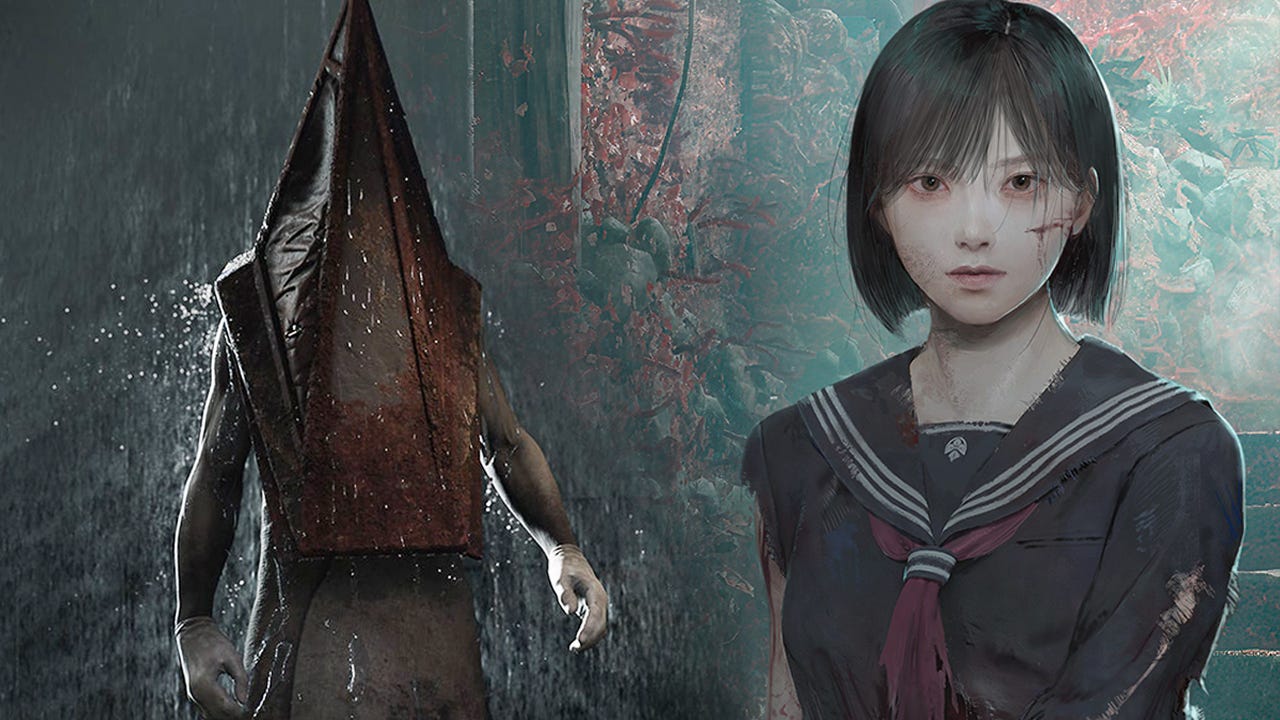
Silent Hill has appeared in the restless dreams of horror fans for almost three decades now. The foggy town and its various iterations, plagued by the Otherworld, continue to define the mechanics and ambience of psychological horror to this day.
Each Silent Hill game contains a relatively standalone story, tied to whatever character the Otherworld has decided to bring to its doorstep. However, the lore of Silent Hill develops across games through returning characters as well as memos, posters, and other small details. Despite its fill of contradictions, some of which are only natural for games with multiple endings, there’s a larger story lurking in the background of each protagonist’s path to atonement (or madness).
If the release of Silent Hill: Townfall has sparked your curiosity about how the timeline all fits together, we’ve got you covered.
How Many Silent Hill Games Are There?
Approximately 18 Silent Hill games have been released since the franchise debuted in 1999.
Four Silent Hill games were originally developed by Team Silent between 1999 and 2004. Subsequent games, including plenty of spinoffs, were developed by a variety of studios across Japan and North America.
Konami has also published four Silent Hill games for mobile devices: The Orphan trilogy and Silent Hill: The Escape. These have some murky connections to the rest of the franchise. For simplicity’s sake, we are not including these on the full timeline, but there’s still some lore in those for anyone trying to get the full Silent Hill picture.
We also won’t be including the Play Novel, which reimagines the original game, or the interactive streaming series Silent Hill: Ascension.
Which Silent Hill Game Should You Start With?
Where to start is really a matter of what drew you to the series and whether you’re interested in the original gameplay. If you’re looking for a taste of the series on modern consoles, Bloober Team’s Silent Hill 2 remake is a faithful recreation with some quality of life improvements.
If you’re interested in Silent Hill for lore reasons, there’s no harm in starting at the beginning or even with the original Silent Hill 2. Unless you still have a PS1 and can somehow get your hands on an original copy (very cool, if so), your best bet here is looking for emulation guides.
Every Silent Hill Game in Timeline Order
The first four Silent Hill games are considered the “major canon,” with subsequent spin-offs and standalone games making references to the original story, but also creating some contradictions. Some games are directly connected, some loosely reference one another, and others are pretty much entirely their own thing.
Still, we have a rough sense of when these games take place, and it’s up to you how they fit into your understanding of the Otherworld.
1. Silent Hill ƒ

The timeline of Silent Hill games actually starts with one of the most recent installments. Silent Hill ƒ takes us to the town of Ebisugaoka in the 1960s, marking the first time the series was set in Japan.
While some loose connections to the lore of the American Silent Hill are revealed through memos and documents, Silent Hill f’s characters, locations, and “version” of the Otherworld are entirely distinct. You play as Hinako, a teenaged girl living in fear of her own future and family, with a unique approach to save states and endings enhanced by writing from Ryukishi07.
2. Silent Hill: Origins
Silent Hill Origins is a prequel that, despite releasing later, directly connects to the original Silent Hill and Silent Hill 3 as part of the “Alessa Gillespie” arc. It also marks the start of some inconsistencies and, despite its direct connection to the mainline games, is debated in its place as canon.
The story, which by in-game logic takes place around the late 70s, follows the truck driving Travis after a crash brings him to Silent Hill. There, he slowly discovers the cult-driven secrets of the town while reckoning with his own traumatic childhood. It’s specifically the “Good” ending from this game that leads into the original Silent Hill, quite literally paving the way for the character of Cheryl.
3. Silent Hill
The original Silent Hill, naturally, stood on its own two feet. It introduced us to the opaque fog that, while serving a practical purpose around real-time generated environments, became the series’ atmospheric staple.
In the late 80s (if you go by Silent Hill 3 logic), a mysterious car crash leads Harry Mason to the eponymous town of Silent Hill. There, he searches for his now missing young daughter, Cheryl, while encountering the original strange cast of characters and nightmares of the Otherworld.
While the canon on this is a bit iffy, we can now think of it as continuing from the “Good” ending of Silent Hill: Origins. And, of course, paving the way for everything else.
4. Silent Hill 2
Perhaps the best-known game in the series, Silent Hill 2 extends the lore of the town from the first game while introducing new characters and plotlines. And, of course, it gave us the iconic Pyramid Head.
James Sunderland heads to Silent Hill after receiving a letter from his deceased wife saying that’s where he can find her. Art director Masahiro Ito has mentioned the game taking place in the late 70s, but documents in later games peg Silent Hill 2 as taking place about a decade after the original. The 90s timeline slot aligns with the dates we see in a number of diaries, and is thus what we’re going with.
Unlike some of the other games on this list, Silent Hill 2 does not necessarily have a “canon” ending that directly leads to future events.
5. Silent Hill: The Arcade
Now we’re getting into spin-off territory. Silent Hill: The Arcade is particularly unique, focusing more on action shooter mechanics than the eerie psychological horror elements the rest of the series is known for. Still, it’s Silent Hill, and specifically a spin-off game that takes place around the same time as Silent Hill 2.
While it’s generally its own thing, Arcade still offers some interesting insight into earlier Silent Hill history, particularly the sinking of the Little Baroness ship back in 1917.
6. Silent Hill: Townfall
Yep, things get weird again. The latest Silent Hill game takes place in 1996 on the fictional island of St. Amelia, which places it firmly in the middle of the original Team Silent games.
Protagonist Simon wakes up at the docks of the island with no memory of how he got there. In typical Silent Hill fashion, he quickly encounters some funky characters and his own variation of the Otherworld. These encounters slowly reveal his and the town’s past, and how exactly they’re connected.
Like Silent Hill f, Townfall has looser connections to the initial cult elements of the series, instead staying connected through themes of guilt. And, of course, the joke ending.
7. Silent Hill 3
While Silent Hill 3 doesn’t technically pick up the story until after Townfall, it most directly follows the events of Silent Hill: Origins and the original game, concluding the aforementioned Alessa arc. Its place on the timeline generally lines up with its own release year in the early 2000s.
The connection here is pretty blatant. You play as Heather, daughter of Harry Mason. The murder of her father (the OG protagonist) prompts Heather to return to Silent Hill 17 years after the first game to learn the true circumstances and implications of her birth.
8. Silent Hill 4: The Room
The last Silent Hill game originally developed by Team Silent carries on from Silent Hill 3 in the early 2000s. One letter in particular clarifies that it’s been a “few years” since the events of the third game.
We’ve since gotten plenty of different iterations of what exactly makes “Silent Hill,” but this was the first game to literally move the game’s location away from the specific town, instead bringing us to Ashfield. There are some character connections to the second and third games, but this one largely stands on its own as you try to help Henry Townsend escape his apartment (and the “Nightmare”).
9. Silent Hill: Homecoming
Homecoming was the first “mainline” Silent Hill game released after Konami disbanded Team Silent. It once again leaves out the actual town of Silent Hill, instead following the protagonist, Alex Shepherd, as he returns to his hometown of Shepherd’s Glen.
Homecoming doesn’t have a particularly concrete place on the timeline, but it generally takes place within a few years of The Room. Travis the truck driver makes an appearance, marking a loose connection to Origins, and the game directly addresses the cultish machinations of “The Order” from the original canon.
10. Silent Hill: Downpour
Downpour is pretty standalone in the grand scheme of things. However, it does bring us back to the actual town of Silent Hill through the classic means of a sad man getting into a car (well, prison transport bus) crash.
There’s not an obvious in-game year attached to the story of Downpour, but general fan consensus places it around the release date of the game itself. Despite its titular setting, there aren’t too many references to the other Silent Hill games, but a certain Pyramid Head does make an appearance. In the joke ending, at least.
11. Silent Hill: Book of Memories
Yep, another funky spin-off. This one is particularly distinct, in large part because it’s the one Silent Hill game where you create your own character. It’s also your birthday! And it’s a dungeon crawler! Again, a weird one.
In all of its weirdness, though, we do know that Book of Memories takes place very specifically in 2010. Just don’t expect too much insight into the rest of the franchise.
12. Silent Hill: The Short Message
The timeline ends with a recent free-to-play spin-off that followed the cancellation of P.T. and is once again generally its own thing. The Short Message takes place in “modern day” Germany, specifically the small town of Kettenstadt.
Events like the COVID-19 pandemic appear in-game, bringing us into the 2020s. However, the course of the game’s events are heavily influenced by the town’s history back in the 1930s as well as the childhood of its protagonist, Anita.
BONUS: P.T.
Sure, it might have been pulled from the PlayStation Store, but P.T. certainly made some waves when it was first released. P.T., which stands for Playable Teaser, was an early demo for the full game of Silent Hills, a collaboration between Konami, Hideo Kojima, and Guillermo del Toro. Unfortunately, the project’s cancellation means we’ll never truly know how it was going to connect to the rest of the series.
The Future of Silent Hill
Silent Hill fans have had plenty to chew on over the past couple of years with the back-to-back release of Silent Hill ƒ and Silent Hill: Townfall. These were two of the wonkier additions to the full timeline, suggesting Konami’s focus is now on experimenting with what exactly can (and should) be “Silent Hill”.
While Konami has openly discussed annual Silent Hill releases, we have yet to hear any official announcements about future new games in the franchise. We do know that Bloober Team is following up their Silent Hill 2 remake with a remake of the original 1999 game.
In the meantime, studios continue to take cracks at trying to make a decent Silent Hill movie.

Blythe Dujardin
Audience Development Coordinator
Blythe (she/her) is an Audience Development Coordinator at IGN who spends way too much time in character customization screens and tracking down collectibles.
