


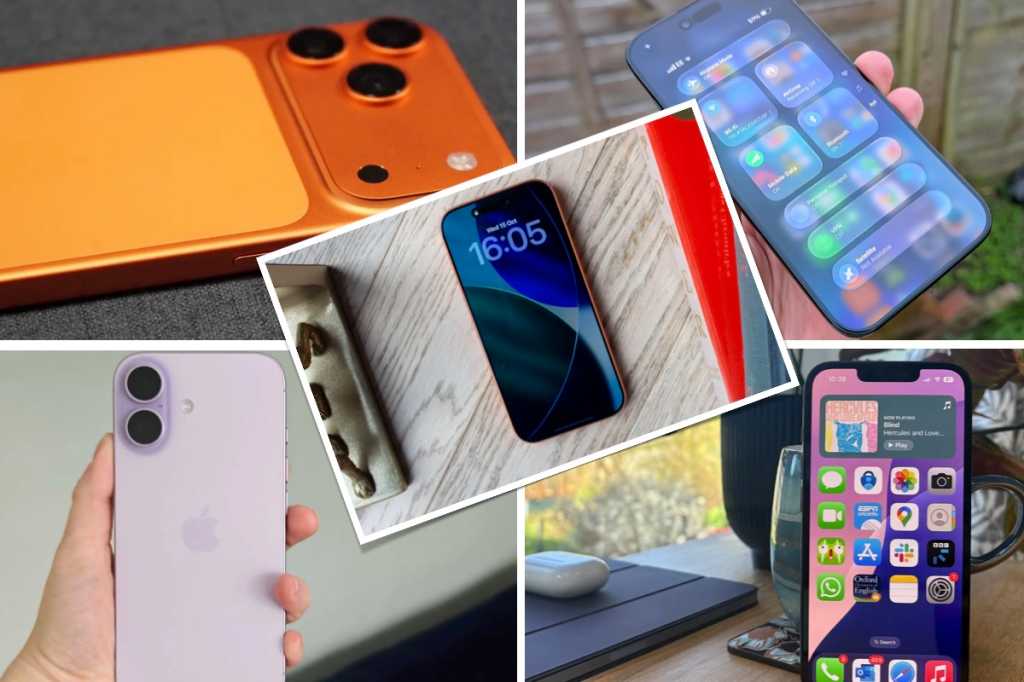
How to choose your iPhone in 2026
Before you jump into the specific iPhone models, think about what matters most to you: battery life for all-day use, camera quality for photos and video, screen size for media or gaming, and how much you’re willing to spend. These simple priorities will help narrow down whether you should choose a Pro model, a middle option like the standard iPhone 17, a lightweight iPhone Air, or a more budget-friendly choice.
Deciding which iPhone to buy has always been tricky and no doubt you have many questions. Which screen size is best for you, and how much storage do you need? Should you save money by selecting an older model, or should you splash out on the latest iPhone? Which iPhone is the best compromise between specs and value for money?
In this article, we talk you through each of the phones currently available from Apple, to help you decide which is best for you. We discuss iPhone prices, specs and features, paying particular attention to the cameras, screens and durability, and how the design of each handset differs, so you should leave feeling much more confident about which iPhone you should get.
For more help with your choice see our full reviews of the latest iPhones (linked below) and our Best iPhone comparison chart where we compare all the new iPhones with the iPhones still being sold by Apple.
Should I buy an iPhone now?
Summer is usually the worst time to buy an iPhone, but 2026 is an exception. Apple recently raised Mac and iPad prices but left iPhones unchanged, leading many analysts to expect the iPhone 18 Pro models to become significantly more expensive when they launch this September.
That makes the iPhone 17 Pro a strong buy right now. The rumored iPhone 18 Pro upgrades don’t appear substantial enough to justify an expected price increase of around $200 or more.
The standard iPhone 17 is an even easier recommendation. Its successor isn’t expected until spring 2027, so it should remain Apple’s current base flagship for almost another year. Starting at $799/£799 with 256GB of storage, it’s also one of the best values in the lineup.
The exceptions are the rumored foldable iPhone Ultra, if that’s the model you want, and the iPhone 18 Pro Max if you’re willing to pay more for its expected camera improvements.
If you need a new phone now, the iPhone 17 or iPhone 17 Pro are excellent buys that could save you money compared with waiting for the iPhone 18 and 18e, which aren’t expected until spring 2027.
| Model | Model | Model |
|---|---|---|
| iPhone 17 | Yes | No successor until spring 2027; current price is stable |
| iPhone 17 Pro | Yes | Avoids expected $200+ price hike on 18 Pro; similar AI features |
| iPhone 17 Pro Max | Consider | Best battery/camera today, but 18 Pro Max may improve further |
| iPhone 17e | Yes | Budget-friendly; successor not due until 2027 |
| iPhone Air | If discounted | Air 2 coming spring 2027, but current deals are strong |
| iPhone 18 Pro & Max | Wait | Expected September with higher price and incremental upgrades |
| iPhone Ultra (foldable) | Wait | First-gen product; likely expensive and flawed |
Best iPhone 2026
- For most people, Apple’s standard iPhone 17 offers the best mix of performance, battery life, and price… but the 17 Pro and Max models make sense if you care about photography or video.
In terms of power and features, the ‘best’ iPhone is either the iPhone 17 Pro or 17 Pro Max, but these iPhoned aren’t necessarily the best for you due to their high price tag. Luckily there is a perfect iPhone for everyone, with each model offering the perfect compromise of features to price. For 2026 we think that the iPhone 17 is a good all-rounder thanks to the new features that bring it closer than ever to the pro models.
Here is a quick-at-a-glance comparison of all the iPhones Apple currently sells, from the ultimate iPhone to the cheapest iPhone you can buy right now. Below this section you can read more about how each iPhone compares in terms of camera, battery life, screen, cost, and other important factors.
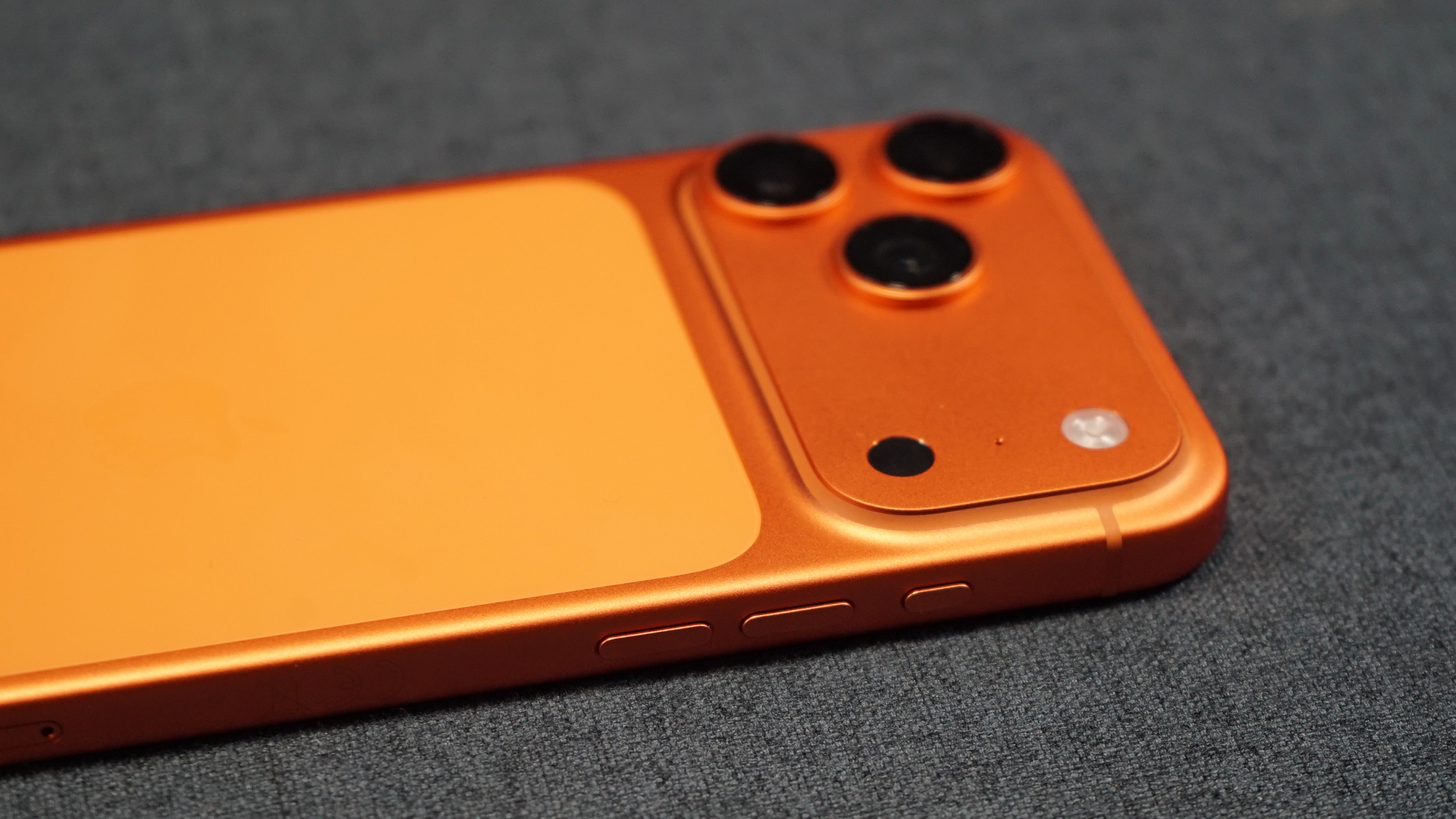
1. Apple iPhone 17 Pro Max – Biggest display, longest battery life, best camera
Price When Reviewed:
$1,199 (256GB) | $1,399 (512GB) | $1,599 (1TB) | $1,999 (2TB)
Best Prices Today:

$1199
What is the iPhone 17 Pro Max best for? The iPhone 17 Pro Max is Apple’s ultimate iPhone for photography, videography and all-day battery life, making it the best choice for demanding users and content creators.
Why buy the iPhone 17 Pro Max? The iPhone 17 Pro Max combines Apple’s most advanced camera system with the longest battery life ever in an iPhone, making it ideal for capturing photos and 4K video without compromise. It also delivers class-leading performance from the A19 Pro chip, fast USB 3 transfers and enough power for professional creative work as well as everyday use.
Who should buy the iPhone 17 Pro Max? Anyone who wants the best iPhone cameras, the longest battery life and flagship performance, especially photographers, videographers and power users.
Who should avoid the iPhone 17 Pro Max? Anyone who wants a lighter, more affordable iPhone or doesn’t need pro-level camera features should consider the standard iPhone 17 instead.
Key specs
- Starts at: $1,199 / £1,199 (256GB)
- Display: 6.9-inch Super Retina XDR OLED with ProMotion (120Hz)
- Chip: A19 Pro
- Storage: 256GB–2TB
- Cameras: Triple 48MP system (Main, Ultra Wide and 4x Telephoto) with up to 8x optical-quality zoom
- Battery: Up to 39 hours of video playback
Buy now or wait? Buy the iPhone 17 Pro Max now if you want the best iPhone available today. However, if you always want Apple’s very best camera system and longest battery life, the iPhone 18 Pro Max is expected to introduce more meaningful camera improvements, although you’ll likely pay a substantial premium.
Read our full
Apple iPhone 17 Pro Max review
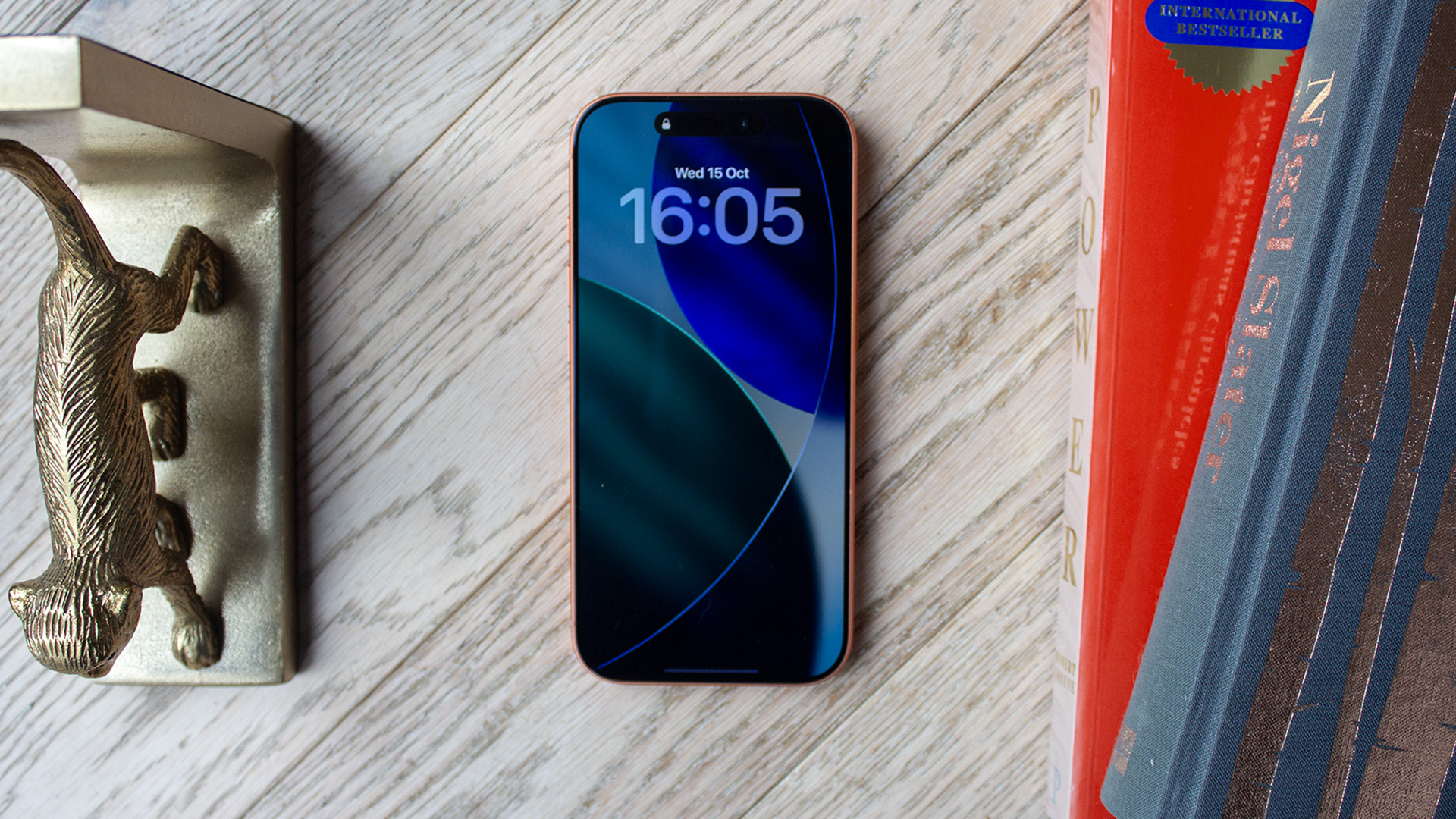
2. Apple iPhone 17 Pro – Best balance of price and pro features
Price When Reviewed:
$1,099 (256GB) | $1,299 (512GB) | $1,499 (1TB) | $1,999 (2TB)
Best Prices Today:
$1099
What is the iPhone 17 Pro best for? People who want the best compact iPhone, with flagship performance and an outstanding camera system.
Why buy the iPhone 17 Pro? It combines Apple’s A19 Pro chip with one of the best camera systems on any smartphone, including three 48MP rear cameras that deliver excellent photos and video. It also offers a 6.3-inch OLED display, strong all-day battery life and premium build quality in a size that’s easier to handle than the Pro Max.
Who should buy it? Anyone who wants Apple’s best cameras and performance without stepping up to the larger Pro Max.
Who should avoid it? Owners of an iPhone 16 Pro or anyone happy with the regular iPhone 17, as the upgrades may not justify the extra cost.
Key specs:
- Starts at: $999 / £999
- Display: 6.3-inch Super Retina XDR OLED with 120Hz ProMotion
- Chip: Apple A19 Pro
- Storage: 256GB–1TB
- Cameras: 48MP main + 48MP ultrawide + 48MP telephoto, 18MP front camera
- Battery: Up to 33 hours of video playback
Buy now or wait? Buy now if you want a premium compact iPhone – the iPhone 17 Pro remains one of Apple’s best all-round phones, and the improvements expected in the iPhone 18 Pro are unlikely to justify waiting unless you specifically want the newest model.
Read our full
Apple iPhone 17 Pro review
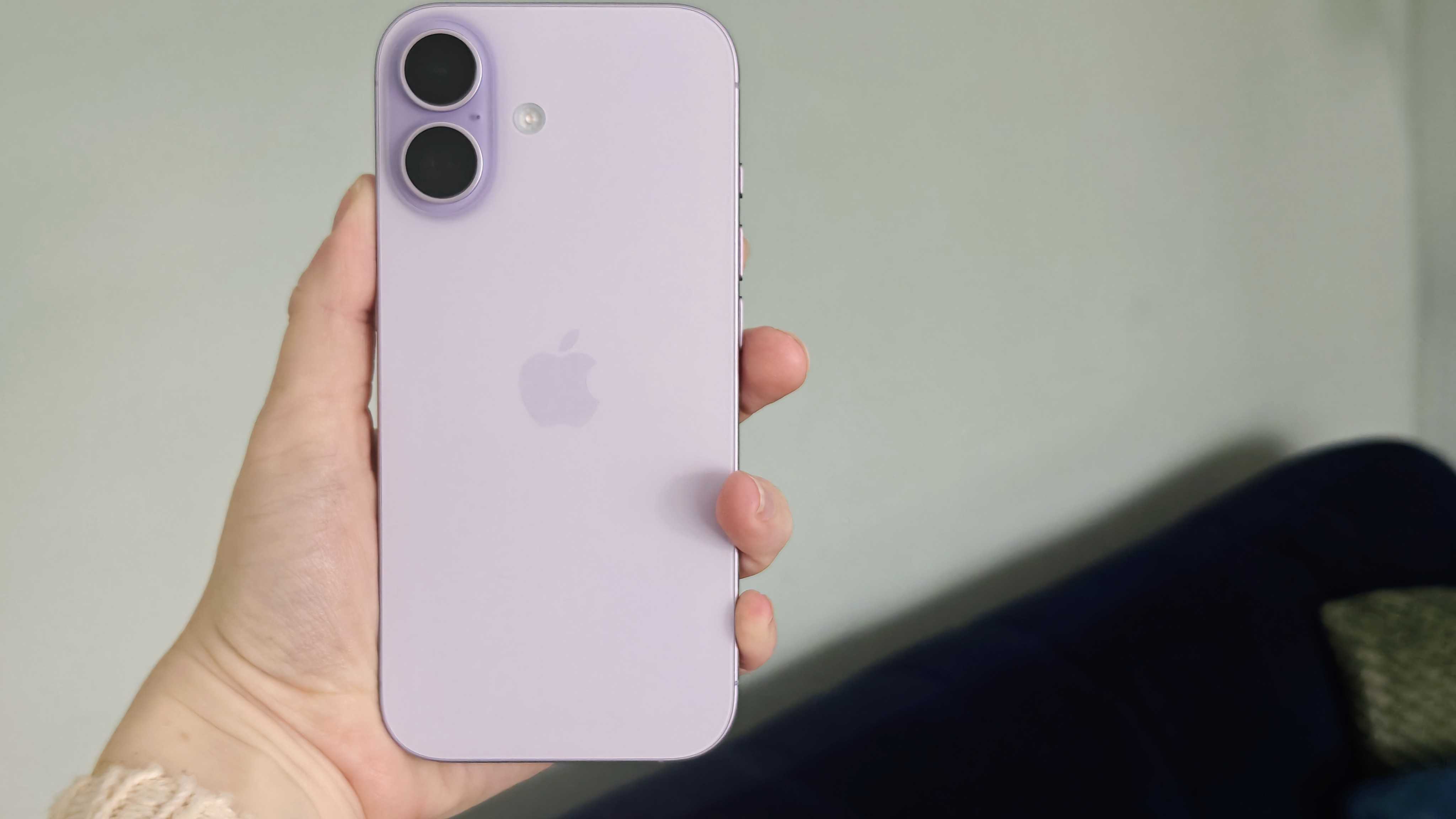
3. Apple iPhone 17 – Best value iPhone for most people
Price When Reviewed:
From $799
Best Prices Today:

What is the iPhone 17 best for? The iPhone 17 is the best all-round iPhone for most people, offering flagship features and excellent value without the Pro price.
Why buy iPhone 17? The iPhone 17 brings several upgrades that were previously exclusive to Pro models, including a larger 6.3-inch 120Hz ProMotion display with always-on support, while doubling the base storage to 256GB without increasing the starting price. It also delivers superb battery life, excellent everyday performance from the A19 chip, and a significantly improved front camera, making it one of Apple’s best-value iPhones in years.
Who should buy it? Anyone who wants the best balance of price, performance and features without paying extra for the Pro models.
Who should avoid it? Mobile photographers, videographers and power users who need a telephoto camera, faster USB transfers or the most advanced camera system should choose the iPhone 17 Pro instead.
Key specs:
Starts at: $799 / £799 (256GB)
Display: 6.3-inch OLED ProMotion (120Hz)
Chip: A19
Storage: 256GB–512GB
Cameras: 48MP main + 48MP ultrawide, 24MP front camera
Battery: Up to 27 hours video playback
Buy now or wait? Buy now – the iPhone 17 delivers excellent value, and with the iPhone 18 unlikely to launch before the spring, and expected to bring higher prices rather than major upgrades, it’s a smart purchase today
Read our full
Apple iPhone 17 review
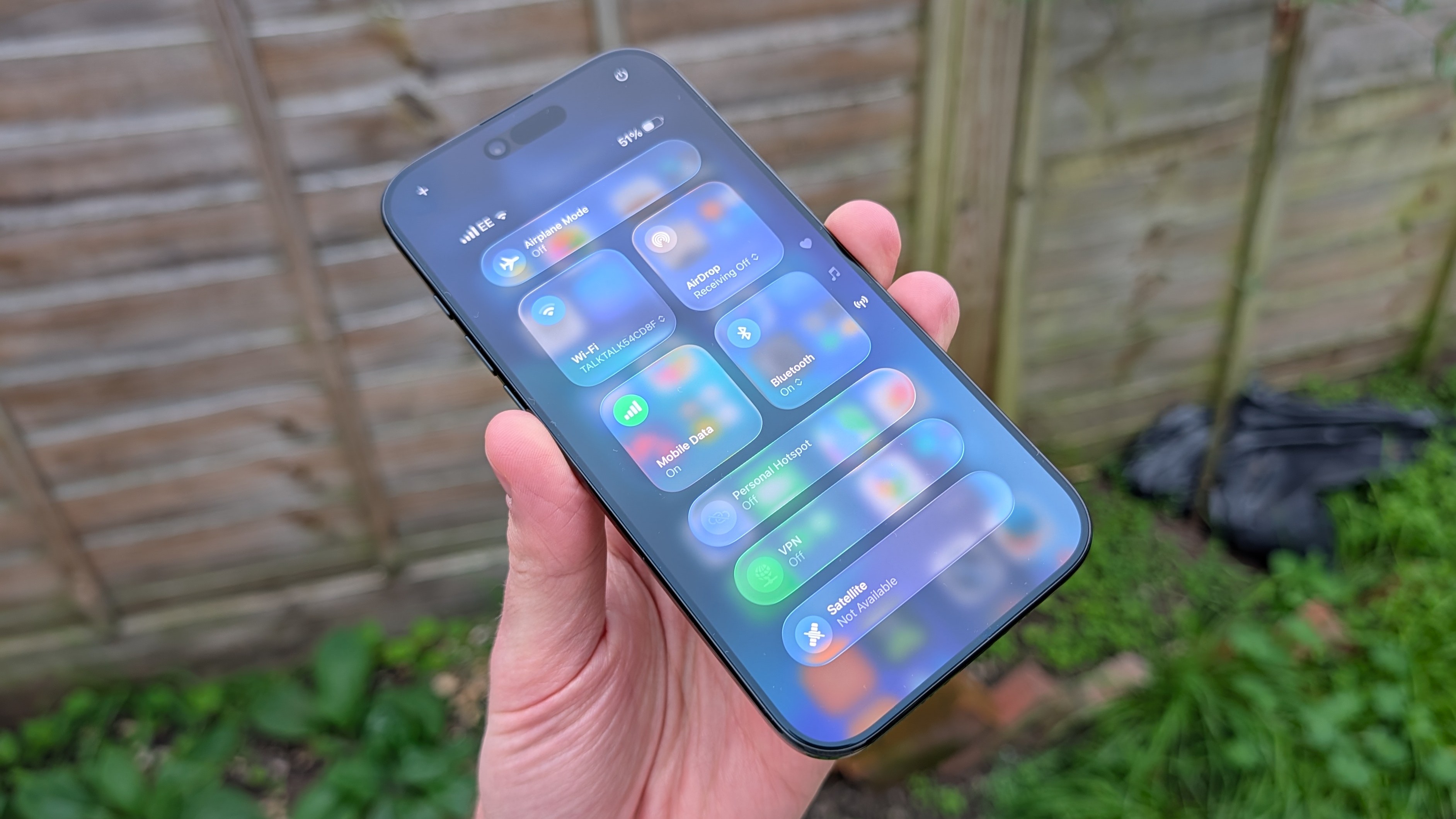
4. Apple iPhone Air – Ultra-thin and lightweight iPhone
Price When Reviewed:
$999 (256GB) | $1,199 (512GB) | $1,399 (1TB)
Best Prices Today:
$999
What is the iPhone Air best for? The iPhone Air is best for people who want the thinnest, lightest iPhone ever without giving up flagship performance.
Why buy the iPhone Air? The iPhone Air’s standout feature is its incredibly thin 5.6mm titanium design, which makes it feel noticeably lighter and more comfortable than any other large-screen iPhone. Despite its slim profile, it still delivers flagship-level performance with the A19 Pro chip, a gorgeous 6.5-inch ProMotion OLED display, and a much-improved Center Stage front camera.
Who should buy iPhone Air? Anyone who values an ultra-light, premium iPhone with a larger display and is willing to trade camera versatility and battery life for its unique design.
Who should avoid iPhone Air? Photography enthusiasts and heavy users who want the best battery life, multiple rear cameras, or stereo speakers should choose an iPhone 17 Pro instead.
Key specs:
- Starts at: $999 / £999 (256GB)
- Display: 6.5-inch OLED ProMotion (120Hz)
- Chip: A19 Pro (5-core GPU)
- Storage: 256GB–1TB
- Cameras: 48MP main + 18MP Center Stage front camera
- Battery: Up to 23 hours video playback
Buy now or wait? Buy now if you love its unique thin-and-light design – it’s unlike any other iPhone – but if battery life and camera versatility matter more, the iPhone 17 Pro offers better value for the money. We often see a decent discount on this handset, especially in the U.K. where it’s sold off contract.
Read our full
Apple iPhone Air (2025) review
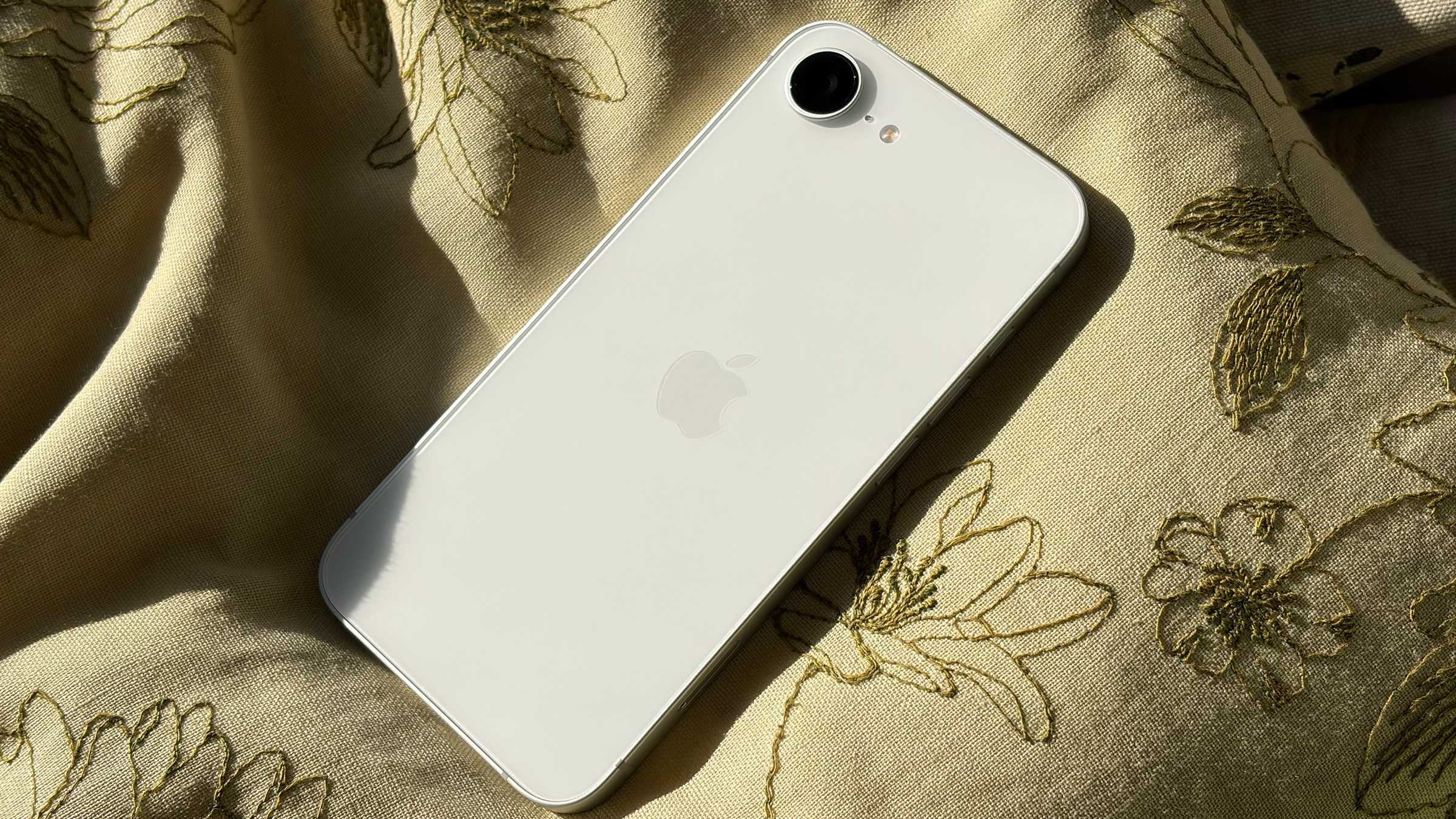
5. Apple iPhone 17e – Best budget iPhone
Price When Reviewed:
$599
Best Prices Today:
$599
What is the iPhone 17e best for? The iPhone 17e is the best-value entry point into the iPhone lineup, offering flagship-level performance and long-term software support at Apple’s lowest price.
Why buy iPhone 17e? The iPhone 17e delivers excellent everyday performance thanks to the A19 chip while adding meaningful upgrades over its predecessor, including MagSafe support and 256GB of base storage. Its attractive design, solid battery life and lower price make it an easy recommendation for anyone who doesn’t need the advanced cameras or display features of the Pro models.
Who should buy iPhone 17e? Anyone upgrading from an iPhone 12 or 13, switching from Android, or buying their first iPhone without paying flagship prices.
Who should avoid iPhone 17e? Photography enthusiasts and power users who want multiple rear cameras, an always-on display or a high-refresh-rate screen should look at the iPhone 17 or iPhone 17 Pro instead.
Key specs:
- Starts at: $599 / £599 (256GB)
- Display: 6.1-inch Super Retina XDR OLED
- Chip: A19
- Storage: 256GB–512GB
- Cameras: 48MP Fusion main (with 2x optical-quality zoom) + 12MP TrueDepth front
- Battery: Up to 26 hours of video playback
Buy now or wait? Buy now – the iPhone 17e is new for 2026, offers excellent value, and isn’t expected to be replaced until early 2027.
Read our full
Apple iPhone 17e review
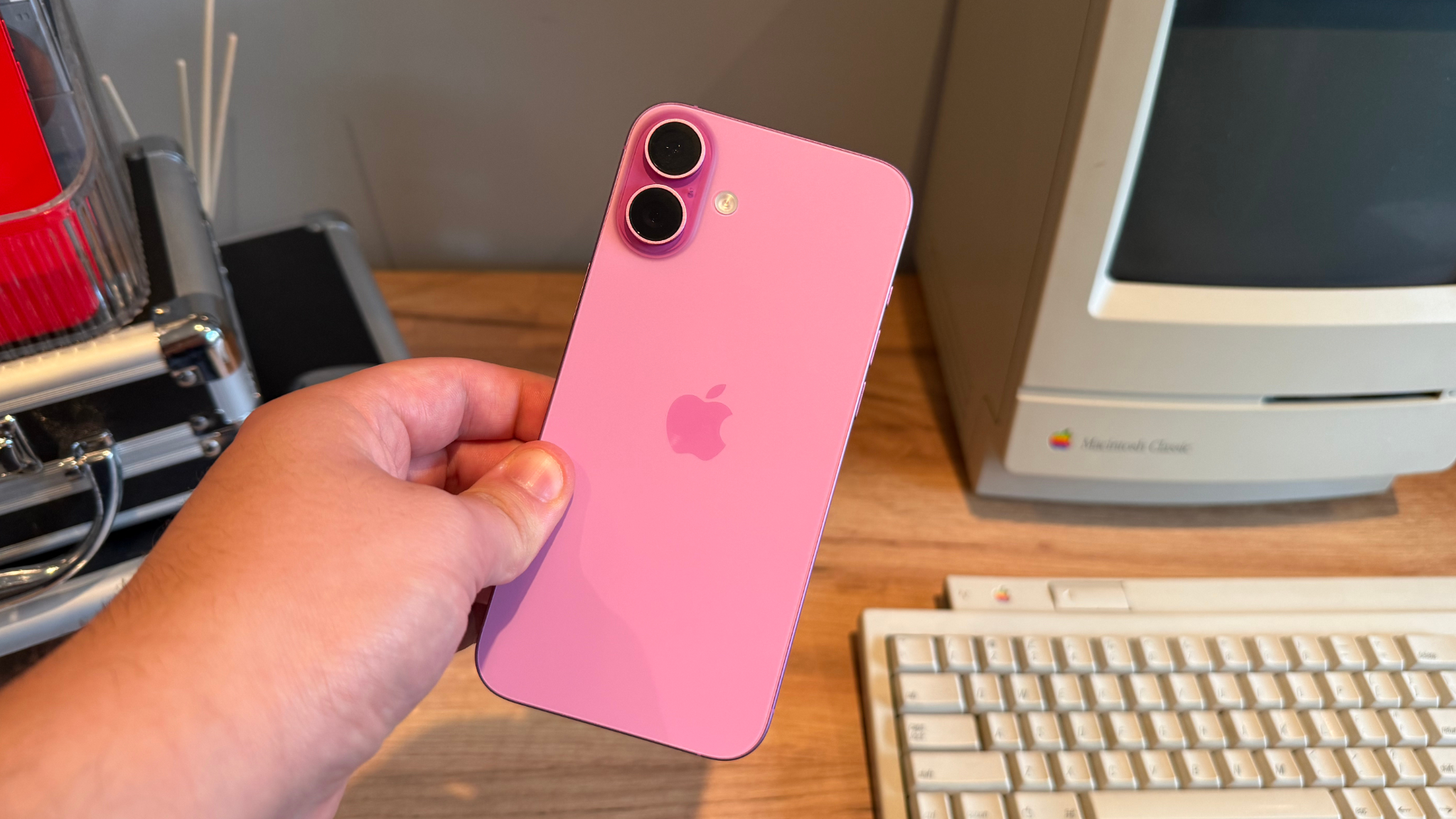
6. Apple iPhone 16 Plus – Budget big screen iPhone
Price When Reviewed:
$899
Best Prices Today:
What is the iPhone 16 Plus best for? With no iPhone 17 Plus in Apple’s current lineup, the iPhone 16 Plus is the only affordable large-screen iPhone, pairing a spacious 6.7-inch display with a significantly lower price than the Pro Max.
Why buy iPhone 16 Plus? The iPhone 16 Plus remains a compelling choice because Apple didn’t release a successor, making it the only large-screen, non-Pro iPhone available. Its larger chassis also accommodates a bigger battery, delivering up to 27 hours of video playback.
Who should buy iPhone 16 Plus? Anyone who wants a large-screen iPhone without paying Pro Max prices, especially those who value long battery life and a display that’s easier to read.
Who should avoid iPhone 16 Plus? Buyers who want a 120Hz ProMotion display, an always-on display or a dedicated telephoto camera should consider an iPhone Pro model instead. The 128GB base storage may also be limiting for some users.
Key specs:
- Starts at: $799 / £799 (128GB)
- Display: 6.7-inch Super Retina XDR OLED
- Chip: A18
- Storage: 128GB–256GB
- Cameras: 48MP main + 48MP ultrawide + 12MP TrueDepth front
- Battery: Up to 27 hours of video playback
Buy now or wait? Buy now – with no iPhone 17 Plus available, the iPhone 16 Plus remains the best-value way to get a large-screen iPhone without paying Pro Max prices.
Read our full
iPhone 16 and 16 Plus review
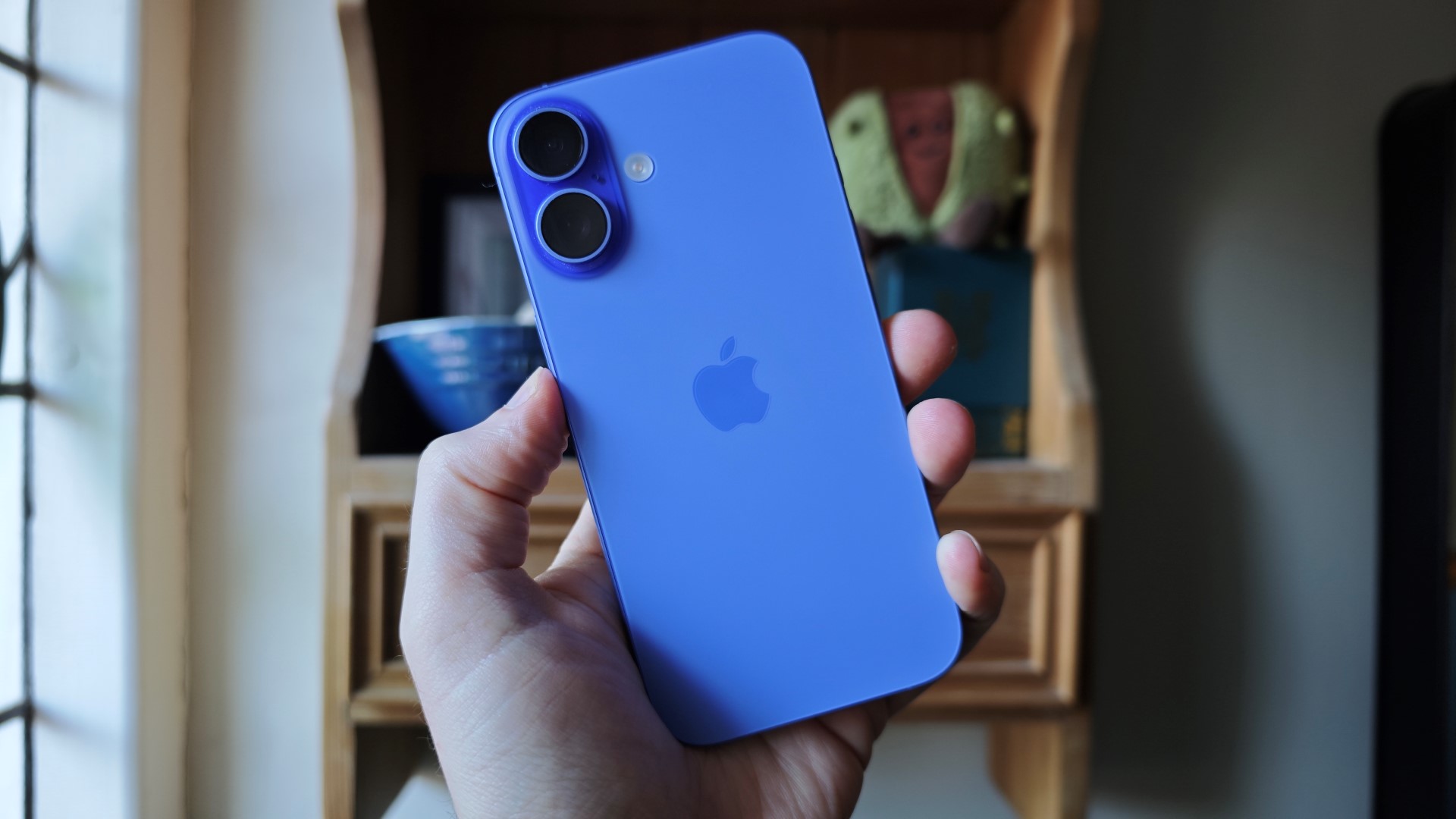
7. Apple iPhone 16 – The iPhone to avoid
Price When Reviewed:
NOW $699 for 128GB (WAS: $799/128GB, $899/256GB, $1,099/512GB)
Best Prices Today:
What is the iPhone 16 best for? The iPhone 16 offer Apple Intelligence features and an excellent camera at a lower price.
Why buy the iPhone 16? The iPhone 16 still delivers fast everyday performance thanks to its A18 chip, supports Apple Intelligence, and has an excellent 48MP main camera. It’s a capable phone, but its biggest advantage is simply that it can often be found discounted below the newer models.
Who should buy the iPhone 16? Budget-conscious buyers who can find it at a significant discount and want a dual-camera iPhone.
Who should avoid it? Most buyers should skip it, as the iPhone 17 and iPhone 17e offer better value, with newer hardware and improved specifications for little or no extra cost.
Key specs
- Starts at: $699 / £699
- Display: 6.1-inch Super Retina XDR OLED
- Chip: A18
- Storage: 128GB, 256GB or 512GB
- Cameras: 48MP main + 12MP ultrawide
- Battery: Up to 22 hours of video playback
Buy now or wait? Don’t buy at full price. Unless you find a substantial discount, the iPhone 17 and iPhone 17e are better-value purchases.
We discuss how the iPhone 16 compares to the iPhone 17 in a separate article.
Read our full
Apple iPhone 16 review
How much do iPhones cost?
Each year, Apple reduces the price of the older iPhone models it continues to sell after introducing a new generation. The tables below show current pricing in the U.S., U.K., Canada and Australia (scroll across to see your region).
In the U.S., iPhone prices are often advertised with carrier subsidies, while unlocked models cost more. In the U.K. and many other countries, Apple sells iPhones unlocked, allowing you to use your existing SIM or switch networks whenever you like.
Will iPhone prices increase? There is a strong chance they will. Apple raised Mac and iPad prices in June because of a global RAM shortage but left iPhone prices unchanged. Many analysts believe that was only a temporary reprieve, with the iPhone 18 Pro models expected to receive a significant price increase when they launch in September 2026. If you’re planning to buy a Pro model, purchasing an iPhone 17 Pro now could help you avoid paying more for relatively modest upgrades.
| Model | Release date | Storage options | U.S. Price | U.K. Price | Canada Price | Australia Price |
|---|---|---|---|---|---|---|
| iPhone 17 Pro Max | September 2025 | 256GB 512GB 1TB 2TB |
$1,199 $1,399 $1,599 $1,999 |
£1,199 £1,399 £1,599 £1,999 |
$1,749 $2,049 $2,349 $2,949 |
$2,199 $2,549 $2,899 $3,799 |
| iPhone 17 Pro | September 2025 | 256GB 512GB 1TB |
$1,099 $1,299 $1,499 |
£1,099 £1,299 £1,499 |
$1,599 $1,899 $2,199 |
$2,049 $2,399 $2,749 |
| iPhone Air | September 2025 | 256GB 512GB 1TB |
$999 $1,199 $1,399 |
£999 £1,199 £1,399 |
$999 $1,199 $1,399 |
$1,799 $2,199 $2,599 |
| iPhone 17 | September 2025 | 256GB 512GB |
$799 $999 |
£799 £999 |
$1,129 $1,429 |
$1,399 $1,799 |
| iPhone 16 Plus | September 2024 | 128GB 256GB |
$799 $899 |
£799 £899 |
$1,149 $1,299 |
$1,399 $1,699 |
| iPhone 16 | September 2024 | 128GB | $699 | £699 | $999 | $1,249 |
| iPhone 17e | March 2026 | 256GB 512GB |
$599 $799 |
£599 £799 |
$899 $1,199 |
$999 $1,399 |
You don’t have to pay full price for a new iPhone. Read our iPhone deals roundup for more advice on getting the lowest possible price from various different resellers and the best contract deals.
Design: How do the iPhones compare?
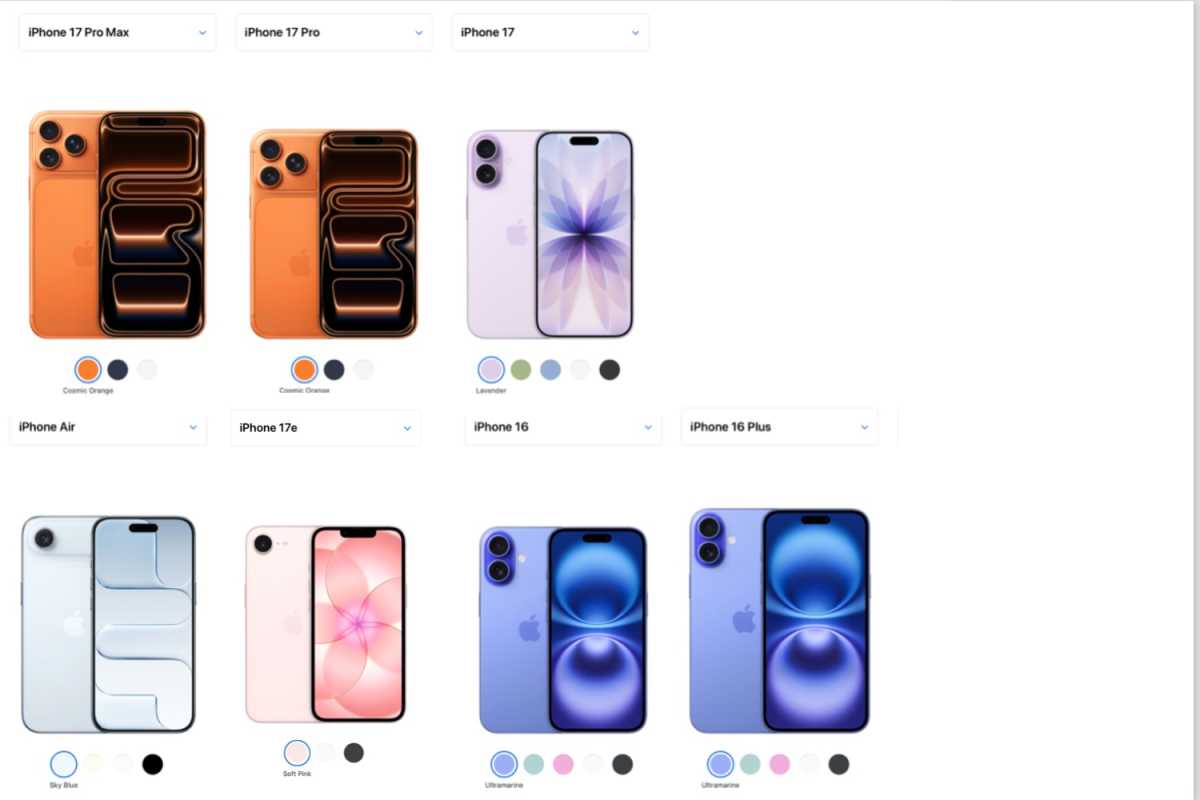
The iPhone line up for most of 2026.
Apple
Camera Control button: The whole iPhone 17 line up, the iPhone Air, and the iPhones 16 and 16 Plus all feature the Camera Control button on the side of the iPhone. The iPhone 17e lacks this button. The Camera Control button opens the Camera app and you can press it again to take a photo or record a video. The button is actually touch sensitive so you can use various gestures, such as sliding your finger over it to adjust exposure, for example. On the iPhone 17e you can set the Action button to open the camera and take a photograph, but you can’t fine tune settings in the same way.
Action Button: The Action Button features on the whole of the iPhone 16 and 17 line up, and the iPhone Air. It is a customisable button that can perform certain actions, such as turning on the flashlight or silent mode. The Action Button is above the volume controls in the same position as the mute button on older iPhones.
Dynamic Island: From the front all the iPhones are visually similar. Each iPhone has an area at the top of the screen that conceals the front camera and Face ID technology. On the iPhone 16e this is referred to as the notch. On the iPhone 17 series, iPhone Air and the iPhone 16 and 16 Push this is a smaller pill shaped adaptive area called the Dynamic Island that can display Live Activities and other software elements in a way that makes the notch a little more useful.
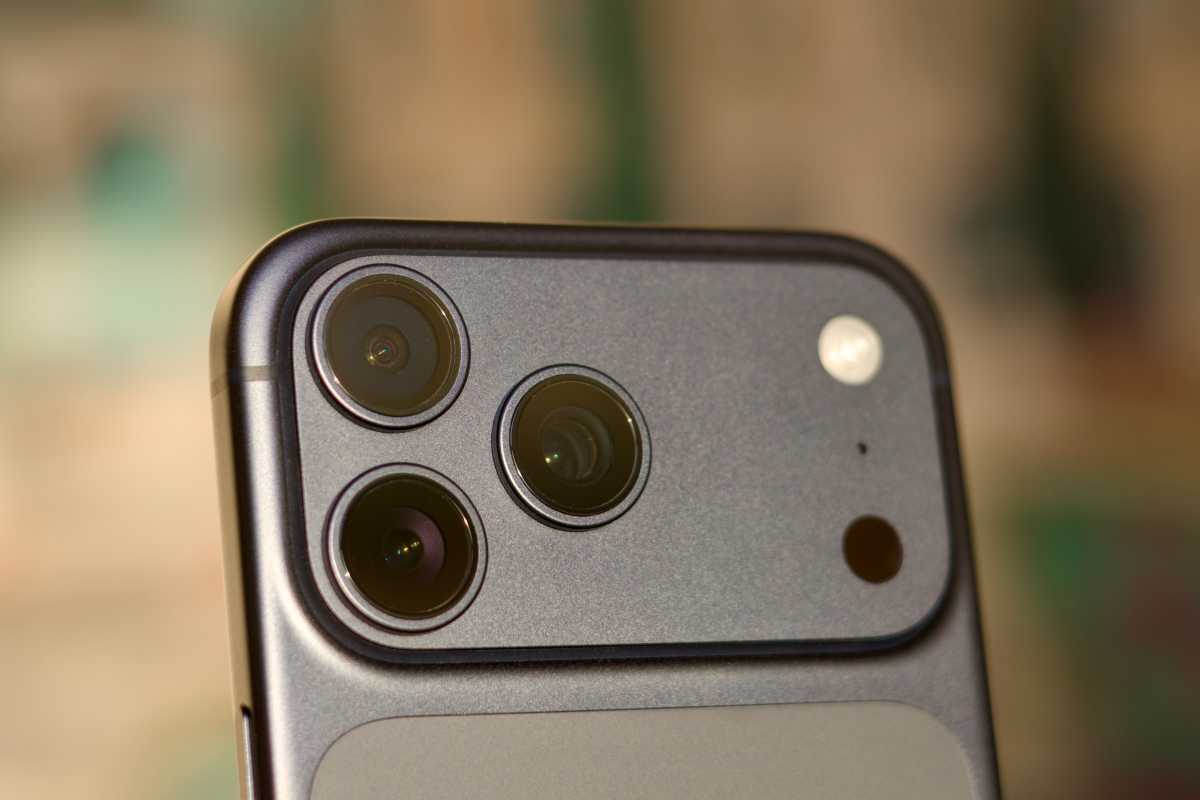
Camera layout: Turn the iPhones over and the differences become much clearer. As you can see from the image above, the iPhone 17 Pro and Pro Max have three lenses laid out in a triangle formation. For these models the flash and LiDAR scanner have been moved to the other side of what Apple is calling the Camera Plateau, where in older models they were closer to the lenses. The iPhone 16 has two lenses, one above the other, and the iPhone Air has a single lens on it’s own Camera Plateau that stretches the width of the iPhone, unlike the single lens of the iPhone 17e.
Dimensions The most obvious difference is the dimensions and weight of each phone. We’ve detailed these in the chart below.
Colors: While it’s very likely that you will put your iPhone in a case and never look at the color on the back again, the color choices available for each iPhone model is another area where there is a lot of difference. You can see the different colors on offer in the chart below.
Here’s how the dimensions and colors compare:
| iPhone | Dimensions | Weight | Colors |
|---|---|---|---|
| iPhone 17 Pro Max | 6.43 inches (163.4 mm) x 3.07 inches (78 mm) x 0.34 inch (8.75 mm) | 8.15 ounces (231 grams) | Cosmic Orange, Deep Blue, Silver |
| iPhone 17 Pro | 5.91 inches (150 mm) x 2.83 inches (71.9 mm) x 0.34 inches (8.75 mm) | 7.20 ounces (204 grams) | Cosmic Orange, Deep Blue, Silver |
| iPhone 17 | 5.89 inches (149 mm) x 2.81 inches (71.5 mm) x 0.31 inches (7.95 mm) | 6.24 ounces (177 grams) | Lavender, Sage, Mist Blue, White, Black |
| iPhone Air | 6.15 inches (156.2 mm) x 2.94 inches (74.7 mm) x 0.22 inches (5.82 mm) | 6.24 ounces (177 grams) | Sky Blue, Light Gold, Cloud White, Space Black |
| iPhone 16 Plus | 6.33 inches (160.9 mm) x 3.06 inches (77.8 mm) x 0.31 inch (7.80 mm) | 7.03 ounces (199 grams) | Ultramarine, Teal, Pink, White, Black |
| iPhone 16 | 5.81 inches (147.6 mm) x 2.82 inches (71.6 mm) x 0.31 inch (7.80 mm) | 6.00 ounces (170 grams) | Ultramarine, Teal, Pink, White, Black |
| iPhone 17e | 5.78 inches (146.7 mm) x 2.82 inches (71.5 mm) x 0.31 inch (7.80 mm) | 5.88 ounces (167 grams) | Black, White, Soft Pink |
Screen: How are the iPhone displays different?
The Pro and Pro Max iPhones used to be the only iPhones to offer ProMotion, which allows for an adaptive refresh rates, with the refresh rate going as high as 120Hz for really smooth scrolling and as low as 1Hz. This is no longer the case: the iPhone 17 and iPhone Air also feature ProMotion screens. And is doesn’t stop there: the iPhone 17 and iPhone Air also feature Always-On displays, which was another feature previously reserved for the Pro models. As a result the iPhone 17, 17 Pro, 17 Pro Max and iPhone Air all have identical screens.
The iPhone 16, 16 Plus and 16e lack the ProMotion and Always-On displays, the peak outdoor brightness is higher on the newer iPhones as well, with the 17-series offering 3,000 nits peak, compared to 2,000 on the iPhone 16 and 16 Plus. The peak brightness on the iPhone 16e is 1,200 nits. The ability for the screen to get very very dim (down to 1 nit) while still remaining usable is also key as it’s great for use in dark rooms. The iPhone 16e is the only iPhone in the current line up that lacks this dimming feature.
The Always-On screen, on all the iPhones except the 16e, means the iPhone can always display elements such as the time and date, notifications and Lock Screen widgets without it being necessary to wake the iPhone. The screen dims to minimize onscreen power usage to preserve battery life and it will turn off should you place it face down or walk away while wearing an Apple Watch.
The screen size may be the most important factor in your decision. If you prefer a larger screen, you’ll want the “Pro Max” version. The iPhone 17 Pro Max has a screen size of 6.9 inches diagonally. The next largest screen is on the iPhone 16 Plus at 6.7-inches, and then the iPhone Air at 6.5-inches. But even the iPhone 17 and 17 Pro have a 6.3-inch display which is by no means diminutive. The iPhone 16 and 17e have the smallest screens: both are 6.1-inches.
Camera: How do the iPhone cameras compare?
Foundry
Rear cameras
For many it’s the capabilities of the cameras that sell the iPhones, so it’s no wonder that every year Apple improves the camera on its iPhones, sometimes improving the tech, sometimes the software. The iPhone 17 still features a dual-camera array with wide and ultra-wide lenses, while only the Pro and Pro Max offer the additional telephoto lens.
In 2024 the iPhone 16 Pro and Pro Max gained a 48 megapixel Ultra Wide camera and the iPhone 16 and 16 Plus gained a 48MP Fusion Main camera, which is also a feature of the 16e.
This time all the rear cameras are upgraded to 48MP. In the case of the iPhone 17 Pro and Pro Max that’s three 48MP cameras, two for the iPhone 17. The iPhone Air has the same 48MP Fusion Main camera as the 16e. The 48MP upgrade across the board should mean more detail when you crop into images. On the iPhone 17 and iPhone Air the extra pixels mean you can shoot 12MP shots as if you had a 2x Telephoto lens. The 48MP images will take up a lot more space though, so it is possible to switch to shooting in a 24MP resolution.
The most impressive camera upgrade is reserved for the iPhone 17 Pro and Pro Max, of course, the telephoto zoom now achieves a 8x optical zoom, up from 5x. This extra lens is likely to be the reason why most people will opt for the 17 Pro over the standard iPhone 17. It offers a little more flexibility in terms of the kind of shots that can be taken, such as portraits and looming into the distance, and macro shots.
The pro models also offer pro video recording features, including ProRes video recording up to 4K at 120 fps, LOG video recording and Academy Color Encoding.
The iPhone 17e and iPhone Air feature a single-lens camera system, omitting certain advanced features found in higher-end models. However, they still delivers notable improvements over previous budget iPhones, with camera capabilities that are suitable for everyday photography needs.
Front ‘selfie’ camera
Foundry
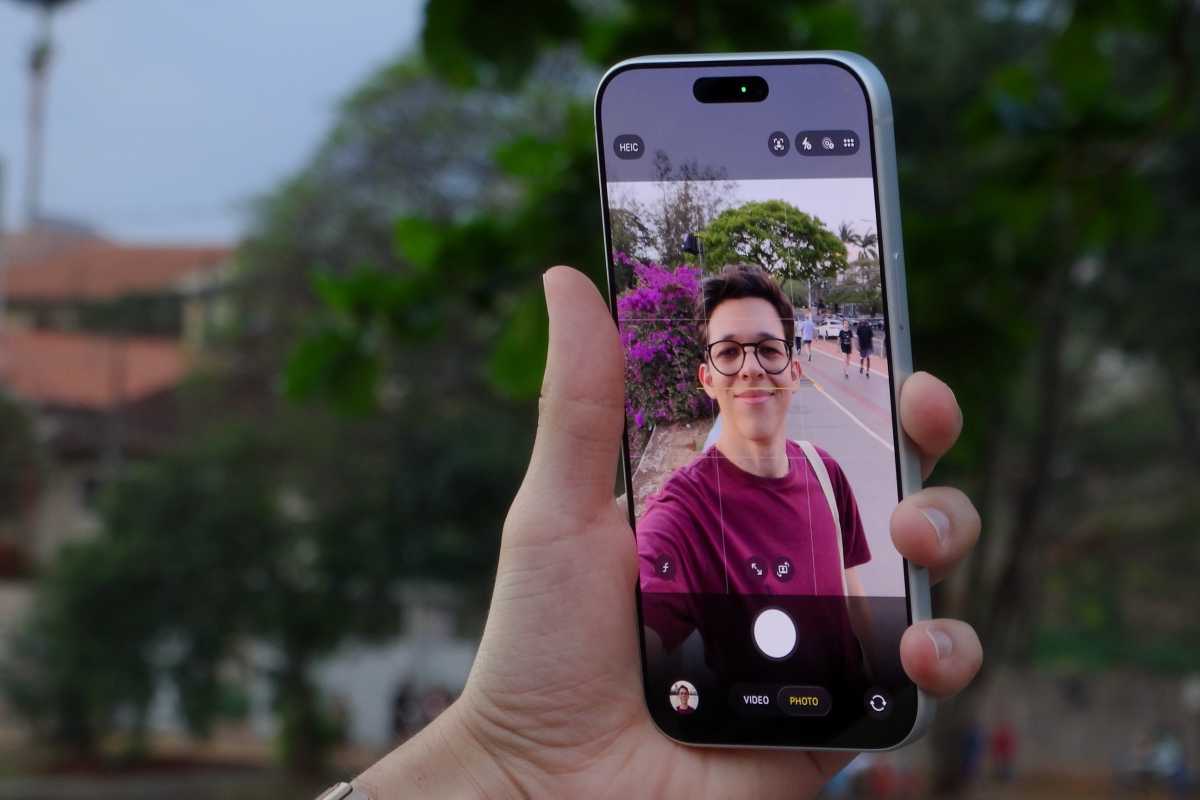
The front camera on all the iPhones, aside from the iPhone 17e, is 18MP (the iPhone 17e retains the 12MP camera of its predecessor). The greater number of megapixels combined with a larger sensor results in more detailed images. The sensor isn’t only larger, it’s now square, which means that it is no longer necessary to turn the iPhone orientation to take portrait or landscape selfies, the image can be cropped for either orientation and can adjust on the fly to give a better framing, for example to include more people in a group shot.
This is also beneficial for FaceTime, because the Centre Stage feature can make sure that subjects are kept centred during a call.
Another feature for the late 2025 iPhones is the ability to record from the rear and front cameras at the same time, so you can capture your reaction.
Also read: Which iPhone has the best camera?
| iPhone | Cameras | Video | Photo & video features |
|---|---|---|---|
| iPhone 17 Pro and Pro Max | Three rear cameras: 48MP Main (ƒ/1.78 aperture), 48MP Ultra Wide (ƒ/2.2 aperture) and 48MP Telephoto (ƒ/2.8 aperture), second-generation sensor-shift optical image stabilization, 8x, 4x, 1x, 2x, 0.5x optical zoom, Adaptive True Tone flash Front camera: TrueDepth front camera, 18 MP (ƒ/1.9 aperture) |
Video: ProRes video recording up to 4K at up to 120 fps (with external recording), 4K video recording at up to 120 fps; 1080p HD video recording at up to 120 fps; HDR video recording with Dolby Vision up to 4K at 120 fps; Sensor-shift optical image stabilization for video; Spatial video up to 1080p at 30 fps | LOG video recording, Academy Color Encoding System, Photonic Engine, Night mode portraits, Night mode, new Photographic Styles, Macro photos, ProRaw, Smart HDR 5 Cinematic mode, Macro video recording, Action Mode, Audio zoom, wind noise reduction |
| iPhone 17 | Two rear cameras: 48MP Main (ƒ/1.6 aperture), 48MP Ultra Wide (ƒ/2.2 aperture), sensor-shift optical image stabilization, 2x, 1x, 0.5x zoom, True Tone flash Front camera: TrueDepth front camera, 18MP (ƒ/1.9 aperture) |
Video: 4K video recording at 24 fps, 25 fps, 30 fps or 60 fps; 1080p HD video recording at 25 fps, 30 fps or 60 fps; HDR video recording with Dolby Vision up to 4K at 30 fps; Sensor-shift optical image stabilization for video, Spatial video up to 1080p at 30 fps | Photonic Engine, Action Mode, Night mode, new Photographic Styles, Smart HDR 5 Cinematic mode, Audio zoom, wind noise reduction |
| iPhone Air | One rear cameras: 48MP Main (ƒ/1.6 aperture), optical image stabilization, 1x, 2x, zoom, True Tone flash Front camera: TrueDepth front camera, 18MP (ƒ/1.9 aperture) |
Video: 4K video recording at 24 fps, 25 fps, 30 fps or 60 fps; 1080p HD video recording at 25 fps, 30 fps or 60 fps; HDR video recording with Dolby Vision up to 4K at 30 fps;Sensor-shift optical image stabilization for video, Spatial video up to 1080p at 30 fps | Photonic Engine, Action Mode, Night mode, new Photographic Styles, Smart HDR 5 Cinematic mode, Audio zoom, wind noise reduction |
| iPhone 16 and 16 Plus | Two rear cameras: 48MP Main (ƒ/1.6 aperture), 12MP Ultra Wide (ƒ/2.2 aperture), sensor-shift optical image stabilization, 2x, 1x, 0.5x zoom, True Tone flash Front camera: TrueDepth front camera, 12MP (ƒ/1.9 aperture) |
Video: 4K video recording at 24 fps, 25 fps, 30 fps or 60 fps, 1080p HD video recording at 25 fps, 30 fps or 60 fps; HDR video recording with Dolby Vision up to 4K at 60 fps; Sensor-shift optical image stabilization for video, Spatial video up to 1080p at 30 fps | Photonic Engine, Action Mode, Night mode, new Photographic Styles, Smart HDR 5 Cinematic mode, Audio zoom, wind noise reduction |
| iPhone 17e | One rear cameras: 48MP Fusion camera (26mm, ƒ/1.6 aperture), optical image stabilization, 2x optical-quality Telephoto, digital zoom up to 10x, True Tone flash. Front camera: TrueDepth front camera, 12MP (ƒ/1.9 aperture) |
Video: 4K Dolby Vision video recording at 24 fps, 25 fps, 30 fps or 60 fps; 1080p Dolby Vision video recording at 25 fps, 30 fps or 60 fps; 720p Dolby Vision at 30 fps; optical image stabilization for video | Photonic Engine, Night mode, Photographic Styles, Smart HDR 5, Audio zoom, wind noise reduction |
Safety features: Emergency protection
Apple introduced some safety features with the iPhone 14 series in 2022 and these are available on all iPhones since. These features include a Crash Detection feature and Satellite Connectivity for emergency phone calls.
Crash detection uses the gyroscope and accelerometer in the iPhones to recognize if the vehicle you are in has crashed. If the iPhone thinks you’ve been involved in a crash, it will call emergency services and notify your preferred contacts (unless you tell it not to).
All phones offer the ability to send an Emergency SOS, and the iPhone 14 and later can do so via satellite, which would be useful if you were in an area with no signal. You just need to be able to establish a clear view of the sky, and be in a country that supports the feature (many do now). Thanks to the feature your iPhone can alert the emergency services to your location in an emergency, the iPhone will also contact your emergency contact.
New for the 2025 iPhones are expanded emergency features, including the ability to text your location to emergency services via satellite.
Durability: Which iPhone is the toughest?
Eugen Wegmann
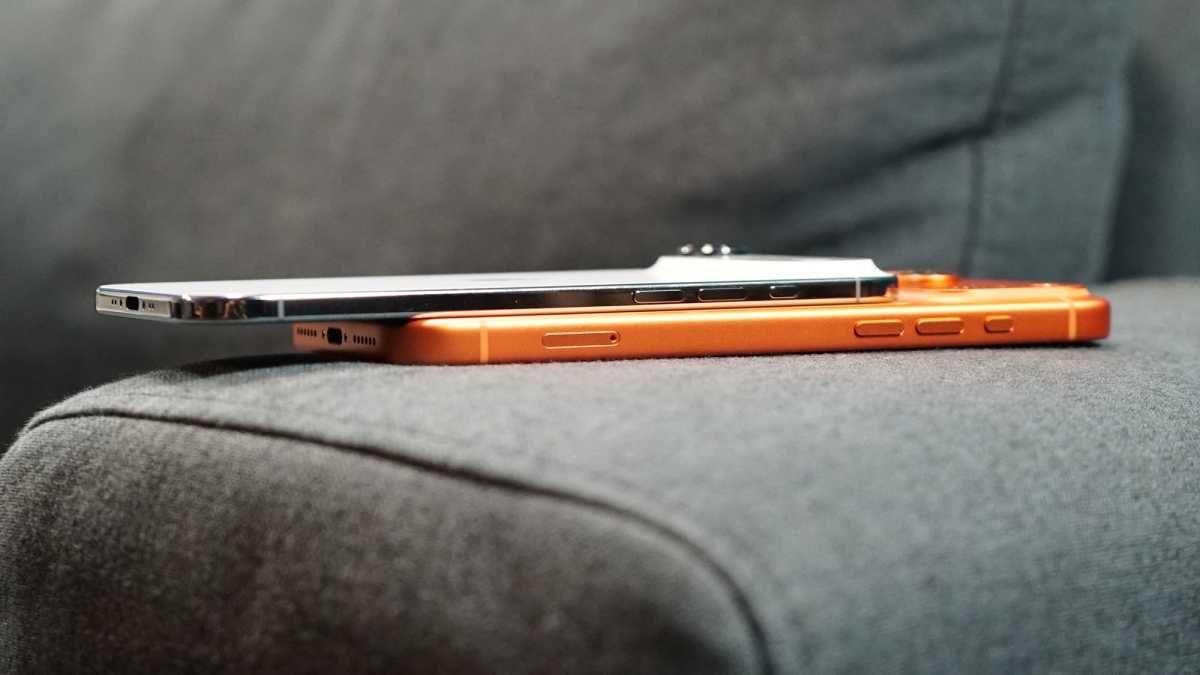
Another factor in the choice of which iPhone to choose is how durable the model is. How likely are you to damage the iPhone?
All iPhones on sale right now offer a Ceramic Shield front, which should mean that the glass on the front is less likely to smash if you drop it. The iPhones 17 Pro Max, Pro, iPhone 17 and iPhone Air feature Ceramic Shield 2, which Apple says offers 3x better scratch resistance. The iPhone 17 Pro and Pro Max, and iPhone Air also have a Ceramic Shield back for extra protection.
Only the iPhone Air is constructed from Titanium. In 2024 the iPhone 16 Pro and Pro Max were Titanium, but for 2025 the Pro and Pro Max are aluminium, as is the iPhone 17, and the 16 and 16 Plus. Titanium is more durable than aluminum, however the construction of the iPhone 17 Pro from aerospace-grade 7000-series aluminium should mean that it is tough enough. The aluminum design is also beneficial for thermal management, for which the iPhone 17 Pro and Pro Max uses a vapour chamber for the first time.
Despite these design features for better durability, dropping an iPhone is likely to damage it, and scratches can still appear on surfaces, so we recommend using a case. For our recommendations see our round-up of the Best iPhone 17 cases and Best iPhone 16 cases.
The other way people damage their iPhones is by dropping them in water. All current iPhones are rated as water resistant to a depth of 6 meters for up to 30 minutes (IP68). That’s water resistant, not water proof, so we still wouldn’t recommend getting your iPhone wet though because Apple will know if it’s gotten wet and it could void your warranty should anything go wrong.
Specs: Storage and processor options
The A19 Pro in the iPhone 17 Pro and Pro Max is distinguished primarily by an extra GPU core (6-core GPU), though it also has super video hardware to support the Pro video features. The iPhone Air also shares the A19 Pro, but with one fewer GPU core (5-core GPU).
Our tests show that the A19 in the iPhone 17 is faster than the A18 found in the iPhone 16, 16 Plus. There is one fewer GPU core in the iPhone 17e (4-core GPU, compared to 5-core GPU in the 17, 16 and 16 Plus).
Missing from the newer iPhones is a 128GB storage configuration, with all models now starting with 256GB – including the 17e. The best news is that the iPhone 17 now starts with 256GB at the same price as the 128GB iPhone 16 used to be sold for. For this reason the 128GB iPhone 16 really looks like a poor deal in comparison, since it is only $100/£100 less and has half the storage.
Each iPhone is available in between three and four capacity options. It’s important to consider how much you need before buying because iPhones don’t have a microSD card slot that will allow you to add additional storage at a later date. For the typical iPhone user, 128GB might have proven too small, especially with 48MP images, but the 256GB starting point should be sufficient .
One reason you may not need more storage is if you choose to sync your data to the cloud. If you pay a monthly fee for iCloud storage all your data will be available on any of your devices, and crucially your photos will be stored in the cloud rather than on your device, freeing up many gigabytes of space. iCloud starts at $0.99/£0.99 for 50GB. See How much does iCloud cost for more information, including Australian and Canadian prices.
Before you decide how much storage you need have a look at your current phone’s usage (go to Settings > General > iPhone Storage) and think about how much space you really need. Read How much storage do you need on an iPhone? for more advice.
| iPhone | Processor | Storage | Battery life |
|---|---|---|---|
| iPhone 17 Pro Max | A19 Pro chip, 6-core CPU, 6-core GPU | 256GB 512GB 1TB 2TB |
Up to 37 hours video playback, up to 50% charge in 20 minutes with 40W adapter |
| iPhone 17 Pro | A19 Pro chip, 6-core CPU, 6-core GPU | 256GB 512GB 1TB |
Up to 31 hours video playback, up to 50% charge in 20 minutes with 30W adapter or higher |
| iPhone Air | A19 Pro chip, 6-core CPU, 5-core GPU | 256GB 512GB 1TB |
Up to 27 hours video playback, up to 50% charge in 30 minutes with 20W or 30W adapter |
| iPhone 17 | A19 chip, 6-core CPU, 5-core GPU | 256GB 512GB |
Up to 30 hours video playback, up to 50% charge in 20 minutes with 40W adapter or higher |
| iPhone 16 Plus | A18 chip, 6-core CPU, 5-core GPU | 128GB 256GB |
Up to 27 hours video playback, up to 50% charge in 35 minutes with 20W adapter or higher |
| iPhone 16 | A18 chip, 6-core CPU, 5-core GPU | 128GB | Up to 24 hours video playback, up to 50% charge in 30 minutes with 20W adapter or higher |
| iPhone 17e | A18 chip, 6-core CPU, 4-core GPU | 256GB 512GB |
Up to 26 hours video playback, up to 50% charge in 30 minutes with 20W adapter or higher |
Battery: Battery life and charging
The iPhone 17 models offer a boost in battery life over the iPhone 16 series. Apple’s official battery life and charging times can be seen in the table above, but in our testing, the difference in battery life was even more pronounced—we saw battery life improvements across the range.
In the demanding Geekbench 4 battery test, the iPhone 17 lasted for 1,053 minutes, which is a 21 percent improvement on the iPhone 16’s 867 minutes. That’s ahead of the iPhone Air (880 minutes) and iPhone 17e (854 minutes). Unbeaten is the iPhone 17 Pro Max at 1,560 minutes. As a point of comparison, the iPhone 16 Pro in 2024 scored 988.
The current iPhones benefit from the efficiency of the A19-series chips and the new C1X cellular modem that uses 30% less energy.
Charging speeds are also improved with even new faster charging with a 40W charger.
We compare battery life, capacity, mah and watt hours for every iPhone separately.
Software: Which iPhones get Apple Intelligence
Apple Intelligence, the suite of AI features that include writing tools, image generation, image recognition, “Genmoji” emoji generation, and new capabilities for Siri is available on all the iPhones currently sold by Apple. The discontinued iPhone 15 and 15 Plus did not support Apple Intelligence features, even though the iPhone 15 Pro and Pro Max were Apple Intelligence ready.
While there is nothing drastically important that you might miss out on if you don’t have Apple Intelligence right now, it’s likely that in time not having Apple Intelligence will be more of a hinderance than it is currently. As more impressive AI features arrive, we anticipate that Apple Intelligence capable phones will become even more attractive, so if you don’t want to be suffering from FOMO then get on the AI bandwagon now with an Apple Intelligence-capable phone.
Find out about what Apple Intelligence is by reading our guide: Apple Intelligence: what is it and how to use it.
Should I buy an old iPhone?
As mentioned above, the iPhone 15 and 15 Plus do not support Apple Intelligence, so if you saw one on sale, most likely as a refurbished model, we wouldn’t recommend buying it. However there are some other discontinued iPhones that could be worth buying, at the right price.
We recommend the iPhone 16 Pro Max if you find one at a good price. It is a larger version of 2024’s iPhone 16 Pro. It boosts excellent battery life, thanks to its larger battery, and an even bigger screen than the previous generation, up from 6.7-inches to 6.9-inches.
The Pro version of the iPhone 16 is also a good buy. It comes in a super tough titanium shell (unlike it’s replacement) and offers better performance and battery life than the standard iPhone 16. The photo and video capabilities are where the Pro models stand out. They include a 5x telephoto camera, a sharper 48-megapixel Ultra Wide camera, and support for high-end formats like ProRAW, HLG video, and video recording at up to 4K and 120fps. And yes, it includes the new Camera Control button.
Which iPhone should I buy?
The best iPhone you can buy right now is the iPhone 17 Pro or iPhone 17 Pro Max, depending on whether you want a larger display or not.
The iPhone 17 is much better value, though. It includes many of the features that used to set the iPhone and iPhone Pro apart, such as the ProMotion display. If you choose that iPhone you are giving up is the 8x telephoto camera and some high-end video features.
You could save money and opt instead for an iPhone 17e, which might appeal if you are on a tight budget. We think that the iPhone 17e is a good option if you don’t mind forgoing the additional cameras, and a much better option than the iPhone 16, which we feel is overpriced now in comparison to the iPhone 17, and given its tiny 128GB SSD.
Once you have chosen your new iPhone be sure to read our iPhone setup guide.
How to buy an iPhone
There are several ways to buy an iPhone, each with its own advantages. The two main options are buying directly from Apple or through a mobile carrier. In the U.S., iPhones are typically purchased on a carrier contract and are often locked to that network. In the U.K., you can also buy an unlocked, SIM-free iPhone outright from Apple or other retailers, either at full price or with a discount.
Buy directly from Apple
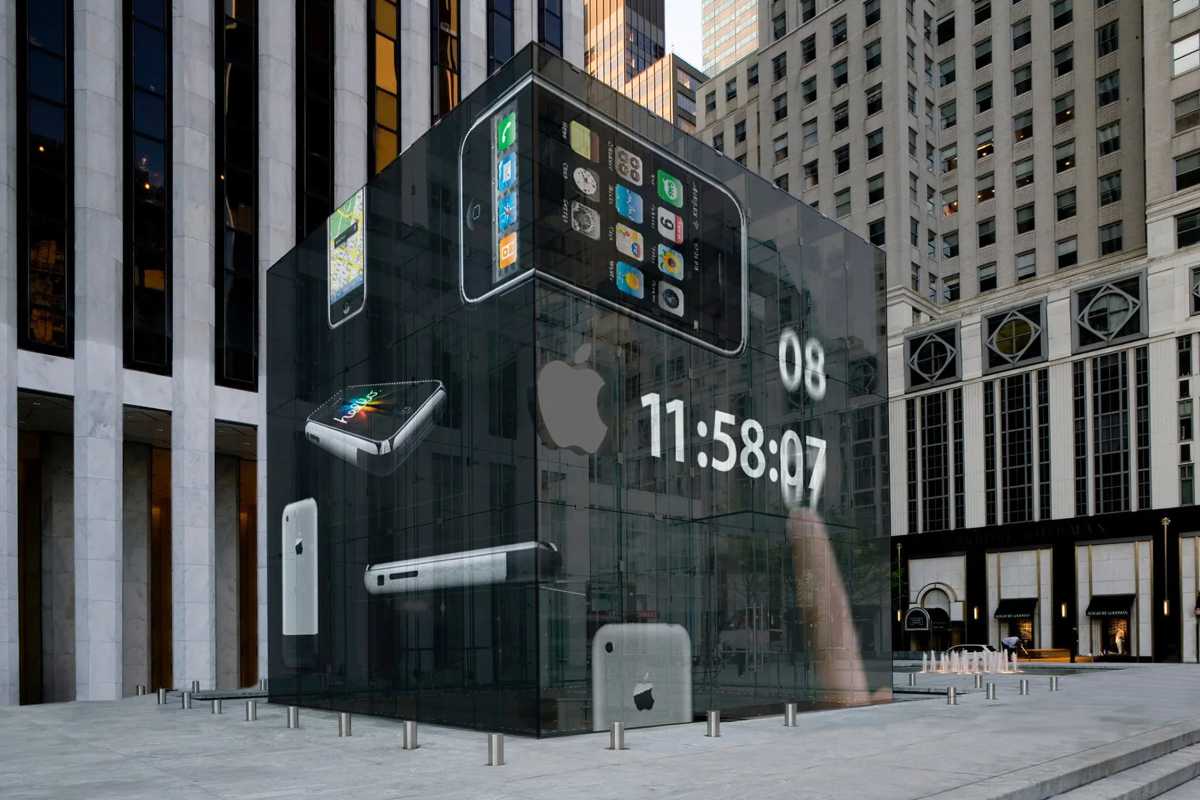
Jon Stoa
Pros: You can get an unlocked, SIM-free phone (in most regions), access to the iPhone Upgrade Program, and the ability to trade in your old device for credit (up to $650). It’s also the best place to pre-order a new model for the fastest delivery.
Cons: You almost always pay full retail price.
Buy from a Carrier
Pros: This is where you’ll find the biggest discounts, often in the form of bill credits over 24 or 36 months when you trade in a phone and sign up for a qualifying plan. For example, AT&T, T-Mobile, and Verizon frequently offer up to $830–$1,000 off new iPhones with a trade-in .
Cons: These deals come with significant strings attached, including long-term contracts and specific plan requirements. Always read the fine print
A contract usually starts with an upfront payment that will vary depending on the iPhone model you go for and also how much you’ll be paying each month. That upfront payment is followed by monthly payments, normally for a total of 24 months, after which you own the phone (in most cases). Those monthly payments also cover data, minutes and texts.
The following networks are worth checking for their contract offers:
U.K. readers can find iPhone contracts from the following networks:
Buy from a third-party reseller
Pros: In the U.K., resellers like Amazon, Currys, and John Lewis frequently sell unlocked iPhones at a discount, often offering the best upfront savings . For instance, Amazon has offered £200 off the iPhone Air.
Cons: Availability and deals change frequently.
You could try the following third-party resellers:
Buy via Apple’s iPhone Upgrade Program
Apple offers financing plans that let you spread the cost of a new iPhone over monthly payments while giving you the option to upgrade to a new eligible model after making a set number of payments.
In the U.S. Apple runs an iPhone Upgrade Program that combines the cost of the iPhone and AppleCare+ into a single monthly payment. After making 12 payments, you can trade in your current iPhone and start a new agreement for the latest eligible model, subject to Apple’s terms.
Monthly payments depend on the model you choose and currently start at $42.41:
- iPhone 17 (256GB): from $42.41/month
- iPhone Air (256GB): from $52.83/month
- iPhone 17 Pro (256GB): from $57.00/month
- iPhone 17 Pro Max (256GB): from $61.16/month
AppleCare+ is included in the U.S. program. It provides unlimited incidents of accidental damage protection (subject to an excess fee), battery service, and priority technical support.
In the U.K., Apple has discontinued the traditional iPhone Upgrade Programme and replaced it with the Flexible Finance Account with Upgrade Option. This offers 0% finance over 20 or 30 months, with the option to upgrade after 11 or 23 monthly payments. Plans start from £39.95 per month, but AppleCare+ is not included and must be purchased separately.
Whether Apple’s upgrade plans represent good value depends on how often you replace your iPhone. If you like having the latest model every year, they can be a convenient option. If you typically keep your iPhone for three or more years, buying outright or using 0% finance is usually the cheaper choice overall.
Apple is also rumored to be preparing a new subscription-style iPhone leasing service in the U.S., although the company has not officially announced any replacement for the current Upgrade Program.
Buy a refurbished iPhone
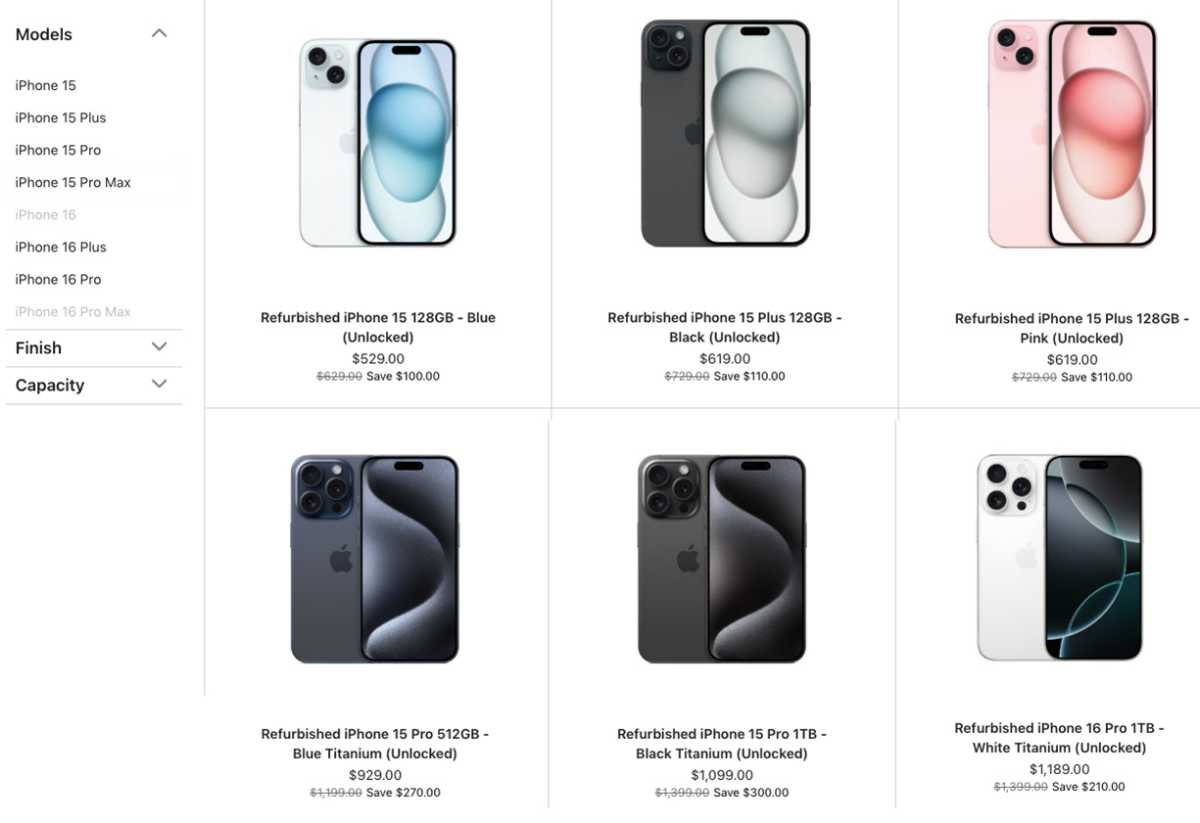
Apple
Buying an iPhone doesn’t come cheap. However, if you’re strapped for cash you don’t have to dismiss the idea of buying an iPhone completely. You may be able to get a good deal on a refurbished model.
Buying a refurbished iPhone is a smart way to save money while still getting a premium device, but the key is knowing where to shop and what to look for.
Understand the difference between refurbished vs used
- Refurbished: Professionally inspected, tested and repaired where necessary. It should come with a warranty and may also have a replacement battery.
- Used or second-hand: Usually sold by an individual in its current condition, often without a warranty or any guarantee that it is fully functional. There is also a greater risk of hidden faults or Activation Lock problems.
What to check before buying
- Warranty: Choose a seller offering a meaningful warranty, ideally for at least 12 months.
- Condition grade: Sellers use grades such as A, B and C, or Fair, Good and Excellent. Higher grades indicate less cosmetic wear but usually cost more.
- Battery health: Check the seller’s minimum battery-capacity guarantee. Many refurbished sellers promise at least 80% of the battery’s original capacity, while Apple-furbished iPhones receive a new battery.
- Unlocked or locked: Confirm that the iPhone is unlocked and can be used with your preferred mobile network. This is particularly important when buying in the U.S.
- Model age: Avoid iPhones that are close to losing software support. As of mid-2026, the iPhone XS, XS Max and XR are no longer sensible long-term purchases, while the iPhone 11 should be approached with caution.
Shop at Apple’s Certified Refurbished Store
Apple’s Certified Refurbished Store is generally the safest place to start and sets the standard for refurbished quality.
Apple thoroughly tests each device, replaces the battery and outer shell, and supplies it in a new box with the appropriate accessories. Refurbished iPhones also come with Apple’s standard one-year warranty, 90 days of technical support and the option to add AppleCare+.
Prices are typically around 15% lower than the original retail price, although availability varies. Apple operates refurbished stores in both the U.S. and U.K.
Consider other trusted resellers
If you can’t find what you need at Apple’s Certified Refurbished Store, try one of these places to buy a refurbished iPhone.
U.S.:
- Back Market: You get 30 days to change your mind and a 12-month warranty… or occasionally more. Take careful note of the phone’s quality rating as the cheapest will have more visible signs of wear (stratches and scuffs) than the more expensive Excellent and Premium buys. Premium-quality iPhones also have the highest-rated batteries and only Apple parts.
- Amazon Renewed Store: This site’s greatest benefit is that purchases are all backed by Amazon’s standard returns policy and its “Renewed Guarantee” lets you get a refund or replacement within a year of receiving your product.
- Best Buy: Best Buy doesn’t offer a great deal of information on pre-owned iPhones’ condition, but you can return within 14 days if the item is “unopened or defective in any way.”
- Walmart: Walmart doesn’t sell refurbished iPhones directly; rather, they are sourced from other sellers. Return policies vary from seller to seller, but there are minimum requirements that apply universally.
U.K.:
- Back Market: You get 30 days to change your mind and a 12-month warranty… or occasionally more. See above for more details on Back Market’s quality rankings.
- Music Magpie: A good place to start looking for refurbished iPhones with a one-year warranty. You may find that sales reduce the price still further.
- Hoxton Macs: Don’t let the Mac in the name fool you. Hoxton Macs has started selling refurbished iPhones, with a one-year Return to Base warranty.
- Reboxed: Pledges that devices “are fully tested and in perfect working order.” All come with a 12-month no quibble warranty.
- Amazon Renewed Store: While you can’t really sell on Amazon Renewed unless you’re a business, those looking to buy a refurbished iPhone Amazon Renewed have plenty of options to choose from. Its greatest benefit is that purchases are all backed by Amazon’s standard returns policy and its “Renewed Guarantee” lets you get a refund or replacement within 1 year of receiving your product.
- Envirofone: Also allows you to trade in your old phone for credit towards purchasing a refurbished phone.
Considering alternatives to iPhone?
By now we hope we’ve helped you to find the perfect iPhone for you. Of course, there are alternatives outside Apple’s ecosystem. Our sister site Tech Advisor can help you find the best phone if you’re considering switching to Android (or maybe just want to laugh at the competition).
