
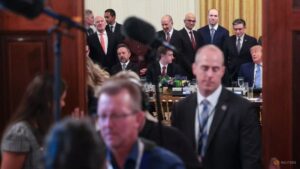





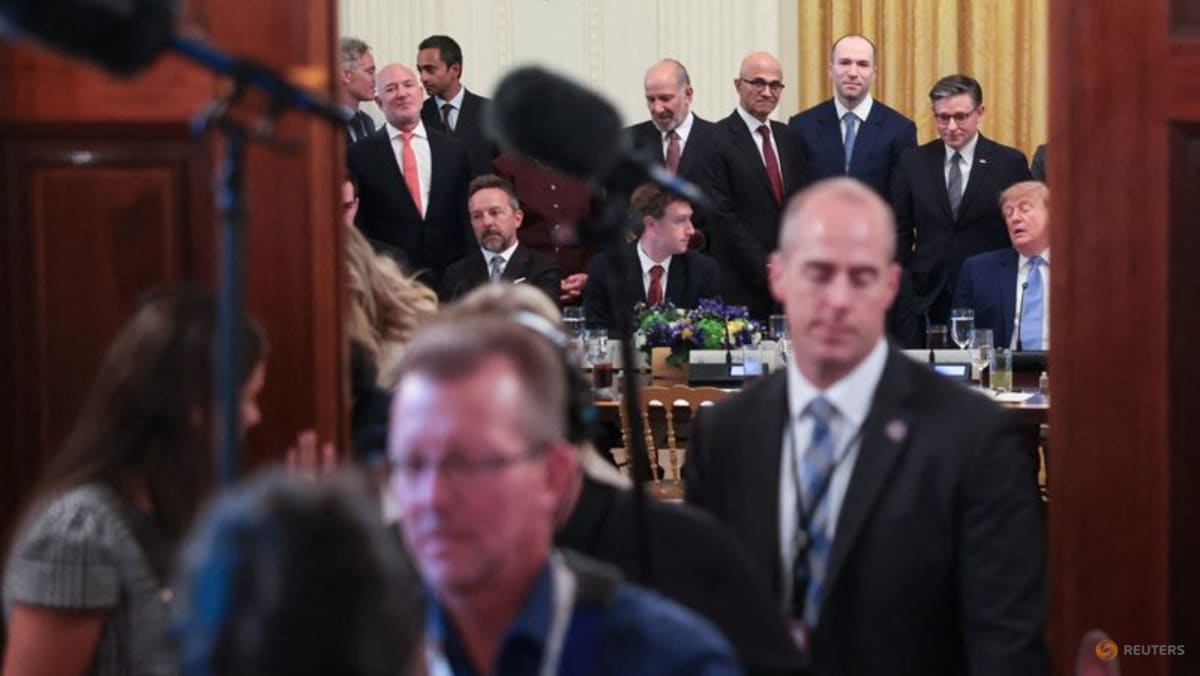
WASHINGTON, Oct 3 : US President Donald Trump spent Tuesday showcasing his administration’s approach to AI — touting the US government’s new AI chatbot, dining with tech titans at the White House, and announcing a voluntary agreement with those executives that he said would address growing fears about the technology’s safety.
The display signaled that Trump is eager to show he is addressing growing voter concerns about AI’s dangers without imposing restrictions that could hamper the technology’s development, AI safety advocates said. The safety agreement with six companies — Nvidia, SpaceX, OpenAI, Anthropic, Meta and Alphabet’s Google — includes no stated consequences if a company chooses not to comply. Trump described it as “morally binding.”
“This was an attempt to give the impression that the government is listening to these concerns without undercutting what has been a very clear and consistent line from this administration: that regulation and governance inherently impede innovation,” said Kat Duffy, who runs an AI team at the nonpartisan Council on Foreign Relations.
Whether voters buy Trump’s effort in the run-up to US midterm elections on November 3 remains to be seen. Public uneasiness with AI, and the small group of people who seemingly hold sway over it, has risen in recent months. Three-quarters of Americans worry that AI companies have not gone far enough to prevent AI from causing serious harm to society, according to a Reuters/Ipsos poll published September 22. A series of security events has also underscored how advanced AI can act unpredictably.
Hundreds of OpenAI AI agents broke out of their testing environment in July and attacked the infrastructure of AI platform Hugging Face. In early September, Anthropic researcher Jacob Coxon resigned, saying that the people building AI believe it “could kill us all by the end of the decade.” His words, and others, sparked a flurry of calls from US lawmakers for AI regulation.
Through it all, Trump has largely dismissed those concerns, saying that government restrictions would make it harder for American companies to compete against their Chinese counterparts. He has repeatedly said that US law enforcement agencies such as the Justice Department serve as sufficient guardrails, and that no new rules are needed. He also directed his administration to call AI “super intelligence,” part of an effort to improve the reputation of an unpopular technology.
The concerns have become prominent enough to make their way into late-night comedy. In late September, “Saturday Night Live” satirized Anthropic CEO Dario Amodei, one of the industry’s most outspoken voices on AI risks — even as his company readies a public stock sale that could value it at $2 trillion — with cast member Jane Wickline portraying the executive.
“AI is not a weapon, it’s a tool: A tool for building weapons. And I urge you to urge me to stop,” Wickline said as Amodei.
CONCERNS ABOUT ENFORCEMENT
The accord, inked Tuesday, does include measures that AI safety advocates have sought, including calling for “robust internal controls” to prevent unauthorized hacks as well as partnering with “independent external auditors.” Those concepts have been included in draft state and federal legislation, and California in September enacted the first state law setting rules for how independent auditors evaluate AI products.
But the one-page White House document did not address details or enforcement mechanisms.
A White House official said in a statement that the agreement will “advance American innovation and strengthen responsible development” of AI models. Trump is expected to name his Director of National Intelligence Jay Clayton as his top AI adviser, Reuters previously reported, a position he has dubbed “AI czar,” even as Clayton stays in his role leading the nation’s intelligence agencies.
Representative Ro Khanna, a Democrat representing Silicon Valley, welcomed the idea of “independent auditors” but said that they should report to an independent federal agency.
“They can’t just be auditors that report to (OpenAI CEO) Sam Altman or Dario Amodei,” he said. “My concern is the president basically trusting these guys who have a huge profit motive and won’t have the judgment to keep us safe.”
Venture capitalist David Sacks, who advises Trump on AI and has been an advocate for unrestricted AI development, said on the social media platform X that securities law and other legal authorities would penalize companies that fail to address problems uncovered by internal controls or auditors.
But AI safety advocates told Reuters those authorities can only address harms after they occur, saying the threats require safeguards designed to prevent large-scale harm before it happens.
Nevertheless, some AI observers saw the simple fact of hosting the event as an indication that Trump is absorbing the worries.
Trump’s agreement with the tech executives is “a shift toward acknowledging that there are serious safety and security concerns that merit closer coordination between the companies,” said Samuel Hammond, AI policy director at the conservative Foundation for American Innovation.


