



There were some indications that the same thing is true in fish, where the elimination of equivalent hox genes also interfered with the formation of the rays at the ends of fins. This would suggest that digits formed by elaborating on a genetic system that already existed in order to produce fins.
However, when a US-French team started looking at the regulation of one set of hox genes in the limbs, things turned out to be a bit more complicated. The hox gene clusters have two chunks of regulatory DNA that help set the activity of the genes within the cluster, one upstream of the genes, one downstream. (For the molecular biologists among us, that’s on the 5′ and 3′ sides of the gene cluster.) And we know that in vertebrates, some of the key regulatory DNA for one of the clusters is on the upstream side, since deleting it left all the genes in the cluster inactive in the region of the limb where digits form.
Same place, different reasons
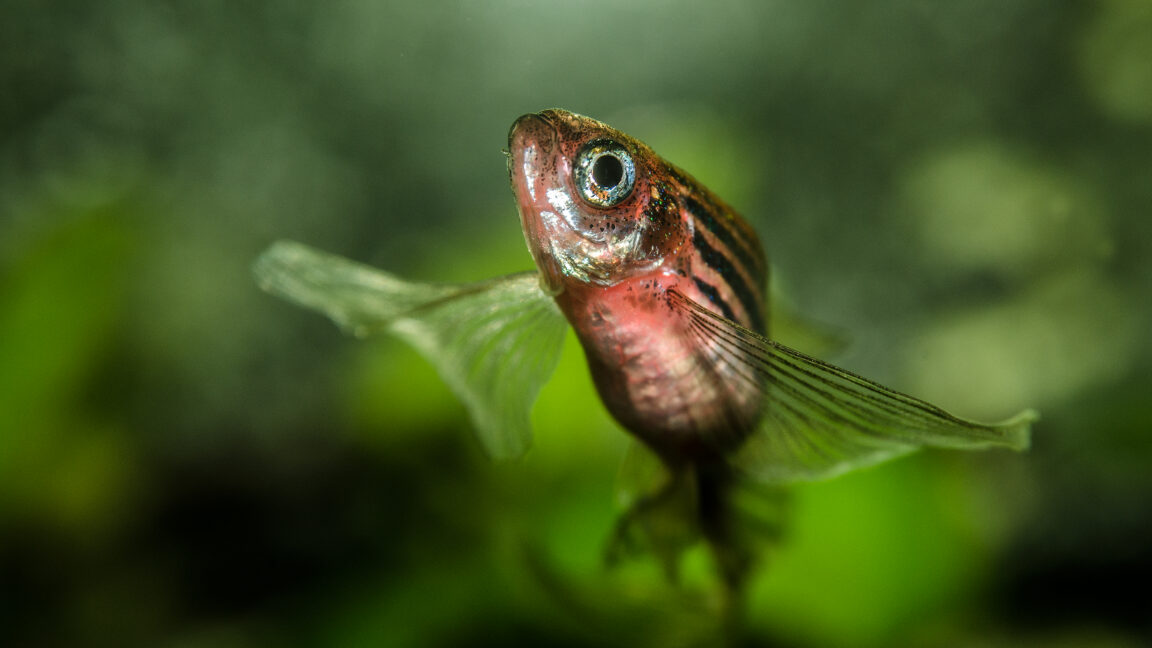
So, the research team behind the new work deleted the equivalent region in a fish (the zebrafish) using the gene editing tool CRISPR. And, deleting the same area that wipes out hox gene activity in the digits in mice did… not very much. The hox gene activity was slightly reduced, but these genes were still active in the right place at the right time to make digits. So, while the activity looked the same, the reasons for the activity seem to be different in fish and mice. Which means that hox activity in the digits isn’t the ancestral state; instead, it seems to have evolved separately in the ray-finned fish and vertebrate lineages.
So, the researchers asked a simple question: If the regulatory DNA they deleted didn’t activate these genes in the limb, where was it needed? So, the researchers looked at where these hox genes were active in fish with and without the deletion. They found one region where it seems to matter: the developing cloaca. In fish, the cloaca is a single orifice that handles excretion (both urine and fecal material) as well as reproduction. So, it’s basically the fish equivalent of our rear ends.
