


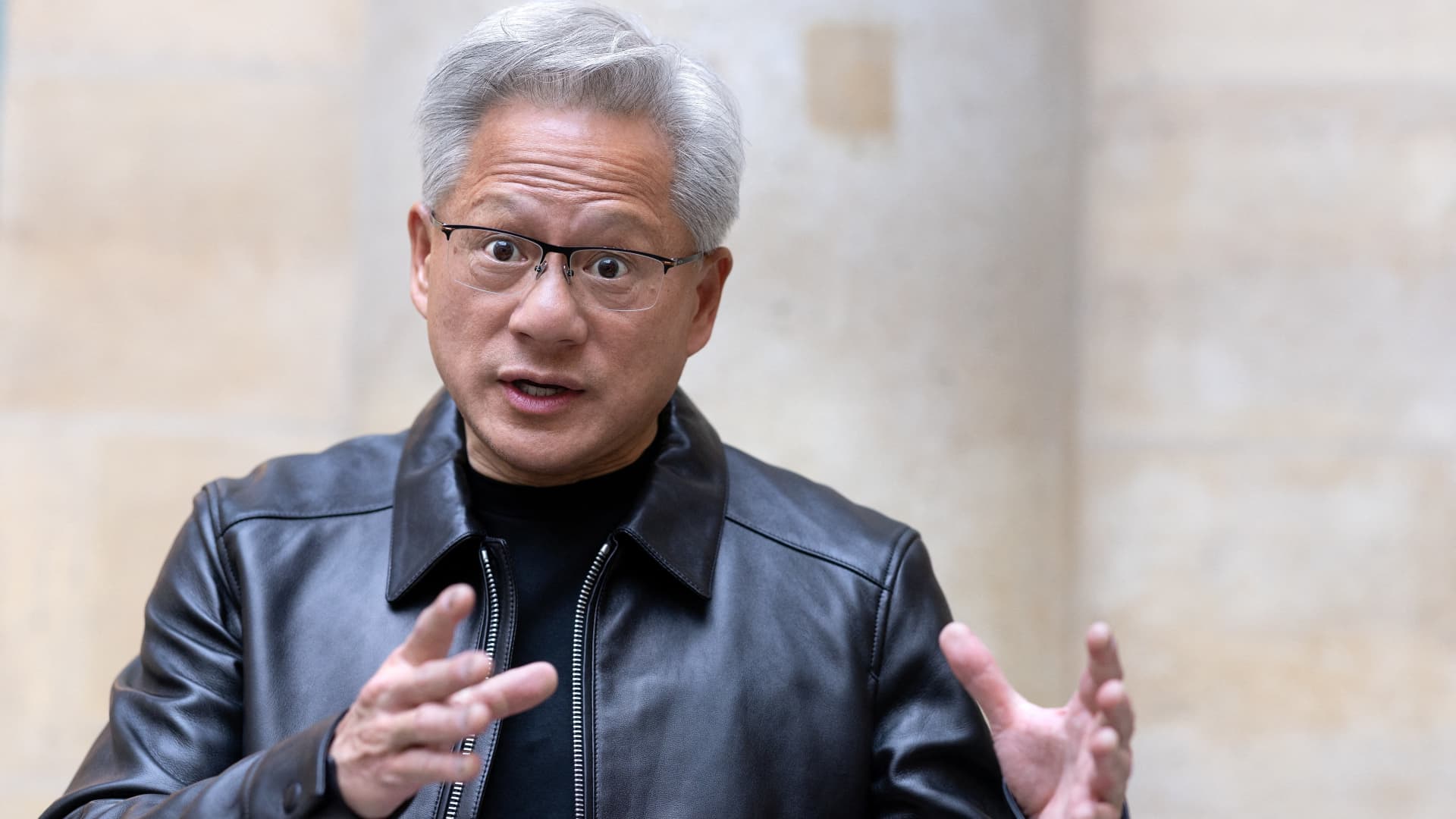
Co-founder, President and CEO of US technology company Nvidia, Jensen Huang, gestures during a press briefing in Paris on Oct. 13, 2026.
Joel Saget | AFP | Getty Images
Nvidia CEO Jensen Huang told CNBC Thursday that a surplus of memory supply is unlikely by 2029, despite a sell-off in memory stocks over the past week amid concerns about oversupply and weakening demand.
“One of the things that’s really great about memory is that you can always use more of it,” Huang told CNBC’s Arjun Kharpal in a wide-ranging interview on the sidelines of the company’s GTC Berlin conference. He added that HBM, a type of random access memory, or RAM, will be used for years to come.
“We’re the first company in the world to put LPDDR memory — what goes into your cell phones — into the world’s data centers, and it’s enabled us to deliver performance that’s twice as energy efficient as anything in the world today, and so we’re going to continue to use abundant amounts of them as well,” he added.
Memory stocks have taken a battering in the past week after an opinion column published in a prominent South Korean publication on Oct. 15 urged the country’s government to brace for a deceleration in the AI boom.
The column cited two experts who said they expect to see a “flood of new supply,” which will turn the memory market “into a red ocean” in 2029, per CNBC’s translation. “The supercycle could be over, and the industry could enter a downturn,” by 2029, they wrote.

Memory is a core component of Nvidia’s chips, and a glut of supply could push prices lower and hit profit margins for the companies that make the product, such as SK Hynix, Samsung, and Micron.
SpaceX and Tesla CEO Elon Musk responded to the article at the time, saying that China “will be making a LOT of RAM in 2028.”
The memory selloff was also driven by China’s ChangXin Memory Technologies, or CXMT, which announced new design architecture that could lead to greater efficiencies. The announcement added to investor concern that CXMT could take market share from rivals SK Hynix, Samsung, and Micron.
“We’re open-minded,” Huang said Thursday when asked about whether he plans to partner with CXMT and use its memory product. “We work with Chinese companies; just about the whole world works with Chinese companies in the supply chain somewhere.”
“China is incredible at the fundamental infrastructure technology, and no country collectively is better at manufacturing than China, and so we have to take their capabilities very seriously,” he added.
U.S. regulation ‘accelerated’ China’s chip advancements
Huang also told CNBC that China’s advancements in the semiconductor industry are due to mounting U.S. regulations, which pushed the country to speed up its own chip technology and manufacturing.
The U.S. currently restricts exports of the country’s most advanced semiconductors to China, including top-end Nvidia chips. However, some Chinese firms are making use of a loophole to access the product’s compute power through data centers in Southeast Asia. Experts say that this has been key to Chinese AI models becoming more capable.
China “definitely accelerated because of all the regulations,” he said.
“We’ve definitely accelerated China’s initiatives, its nationalization of semiconductor manufacturing capabilities, and all of the industrial support that has been put into that sector, and so there’s no question we’ve accelerated that,” he added.
Huang emphasized that American tech firms are “mighty” and are prepared to take on competition “from anybody.”
