







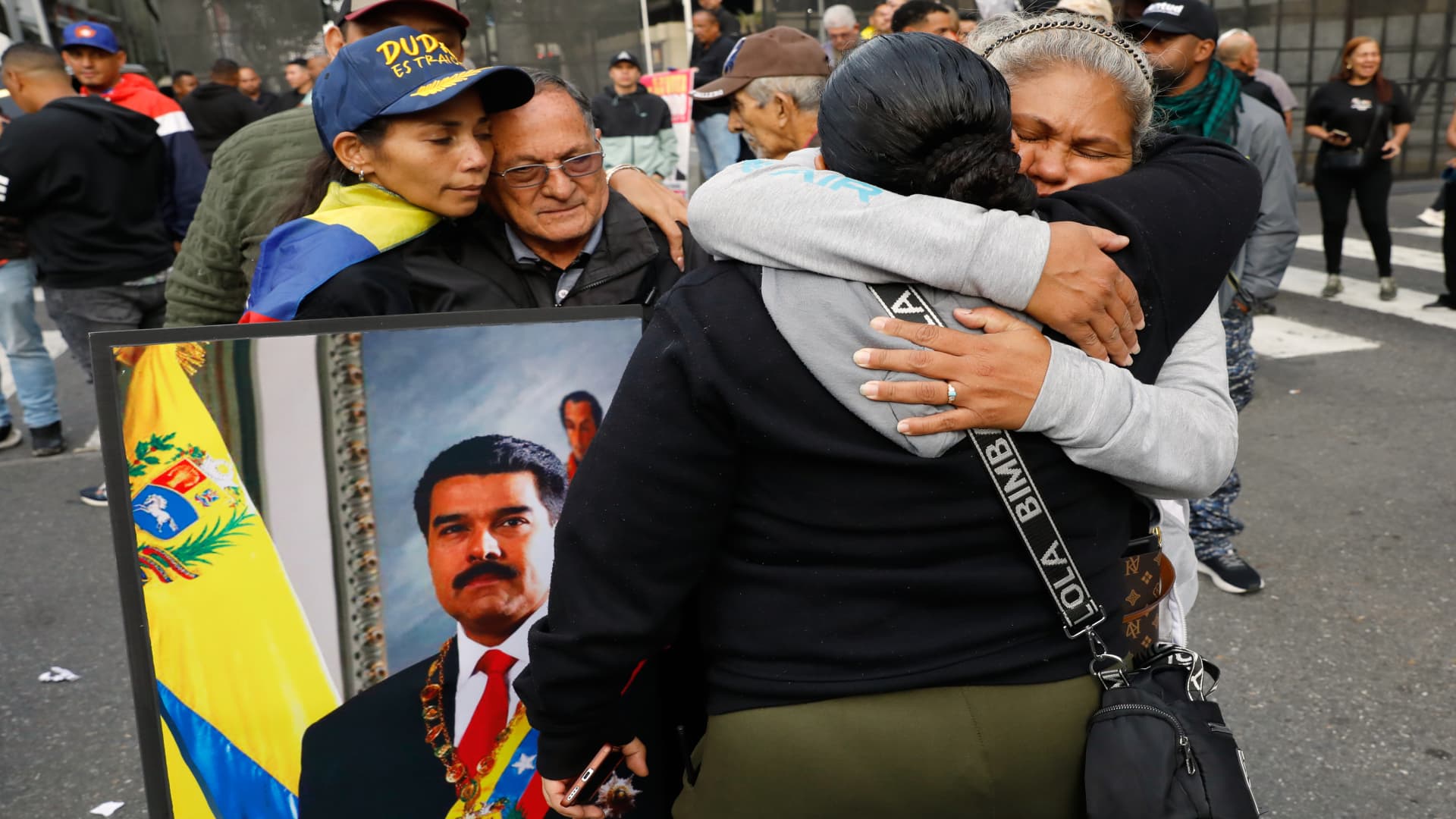
Russia and Iran broadly condemned the U.S. attack on Venezuela early Saturday, while elsewhere, world leaders called for an immediate meeting of the UN Security Council.
UN Secretary-General Antonio Guterres said he is deeply alarmed by U.S. action in Venezuela that sets “a dangerous precedent,” his spokesperson said in a statement.
“The Secretary-General continues to emphasize the importance of full respect — by all — of international law, including the UN Charter. He’s deeply concerned that the rules of international law have not been respected,” UN spokesperson Stephane Dujarric said.
The Russian foreign ministry called Saturday’s strikes on Venezuela “an act of armed aggression” that is “deeply concerning and condemnable.”
“The pretexts used to justify such actions are unfounded …In the current situation, it is important, first and foremost, to prevent further escalation and to focus on finding a way out of the situation through dialogue.”
“Latin America must remain a zone of peace, as it declared itself to be in 2014. And Venezuela must be guaranteed the right to determine its own destiny without any destructive, let alone military, interference from outside.”
The ministry said it was joining Venezuelan authorities and leaders of Latin American countries in calling for an urgent meeting of the UN Security Council.
The UN Security Council is scheduled to meet on Monday over the U.S. action.
Brazil’s President Luiz Inacio Lula da Silva condemned the U.S. military attack on its neighbor, Venezuela, and said the capture of his Venezuelan counterpart Nicolas Maduro, crossed “an unacceptable line.”
“These acts represent a grave affront to Venezuela’s sovereignty and yet another extremely dangerous precedent for the entire international community,” Lula said in a post on X.
Lula also called for a “vigorous” response from the United Nations, adding that Brazil remains open to promoting dialogue and cooperation.
Iran’s Supreme Leader Ayatollah Khamenei said the U.S. is “arrogantly trying to impose something on the country, on the officials, on the government, and on the nation” of Venezuela.
“We will not yield to the enemy,” he said.
Colombian President Gustavo Petro, in a social media post on X, called for a meeting of the UN Security Council, saying the U.S. attack is an “aggression against the sovereignty of Venezuela and Latin America.”
Petro said Colombia also said it is deploying forces to the border “in case of a massive influx of refugees.”
Kaja Kallas, EU high representative for foreign affairs and security policy, said in a post on X that the European Union is closely monitoring the situation in Venezuela.
“I have spoken with Secretary of State Marco Rubio and our Ambassador in Caracas… The EU has repeatedly stated that Mr Maduro lacks legitimacy and has defended a peaceful transition,” she said.
“Under all circumstances, the principles of international law and the UN Charter must be respected. We call for restraint. The safety of EU citizens in the country is our top priority,” Kallas added.
UK Prime Minister Kier Starmer said in a post on X that while his country shed no tears about the end of Maduro’s regime, he reiterated his support for international law.
“The UK government will discuss the evolving situation with US counterparts in the days ahead as we seek a safe and peaceful transition to a legitimate government that reflects the will of the Venezuelan people,” he wrote.
French Foreign Minister Jean-Noel Barrot said the U.S. military operation ran afoul of the principles of international law.
“The military operation that led to the capture of Nicolas Maduro violates the principle of not resorting to force, that underpins international law. France reiterates that no lasting political solution can be imposed from the outside and that only sovereign people themselves can decide their future,” wrote Barrot on X.
Danish Foreign Minister Lars Lokke Rasmussen said international law must be respected.
“Dramatic development in Venezuela, which we are following closely. We need to get back on track toward de-escalation and dialogue,” Rasmussen wrote on X.
In Germany, Roderich Kiesewetter, a prominent member of the conservative Christian Democratic Union, called the U.S. attack a “coup.”
“With President [Donald] Trump, the U.S. are abandoning the rules-based order that has shaped us since 1945,” he said. “The coup in Venezuela marks a return to the old U.S. doctrine from before 1940: a mindset of thinking in terms of spheres of influence, where the law of force rules, not international law.”
Kiesewetter added: “Trump is destroying what was left of any trust in the U.S.”
Maxime Prevot, Belgium’s deputy prime minister and foreign affairs minister, said the safety of its citizens in Venezuels is the European country’s top priority.
“Our embassy in Bogotá, which is responsible for Venezuela, and our services in Brussels are fully mobilized. The situation is being closely monitored, in coordination with our European partners.”
The Spanish foreign ministry urged the U.S. to de-escalate hostilities.
“In this regard, Spain is willing to offer its good offices to achieve a peaceful and negotiated solution to the current crisis,” it said in a statement.
Giuseppe Conte, a former prime minister and current opposition party leader in Italy, said the U.S. operation “has no legal basis.”
“We are facing a blatant violation of international law, which certifies the dominance of the strongest and best equipped militarily… I hope that the entire international community will make its voice heard and that everyone will understand that if rules only apply to enemies and not to friends, no one can feel safe anymore. Nor can the illiberal nature of a government’s rule justify an attack to a sovereign state.”
Yvonne Mewengkang, spokesperson for Indonesia’s foreign ministry, said it is monitoring developments to ensure the safety of its citizens in Venezuela.
“Indonesia also calls on all relevant parties to prioritize peaceful resolution through de-escalation and dialogue, while prioritizing the protection of civilians.”
“Indonesia emphasizes the importance of respecting international law and the principles of the UN Charter.”
In Trinidad and Tobago, Prime Minister Kamala Persad-Bissessar made clear that the country is not participating in U.S. military operations in Venezuela.
“Trinidad and Tobago continues to maintain peaceful relations with the people of Venezuela,” Persad-Bissessar said.
— CNBC contributed to this report.


