


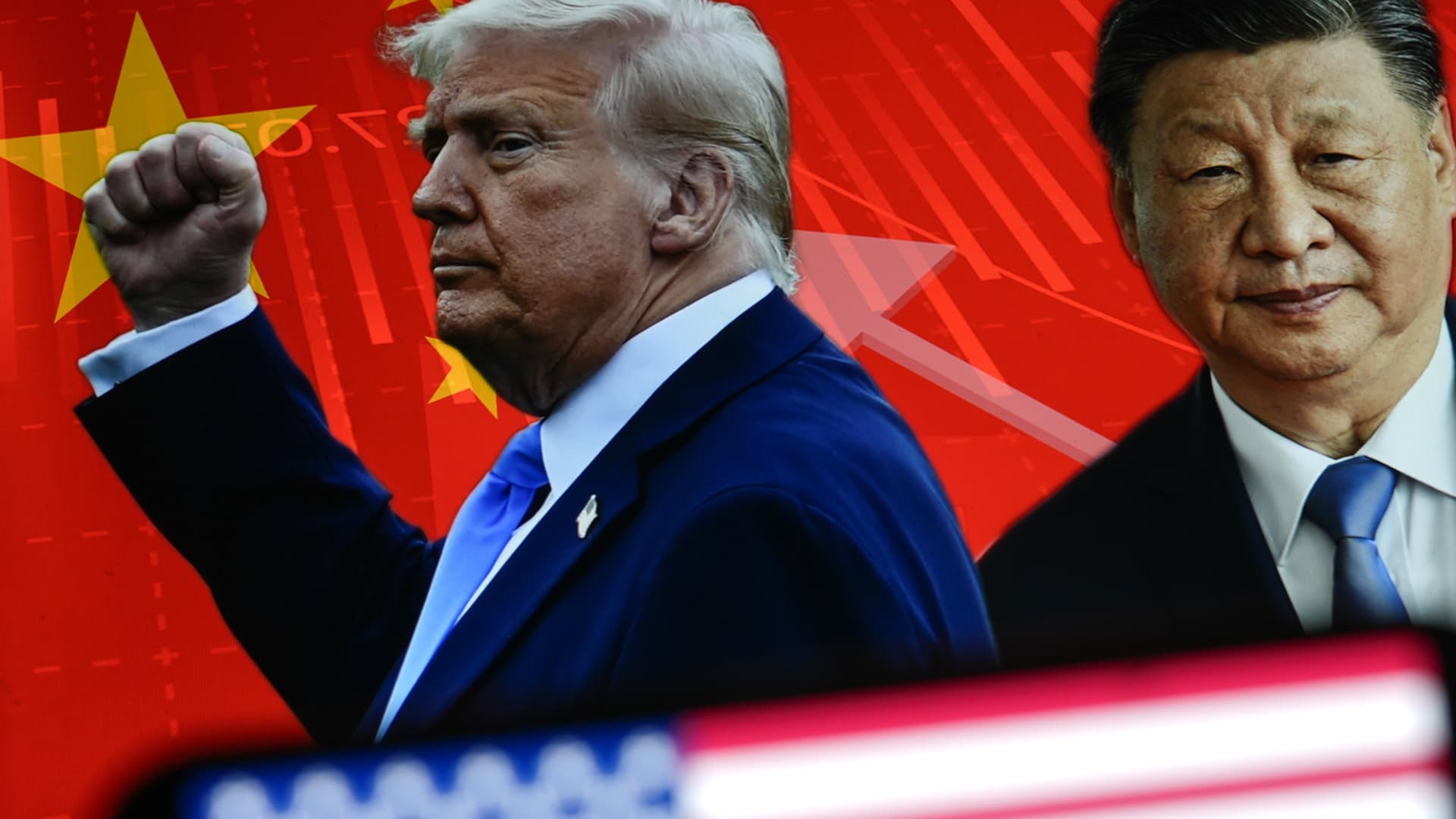
In this photo illustration portraits of US President Donald Trump and Chinese President Xi Jinping are displayed on computer screen as US flag is seen.
Dilara Irem Sancar | Anadolu | Getty Images
In 10 days, Donald Trump captured the Venezuelan president, spooked European leaders with talk of annexing Greenland, and imposed 25% tariffs on anyone trading with Iran. The common thread may be America’s determination to challenge China and its dominance of critical minerals.
By deposing Venezuela’s Nicolas Maduro and taking over the country’s oil industry, the U.S. can curb Chinese access to crucial resources and mining investments. By annexing Greenland, it could keep rivals out of emerging trade routes and, potentially, mining of minerals. By tariffing anyone trading with Iran, as protests threaten the survival of its regime, the U.S. can penalize both the Middle Eastern country and China for buying oil from it.
“The connection here is the U.S.-China rivalry, and to a lesser extent U.S.-Russia strategic frictions,” Dan Alamariu, chief geopolitical strategist at Alpine Macro, told CNBC over email.
“The U.S. simply doesn’t want either China or Russia – or Iran for that matter – operating out of Venezuela. It doesn’t want Chinese economic influence in Greenland, while it wants to counter Russian pushes into the Arctic. And it wants to weaken Iran and Venezuela, which are Beijing and Moscow friendly.”

Russia and China have been attracted to Greenland by the warming of the Arctic, which is melting the ice sheet and making the island’s critical minerals increasingly viable, Guy Kioni, the CEO of Missang, a consultancy, told CNBC’s “Squawk Box Europe” on Jan. 12.
As a result, political and commercial interest in the self-governing Danish territory has increased in recent years. Critical minerals are needed for everything from EVs to aerospace and defense, while new trade routes in the Arctic have also emerged in what’s been dubbed the Polar Silk Road.
Washington is determined to deny such “strategic locations” and resources to its rivals, Alamariu added.
Curbing energy supply
China has a near-monopoly on rare earths. It controls 60% of the world’s mining and more than 90% of processing capacity, per the International Energy Agency.
At the moment, the country has an “untapped advantage,” Kioni said. “Without energy, that advantage then reduces,” he said, noting that annexing Greenland would also give the U.S. access to abundant green energy and help it “come to balance China.”
Kioni added that U.S. actions against two countries that both provide oil to China — Venezuela and Iran — are intended to constrain its energy supply, and processing rare earths is energy intensive.
Venezuela’s cheap oil – of which up to 50 million barrels are expected to flow to the U.S. – may then help Washington secure its own processing capabilities.
Building processing capacity for rare earths is more important to the U.S. than mining them, Alamariu said. “Greenland is important in this context, but not make-or-break.” He added: “To be a great power, a country needs to have cheap power.”
“Neither Venezuela nor Iran are major rare earths producers, though both are obviously major energy ones,” Alamariu said, adding they both have “not insignificant” mining industries.
Critical minerals maneuvers
Trump is encouraging U.S companies to re-enter Venezuela and invest $100 billion there. Chinese companies, many of which are state-owned, have invested $4.8 billion in the South American country the last two decades, per data compiled by the U.S.-based research firm Rhodium Group. Beijing has also loaned Caracas cash, meaning the U.S.’ intervention puts its investments at risk.

China is also heavily invested in mineral-rich Africa. However, the continent’s distance from the U.S. and existing Chinese presence may keep it from being a U.S. target, according to Kioni.
“Greenland is completely different. They are geographically near the U.S., and that’s why it’s important for the U.S., not only to partner, but also to have control over the territory,” he said.
The U.S. created a critical mineral framework with the Democratic Republic of the Congo in December. A similar one for Greenland could be an outcome of Wednesday’s talks between Secretary of State Marco Rubio and Danish leaders representing Greenland, Kioni said.
Australia and Malaysia have also signed deals with the U.S. on critical minerals, but allies will likely be watching events in Greenland closely.
So far, the markets have largely shrugged off threats to use military force. Doing so against another NATO member would make American allies question the benefits of alignment, including countries in Asia, Alamariu said.
“What is the benefit of an ally that asks for parts of your territory? Were this pursued, it would severely weaken U.S. global power, as it will likely lead to loss of major allies,” he said
‘An emerging bi-polar world’
Moving against Venezuela was also about removing “non-American powers from the Western Hemisphere,” Alamariu said, as is agitating to annex Greenland, although that is “potentially far more risky and extremely controversial.”
Iran is farther away, but China is its top trading partner. Trump’s hard line on Iran is partly about the Mideast oil – “and China does import a significant share of its energy from the Persian Gulf” – but also about its nuclear and missile capabilities, support for movements the U.S. designates terrorists, its drive for regional hegemony, and its longstanding enmity with the U.S., Alamariu said.
“The fact that Iran is geopolitically closer to Russia and China is another reason,” he added.
He said that the U.S.-China rivalry was “the main thread” between Trump’s actions, adding this is “increasingly defining the geopolitical and geoeconomic environment. We live in an emerging bipolar world.”
But, while the U.S. seeks to contain or counter Chinese influence, it is not seeking direct conflict with Beijing, Alamariu said, adding that détente and summits between Presidents Trump and Xi are widely expected to happen this year.
An easing of tensions is still possible, he added. However, the announcement of tariffs on Iran’s trading partners could force China to choose between access to the American market and its ally and “scuttle” political dealmaking between the two superpowers.
Laura D. Taylor-Kale, a former assistant secretary of defense for industrial base policy, who is now a senior fellow for Geoeconomics and Defense at the Council on Foreign Relations, said tariffs may be a way for Washington to reduce Beijing’s rare-earths leverage in trade negotiations.
“I don’t think that the President enjoys having others have leverage over him in negotiations, and so the move to be much more independent and to have both the mining and the processing capabilities, either domestic or with close allies and partners, definitely would be, I assume, be a part of that,” she told CNBC’s “Squawk Box Europe” on Jan. 13.
“How long will it take? That’s a different question,” she added
