


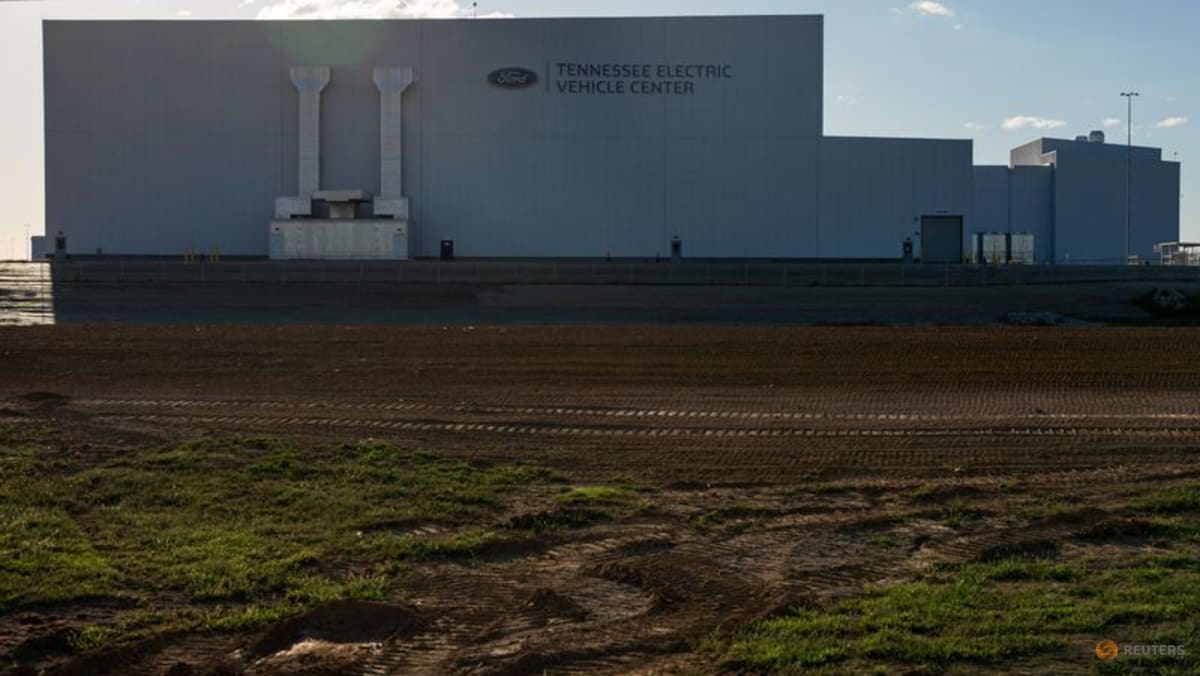
STANTON, Tenn :Stanton, Tennessee – population 450 – welcomed a massive new neighbor a few years ago: a Ford electric-truck and joint venture battery plant slated to employ 6,000 workers.
Ford’s 2022 groundbreaking triggered an influx of construction activity into the former cotton-and-soybean farmlands outside of Memphis. Hard-hatted workers filled local diners. Developers scrambled to build homes and fire stations.
Stanton is quieter these days. Ford over the past 18 months repeatedly delayed phases of the project. The EV truck plant is slated to begin initial production in 2027 and start sending deliveries the next year, a timeline delayed several times from the original plan of coming online in 2025.
Ford said it “will be nimble in adjusting our product launch timing to meet market needs and customer demand while targeting improved profitability.”
The Ford complex is part of the so-called Battery Belt, a swath of factories stretching across the U.S. heartland that spans from Georgia to Indiana. Roughly two dozen battery projects worth tens of billions in investment have been announced this decade, promising to inject tens of thousands of jobs in Republican-dominated states like Georgia and Kentucky.
By last year, though, Americans’ waning enthusiasm for electric cars led automakers to delay or scrap some factory projects. Now, the additional fallout from U.S. President Donald Trump’s recent policy changes is descending on the Battery Belt.
Ford CEO Jim Farley last week offered the prediction that electric-car sales could fall by around 50 per cent following the Sept. 30 expiration of a $7,500 tax credit for buyers, echoing other gloomy forecasts for the EV market.
The uncertain fate of these massive, high-tech factories and their employment has rattled the small rural communities that spent years hitching their economic futures to these projects.
“That’s on everybody’s mind, quite frankly,” said Allan Sterbinsky, who retired as mayor of Stanton in December and advocated for the site for years before Ford came to town. Some residents worry that Ford will never follow through on the plant, the former mayor says. Others hope the company will repurpose the 3,600-acre site if demand doesn’t increase for EVs.
A Ford spokesperson pointed to the automaker’s community work in Stanton, including grants to public safety organizations as part of a broader $9 million commitment to the area.
A Reuters review of U.S. battery-investment plans shows those worries are justified. The industry appears headed toward a huge glut of factory capacity, if all those projects were to move ahead as planned.
By 2030, the planned battery plants would provide the capacity to produce 13 million to 15 million EVs annually, according to figures provided to Reuters by research firm Benchmark Intelligence. But the industry now might only need about one-quarter of that factory space. S&P Global Mobility predicts only around 3 million EVs will be produced that year, and some would likely use batteries imported from other countries.
Some of that excess roughly 10 million-EV worth of battery capacity would likely be used for hybrids and extended-range EVs as well as the booming energy storage industry, but there is still a sizable gulf, said Stephanie Brinley, S&P Global Mobility automotive analyst.
The demise of the $7,500 tax credit – which had been in place for more than 15 years to persuade Americans to try green cars – is only the highest profile of several anti-EV measures put forth by the Trump administration. Combined, they further jeopardize battery projects and other electric-car-related investments, experts say. In the last few months, several automakers have canceled, delayed or downsizedEV projects.
Meanwhile, a pot of tens of billions of dollars available to companies that make EV batteries domestically has tighter restrictions that will likely reduce the amount of federal money that flows to the battery sites.
“All of a sudden, much of what was originally going to benefit from these credits now no longer can to a large degree,” said Jennifer Stafeil, tax auto sector lead for KPMG.
Trump has said he is not anti-EV, but prefers that consumers decide what cars to buy, without government influence. He also has criticized EV-friendly regulations implemented under former President Joe Biden, which Trump has said were costly and threatened American auto jobs.
One of the nation’s largest EV projects, Hyundai Motor’s $12.6 billion assembly plant and joint-venture battery factory near Savannah, Georgia, is moving ahead. Last month the project suffered a setback when federal law enforcement raided it. Hyundai has said the fallout would delay the battery plant by at least two to three months.
In the three years since Hyundai announced the megasite, 21 suppliers have opened operations near the site.
“Hyundai is committed to offering a diverse product lineup, including internal combustion, hybrid, plug-in hybrid, and EV models. We understand that every customer is unique, and we strive to meet a wide range of needs,” a spokesperson said.
The complex is gearing up to hire 8,500 employees by 2031, and is paying wages 25 per cent above the county average, said Trip Tollison, president of the Savannah Economic Development Authority.
Tollison acknowledged that some in the community worry about the uncertain future of the nascent EV industry that underpins all that development. He is hopeful Hyundai can flexibly shift to hybrid production if the EV market doesn’t take off.
“That’s how you provide opportunities like this to lift people out of poverty,” he said.
(Editing by Mike Colias and Anna Driver)
