


O
n a Sunday morning in June, a man took his seven-year-old daughter into a Williamsburg, Brooklyn, coffee shop so she could use the restroom. He bought a coffee to thank them for their kindness, and they went on their way.
Hours later, Poetica Coffee posted a seething message on Instagram, addressed to the man, Democratic Congressman Dan Goldman:
“We see that you stopped by our shop today for a coffee,” the caption read, along with a photo of Goldman taken while at the shop by a surveillance camera. “Do you see how it doesn’t taste like genocide juice? Or are you still having a hard time telling the difference? We don’t serve racists, fascists, homophobes, genocide enablers or anyone in between. Too bad we didn’t recognize you right away, or we would have turned you away. We issued you a refund — we don’t need your money (it’s probably coming from AIPAC anyways). Enjoy your loss on Tuesday. Don’t ever come to Poetica.”
Goldman’s sin, like that of so many in the new Democratic world order, was supporting Israel. Two days later, he would lose a Democratic primary to a far-left progressive opponent — also Jewish — who had made his criticism of Israel a pillar of his campaign.
The Mayor of New York City, Zohran Mamdani, declined to condemn the coffee shop for its blatant act of discrimination. This was lamentable, but unsurprising. Just several days earlier, at a rally for his slate of anti-Israel progressive candidates, he had called AIPAC — the American Israel Public Affairs Committee — “monsters.”
Goldman’s loss in the Democratic primary was mirrored by Mamdani’s wins — several of them. And they were well-earned. Mamdani didn’t just endorse candidates who also made targeting Israel a central part of their platforms. According to The New York Times, he “personally involved himself in everything from candidate recruitment and fund-raising to ad shoots and private strategy sessions.”
Mamdani, the inexperienced but charming democratic socialist who managed to utterly neutralize the Dem establishment machine that very much did not want him to become New York’s mayor, backed candidates who read like characters out of a Portlandia sketch. One believes in abolishing all prisons, eliminating our borders, and permanently ending deportations, including of violent criminals. Another argues that America brought 9/11 on itself. And they all believe in abolishing ICE.

Rep. Dan Goldman (D-N.Y.) lost his primary to former city comptroller and DSA ally Brad Lander.
Laura Brett/Getty Images
Which puts them on the wrong side of a majority of Americans, who — according to the liberal think tank Center for American Progress — support increased border security and agree that illegal immigration is a big problem facing the country.
It’s also put them on the wrong side of the Democratic establishment, exposing a host of ugly internecine fights that are playing out very publicly as competing factions struggle to answer some messy questions in time for midterms.
Will Democrats be the party of Illinois Gov. JB Pritzker or Vermont Sen. Bernie Sanders? California Governor Gavin Newsom or Georgia Senator Jon Ossoff? New York Rep. Alexandria Ocasio-Cortez or Pennsylvania Gov. Josh Shapiro? Are billionaires bad – unless they’re named Tom Steyer? Are populist, conspiracy theorist influencers like Joe Rogan a force for evil – unless the left can find one of its own? Should controversial influencers like Hasan Piker – who has defended both Hamas and the 9/11 attacks on America – be a media stop for would-be 2028 hopefuls? And how much should character – like that of Graham Platner or Arizona Sen. Ruben Gallego – matter, when the stakes are so high?
While Mamdani and progressives are celebrating their effective shivving of more establishment lawmakers and pushing the Democrats further to the left, they’d be wise to learn from very recent history that this sort of radical migration doesn’t bode well for the party — or the country.
I should know. I watched the Republican party implode from the inside.
PRACTICALLY SINCE THE moment Donald Trump descended down that golden escalator in 2015 to announce his run for president, political analysts and stenographers of history have been attempting to forensically identify exactly when, why, and how the Republican Party — the same one that nominated Barry Goldwater in 1964 and Ronald Reagan in 1980 — became such a ripe target for hostile takeover by a guy with no experience, no principles, and no affection for either the Constitution or the conservative movement.
Indeed, it was quite a feat — and the GOP has enjoyed the resulting electoral successes. But more ecumenically, it also prompted the party’s inarguably deleterious shift toward authoritarianism, fascism, and nationalism. Not to mention deep unseriousness. (We’re supposed to buy a party’s stated commitment to law and order when its figurehead is himself a convicted felon who pardoned violent cop-attackers?)
Thanks to Trump’s capricious and self-interested policy pursuits and his personal peccadilloes, the party willingly abandoned a number of long-held orthodoxies, as well as any moral or practical high ground on issues as disparate as family values, foreign policy, fiscal responsibility, and government corruption. The thing that binds the Republican Party and what’s left of the conservative movement together today is whatever Trump just said last.
Few inside the GOP have seemed to care, so long as it’s meant more electoral wins, power, and money in their coffers. Those that did were shown the door. But self-immolation for near-term gains will eventually catch up with them when it can no longer keep purifying the party for Trump and appeal to enough voters to win nationally. At least, that’s the hope among many of us who were once part of a robust and principled conservative movement that no longer exists
I witnessed this collapse firsthand, while on my way to becoming a political exile myself.
In 2000 I’d graduated college and moved to New York City to start my journalism career. With an apartment in Murray Hill, Manhattan’s first stop for twentysomethings, eventually a job at The New York Times, nights stalking dive bars and live music joints in the East Village, and a pursuit of Carrie Bradshaw’s shoe collection, I certainly had all the trappings of “cool college grad.” But I also had a secret: I was a closet conservative.
Back then, being a Republican meant supporting normal-sounding things like limited government, lowering the debt and deficit, and a strong national defense. The cultural and social issues were important to many in the movement, but not all — and there was plenty of room for deficit hawks like me at the table, right next to Ralph Reed’s Christian Coalition, Irving Kristol’s neocons, the Federalist Society’s originalists, and Ron Paul’s non-interventionists. It was the definition of a big-tent party.

New York Mayor Mamdani flexed his political muscle in the primary this year and won victories for DSA candidates at the expense of establishment Democrats.
Andres Kudacki/Getty Images
Even in those salad days, conservatives weren’t cool, but at least we were principled, we reassured ourselves. Raised on the intellectual canon of Edmund Burke, Alexis de Tocqueville, Friedrich Hayek, Ayn Rand, and Russsell Kirk, we were undergirded by philosophy, orthodoxy, and most importantly, ideas. Ideas were the thing that brought us out of the political wilderness in the 1960s.
And whatever you thought of those ideas, there’s no arguing they were immensely popular. The 1980 presidential election was an historic landslide victory for Republicans, with Ronald Reagan carrying 44 of 50 states, winning 489 electoral college votes and the popular vote, and beating Jimmy Carter by nearly 10 points.
The 1984 election was even more resounding for Reagan and the right. He won 49 states, 525 electoral college votes, the popular vote, and beat Walter Mondale by a whopping 18 percentage points. By the early 2000s, those same ideas were still animating the right, chief among them an attention to fiscal responsibility. That was due in large part to a new group on the scene called the Club for Growth.
Founded by economist Stephen Moore in 1999, the political action committee set out to be “the tax cut enforcer in the party.” It was laser-focused on cutting taxes and spending, balancing the budget, lowering the debt and the deficit, free markets and free trade, and ending earmarks and pork. Finally, there was a club for me.
I watched with unbridled glee at the time as the Club began targeting Republicans for their fiscal irresponsibility. The group launched a “RINO [Republicans in Name Only] Watch” list and began actively primarying conservatives who were seen as insufficiently austere. As Moore said in 2003, “We want to take over the party’s fundraising. We want it to be, in 10 years, that no one can win a Senate or a House seat without the support of the Club for Growth.” And in one year, by 2004, the Club became the single largest fundraiser for GOP House and Senate candidates, outperformed only by the party itself.
That year, in an effort to assert its importance, it set its sights on a very big fish: Pennsylvania’s longtime senior Senator Arlen Specter. “If we’re going to be a major political force,” said Moore, “we have to defeat one of the incumbent RINOs.”
The Club backed Republican Rep. Pat Toomey and spent $2 million in ads painting Specter as insufficiently conservative, especially on fiscal issues.
But, the party establishment, including George W. Bush, still backed Specter, who narrowly avoided an upset by winning 51 percent of the vote. He’d go on to win the general.
Toomey would become the Club’s new president in 2005, and eventually he’d win Specter’s seat in 2010, but in the years in between the Club became a thorn in the side of the party establishment who thought it impolitic to go after their own. Republican Rep. Tom Cole, who was then appointed head of the National Republican Congressional Committee, a job explicitly focused on getting Republicans elected to Congress, said in 2008, “The problem I have with the Club is I think they’re stupid. They spend more money beating Republicans than Democrats.”
Bush’s political advisor, Karl Rove, also called the Club’s ads attacking incumbent Republicans like Sens. George Voinovich of Ohio and Olympia Snowe of Maine “stupid” and “counterproductive.”
While the group’s focus on fiscal responsibility may have titillated me, Cole and Rove were right. These primary efforts were both stupid and counterproductive, not only because they were expensive and unsuccessful — Specter, Voinovich, and Snowe all won their primaries in 2004 — but because they telegraphed to Democrats that ours was a party divided, and those divisions could be exploited.
THEN CAME THE FINANCIAL crisis, and divisions within the GOP became a chasm. The Club’s RINO-hunting efforts gained momentum, especially after Bush bailed out the banks in 2008. His Troubled Asset Relief Program, or TARP, which authorized the Treasury to purchase up to a whopping $700 billion in distressed assets to stabilize the American economy during the global financial crisis, was condemned by the Club, which threatened to primary any Republican who voted in favor of it. This moment is often credited (or blamed) for the advent, a year later, of the Tea Party — a new wave of anti-establishment, fiscally conservative, and decidedly populist conservatives that would soon take on all the RINOs.
Under this new world order, the RINO label wasn’t just meant for the big tax and spenders, but for anyone deemed insufficiently conservative. Suddenly, anyone who didn’t back Republican extremism on fiscal, social, cultural or even foreign policy issues was a RINO, a cuck, a squish.
It was in this bubbling environment of right-on-right crime that Republicans nominated Sen. John McCain, a longtime moderate who’d made a habit of pissing off his party when it needed him most — voting for the Civil Rights Restoration Act of 1987, voting to confirm President Bill Clinton’s Supreme Court nominees, Ruth Bader Ginsburg and Stephen Breyer, and pushing campaign finance reform, to name a few examples.
Despite his much-deserved hero status, in a party that was already seeing fissures, McCain was hardly a unifying choice.
“McCain is straining to appease a conservative movement that is too fragmented to be appeased,” wrote Allan Lichtman in Politico in 2008. “Like Humpty Dumpty after the fall, all the GOP’s horses and all the GOP’s men cannot put together again business and social conservatives, big-and small-government conservatives, tax-cutters and deficit hawks, and foreign adventurers and advocates of the humble foreign policy that Bush proposed in his 2000 campaign but quickly abandoned.”
Four years later, it was the same story. Mitt Romney, the well-liked former Massachusetts governor, was next in line for the nomination for president, but the party was even more divided than it was in 2008. While a majority of Republican voters agreed Romney was the most likely to beat Obama — some might say the most important metric — Republicans were deep in their feelings and entrenched in their camps.
Romney’s original sin? Implementing mandatory health care while governor of Massachusetts. Nearly half of Republican voters said they were less likely to vote for him because of that.
Enthusiasm inside the Republican Party for either McCain or Romney was lackluster at best — and it was reflected in turnout. In 2004, Republicans increased their voter turnout by 11 million from 2000, giving Bush the win. But in 2008, with McCain on the ballot, Republican turnout dropped by 2 million. In 2012, it dropped again.
There were all kinds of factors impacting those two races, but it’s inarguably astonishing to think that in 2008 and 2012, Republicans nominated two of their best candidates in modern history, at least on paper — one a war hero and giant of the Senate, the other a successful businessman and popular governor. Whatever you thought of their politics, both men were decent, smart, and upstanding. And yet, neither were good enough — in many cases, for voters who self-identified as Republican or conservative.

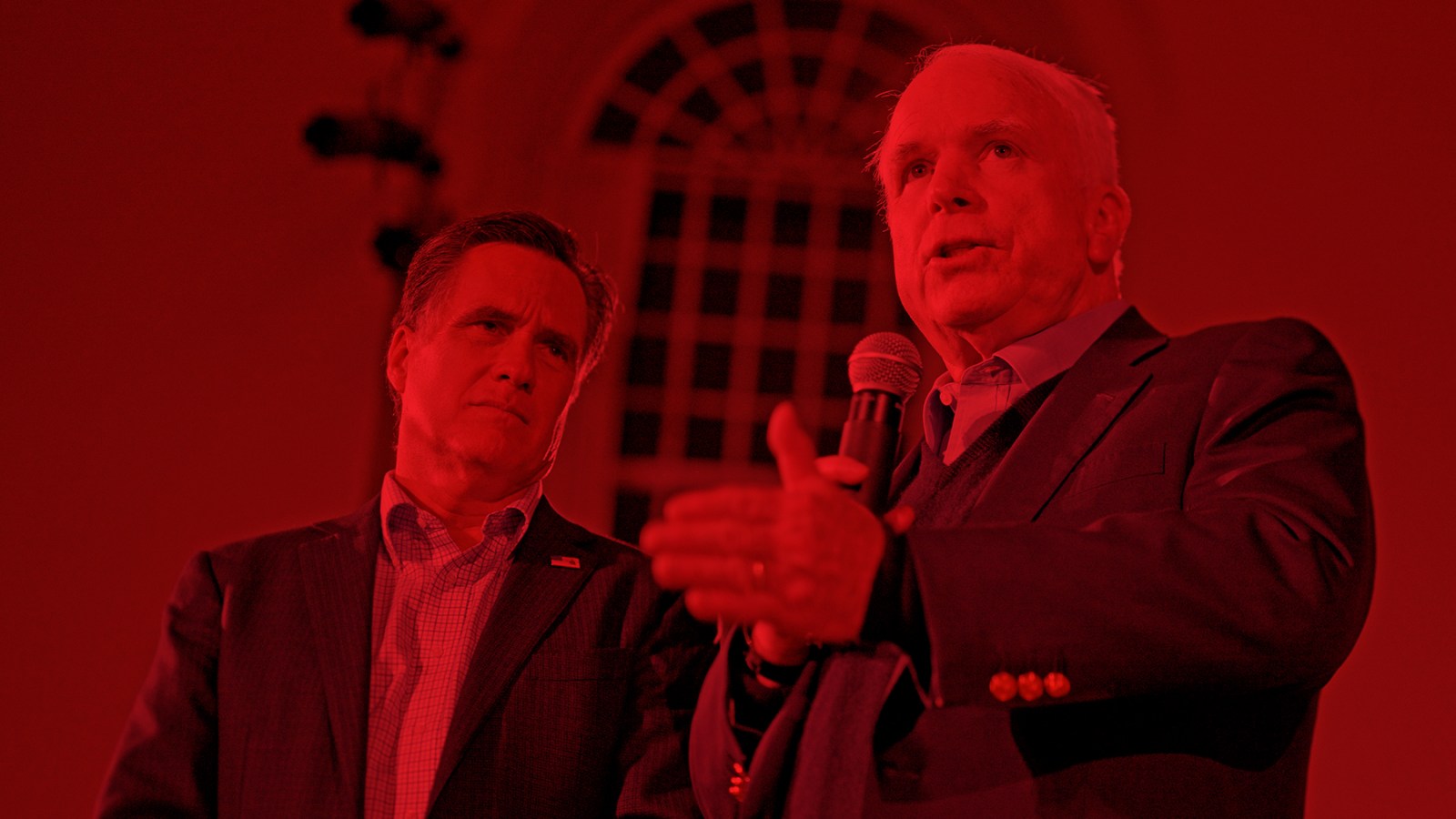
Then President-elect Donald Trump and Sen. Mitt Romney at dinner in 2016. Romney would leave the Senate after clashing with the president and the MAGA wing of the party. Romney voted to impeach Trump over the attempt to overturn the 2020 election.
Drew Angerer/Getty Images
The Club for Growth kickstarted a purge that would last another 20-plus years. In 2014, former Heritage Foundation leader Jim DeMint would famously mount a purification campaign to primary incumbents – with candidates like Delaware’s Christine “I am not a witch” O’Donnell – and said aloud what many already knew: “I’d rather have 30 Marco Rubios than 60 Arlen Specters.” Ideological purity now meant more than winning.
That’s what happens when a party starts doing the three P’s: purifying, primarying, and purging. Suddenly and swiftly, no one looks good enough, no one ticks all the boxes. Former stars of the party become squishes, onetime stalwarts become apostates, and identifying heretics becomes far more important than identifying converts. Subtraction, not addition, becomes the perverted point. The party became like a can of frozen orange-juice concentrate — with no one adding water to make it expand or taste good.
It’s a never-ending cycle of self-sabotage that trains voters to want more and more purity to the point of cartoonish extremism.
ENTER DONALD TRUMP in 2015. The lore that’s been concocted around Trump’s admittedly swift takeover of the Republican Party vastly overestimates his role in it. Initially, Trump wasn’t all that politically talented. He benefitted from a crowded field and a voter base that had been conditioned over the past decade to loathe their own party. He didn’t even win a majority of Republicans’ votes to become the nominee; he won just 44.9 percent of the total popular vote in the Republican primary — just a plurality.
This isn’t to diminish what is now his impressive grip on the GOP, but to state the obvious, which is that Trump exploited a weakness that the Republican Party had created for itself by purifying, primarying, and purging to the point of self-destruction. Disillusioned from disappointment, broken promises, and endless wars, Republican voters weren’t being persuaded by conservative principles, character, or ideas anymore — they were being persuaded to burn it all down.
That project has only worsened as Trump’s sunk his claws into a voter base that’s largely forgotten what conservatism is or what Republicans once stood for.
Trump now oversees a party that’s exploded the debt and the deficit; that’s embraced protectionist trade policies that have weakened our economy; that’s chucked ethics and morals out the window because he has neither; that embraces dictators like Vladimir Putin and Victor Orban; that creates crypto scams and meme coin grifts off of its own voters’ blind loyalty to Trump; that engages openly and nakedly in self-dealing, cronyism, nepotism, and large-scale corruption.
The purity and purging project of the past quarter century may have turned the GOP into a formidable Trump-centric machine, but it’s also left the party smaller and weaker. It may briefly make successful appeals to new voters but it cannot retain them, certainly not with the president’s polling cratering to the low 30s.
The insidious destruction of the conservative movement and Republican Party — by conservatives and Republicans — may have manifested in ways that seem to contradict the notion of “destruction.” Republicans, after all, control all of Washington, added three Supreme Court justices to the court, and won the presidency twice in eight years. But obviously winning cannot be the only metric of a healthy party. Not if we want a political system that adequately represents American voters, not if we want a government that is functional, not if we want our allies to trust us, not if we want our enemies to fear us, not if we want our children and our grandchildren to want to invest in solutions, not if we want to do better than our current state of chaos, division, intransigence, and incompetence.
THE LEFT, SIMILARLY, seems to be flirting with self-destruction, and can’t seem to right the ship.
That’s not just evidenced in the precarious position DNC chair Ken Martin currently occupies, with mind-boggling revelations about his 2024 failures and its $100 million cash shortfall versus Republicans as midterms approach. As one Dem operative told me, “If you can’t win elections and you can’t raise money, what exactly are you good for?”
But increasingly influential voices on the far-left are pushing unpopular and unserious policies to remake and purify the party.
Hasan Piker, the 33-year-old Mao-cosplaying Twitch streamer and coveted ally of up-and-coming far-leftists, is fashioning himself arbiter of progressive purity. A self-proclaimed socialist, he routinely extols the virtues of communism without a hint of irony, enjoying a massive personal wealth and freedom of speech no communist country would ever allow.
He asks progressive candidates who come to kiss the ring litmus test questions about Medicare for All, abolishing ICE and prisons, and, of course, Israel.
“In your 2020 DFLIA questionnaire, you said that you don’t support Boycott, Divestment and Sanctions, BDS, and that you support Israel’s right to exist. Has your stance changed since then?” he asked Nithya Raman, the Democratic socialist running against incumbent Los Angeles Mayor Karen Bass.
Of course, the next mayor of LA will not have much say over whether Israel should exist, but this line of questioning has consumed the far-left, whose candidates ran in places like New York City and elsewhere largely on the issue of Israel.
Piker speaks like the very online personality he is. “The whole California gubernatorial race is so black-pilling honestly because Xavier Becerra is so ass,” he said on one of his live streams.
The appeal of that kind of unvarnished “real talk” is understandable, and what helped sell Donald Trump to millions of voters. But Piker also seems to share Trump’s determination to break his party open and remake it in his image, even if that hurts the party in the long term.
“I’m a very stubborn person,” Piker has said, “so I’m going to continue doing it until either they put me in prison or until the Democratic party says ‘enough is enough, it’s now illegal to be a socialist or a communist and run for the Democratic ticket.”
This kind of purity testing and defiance is alienating other coalitions that were once considered important to Democrats.
Progressive anti-Israel Senate candidate Abdul El-Sayed, who beat moderate Haley Stevens to become the Dem nominee for Michigan Senate, earned the ire of Democratic party elder Rep. James Clyburn of South Carolina, who told Punchbowl, “I saw a picture that concerned me [from a Detroit] rally. I didn’t see a single person that looks like me. That tells me all I need to know.”
Over in Michigan’s 7th District, William Lawrence, a white climate change activist running for Congress, got backlash after he disparaged some Black lawmakers on aid for Israel, accusing them of being “a pillar, frankly, for establishment, capitalist, imperialist American power.”
The PAC for the Congressional Black Caucus released a statement on social media declaring that “Anyone supporting William Lawrence should denounce his hateful remarks and withdraw their support.” Lawrence later walked the comments back.
Importantly, Haley Stevens, El-Sayed’s opponent, led among non-college-educated and Black voters before losing her primary – the very voters Bernie Sanders insisted the establishment had abandoned and progressives were winning back. Now the question is, will they vote for El-Sayed in the general? Or stay home?
And are progressives winning certain kinds of voters at the expense of others – including Black and working class voters who were once foundational to the Democratic coalition?
I talked to Obama White House veteran David Axelrod about these internal fights, and the direction the far-left clearly wants to take the party.
“There is a real danger of winning the primaries and losing the war,” he said. “An opposition party that is unified to the degree it can be in a big, diverse country has a better shot than one that is at war with itself. And Republicans will seize on the most extreme voices to create boogeymen and women to try and caricature the party in some swing districts or states.”

Protestors at a No Kings anti-Trump demonstration at the Vermont State House in Montpelier, Vermont.
John Lazenby/UCG/Universal Images Group/Getty Images
IN THE YEARS since the Club for Growth began RINO hunting and purity testing, a full quarter century, the group has maintained a presence but lost much of its relevance as Trump blotted out the sun that was the conservative movement and everything it once cared about.
The RINO hunting project that the Club started in the early 2000s devolved to its logical conclusion, perhaps, in 2022, when a GOP candidate for Senate in Missouri released a campaign ad in which he and a group of armed men in tactical gear busts into a house looking for RINOs to hunt.
“Get a RINO hunting permit,” says a shotgun-wielding Eric Greitens, the former Missouri Governor who resigned in 2018 amid a sexual misconduct and campaign finance scandal. “There’s no bagging limit, no tagging limit, and it doesn’t expire until we save our country.”
Greitens came in third – in the Republican primary.
I recently asked Pat Toomey about his thoughts, many years after leaving the Club as its president. He expressed zero regret and instead defended the policies that were overwhelmingly popular inside the party, economic policies like free markets, limited government, economic freedom and fiscal discipline – the policies that drew me to the Republican party in the first place.
“The RINO hunting in that era was about enforcing policy positions that were very nearly the unanimous consensus among Republican voters, had been for decades, were advocated by members of Congress, but then there were people that just didn’t live up to that.”
That’s true, of course. And the kind of RINO hunting Trump is participating in today looks nothing like the Club’s.
But that’s like saying “Our war on our own was principled.” It was still a war, it still weakened the party, it still purged good conservatives, it still opened the door for Trump – and more insane purity tests.
Mamdani, El-Sayed, Piker, Bernie, et al may feel righteous in purging their party of what they might call DINOs – moderates, squishes, and establishment hacks. And the party establishment may feel confident that swinging to the center is the better way to recapture the moderate middle, working class voters, and minorities that they’ve lost.
But if the party is to survive, it cannot fight itself with more vigor than it fights the right. It cannot call itself a “big tent” if the establishment is telling socialist candidates they can’t run as Democrats and the progressives are purity testing everyone who comes their way.
Democrats have my sympathy. These internal fights are never fun, and if one side wins it means the other side – still your people – loses. It shrinks the tent, it projects vulnerability, it destroys people and principles and policies.
Axelrod put it this way: “You win elections by building coalitions around big, pressing issues that unite the largest number of people, not by excluding those who may disagree with you on some things that are a less universal concern.”
“Is that advice for the moderates or the progressives?” I asked him, earnestly.
“Well, both!”
The good news for folks like me, stuck in political exile, who don’t feel either party fully represents them, is that we’re a growing voting bloc. The disaffected conservatives repulsed by MAGA and the disillusioned Dems abandoned by the far left are finding common ground in our distrust of both and willingness to give our vote to anyone who sounds principled and, well, normal. And if the parties keep purifying to cartoonish extremes, they might just purify themselves right into irrelevance.
