


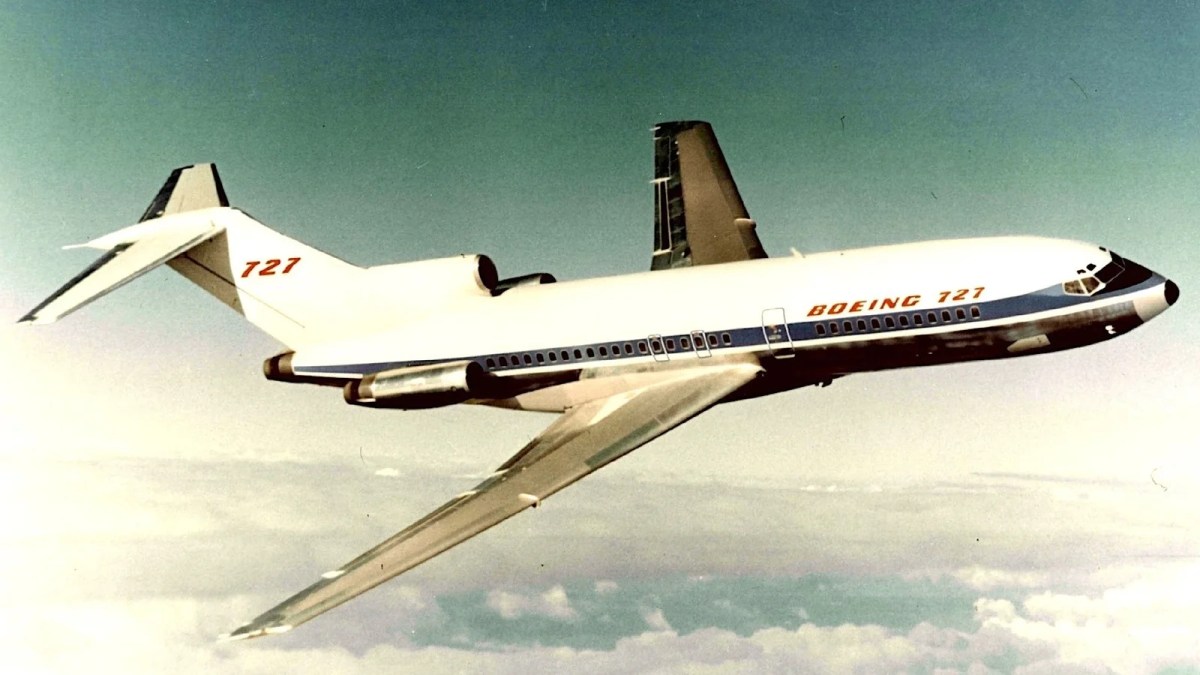

Few planes have left their signature on the jet age as indelibly as the Boeing 727. Designed in an age of cutthroat competition and continuous innovation, the tri-jet was a global workhorse overnight. It bridged the gap between the glamorous early jetliners of the 1950s and the fuel-efficient twin-engine aircraft that would go on to conquer the skies.

By the beginning of the 1960s, Boeing’s long-haul 707 was a hit, but the competition was fast catching up. Douglas had launched the DC-9, a short-to-medium range jet that was economical, user-friendly, and ideal for high-utilization routes.

United and Lufthansa were some of the carriers piquing Boeing’s interest to respond, and while the initial 727-100 was a hit, it was not as economical and did not have the amount of capacity necessary to hold on to ground. Boeing knew it had to change.

The company launched a twin-branched strategy. In 1968, it launched the 737 to battle the DC-9 head-on. At the same time, Boeing lengthened the 727 into a new plane—the 727-200. It featured an over six-meter-long fuselage, up to 189-passenger seating capacity, and lower cost per seat, but with the same performance pilots loved. Big U.S. carriers like United, American, and Eastern placed large orders, and Air France was the first continental European airline to put it into service.

However, the stretch came at a cost. The 727-200’s range and capacity were smaller than those of some rivals, and its takeoff thrust was lower than that of the original 727-100. It became especially evident at high-altitude airports in Mexico and South America, where thin air reduced lift. Mexicana even used rocket-assisted takeoffs for a time to fix the issue—a flashy but short-term fix.

Boeing’s actual solution in 1973 was the 727-200 Advanced, which was initially delivered to Lufthansa. The upgrade featured more efficient Pratt & Whitney JT8D-15 engines, larger fuel tanks, aerodynamic enhancements, and newer interiors. Its arrival couldn’t have been better timed. It was in the same year that the OPEC oil embargo compelled airlines to cut fuel burn. The Advanced version gave carriers the efficiency they needed without giving up the familiar performance and reliability they needed.

Besides passenger service, the 727 was also a very handy freighter. FedEx and others made the 727-200F a workhorse of their fleets, with 24 tons of cargo capacity. But by the 1980s, fuel costs were higher, and noise restrictions were becoming more stringent, so the three-engine configuration was less attractive. Each plane costs around $34 million, and airlines started shifting toward newer twin-engine models that consume less fuel.

In spite of this, the 727 remained a workhorse of airline fleets for several decades. United Airlines operated 230 of them, more than any other operator, and Delta Air Lines had 191, including milestone aircraft like the 500th and 1,000th built. Delta president Frederick W. Reid well summarized the importance of the type thus: “The Boeing 727 was a sleek and rugged workhorse of Delta’s fleet for over 30 years.” It was a big part of our company’s growth.” Delta finally retired its last passenger 727 on April 6, 2003, ending an era.

Like with most of the great planes, the 727 also had its own share of disasters. Through its lengthy history, it was involved in 353 accidents and claimed more than 4,000 lives. Some of the most notable ones were United Airlines Flight 389 in 1965, Eastern Air Lines Flight 66 in 1975, and Mexicana Flight 940 in 1986, which was Mexico’s worst aviation disaster.

727 production ended in 1984 after 1,831 had been manufactured in Boeing’s factories. Though its numbers were subsequently eclipsed by the 737 and Airbus A320 families, the 727’s influence was unquestionable. The 727 opened up airline networks, flew tricky airports with ease, and served to close the gap between the early jetliners and modern aviation.

With something more than merely another mass commercial airliner, the Boeing 727 was a plane that pilots liked to fly—responsive, dependable, and full of character. It was a moment of transition in aviation history, taking the zeal of the early days of the jet age into a new era of global travel.
