


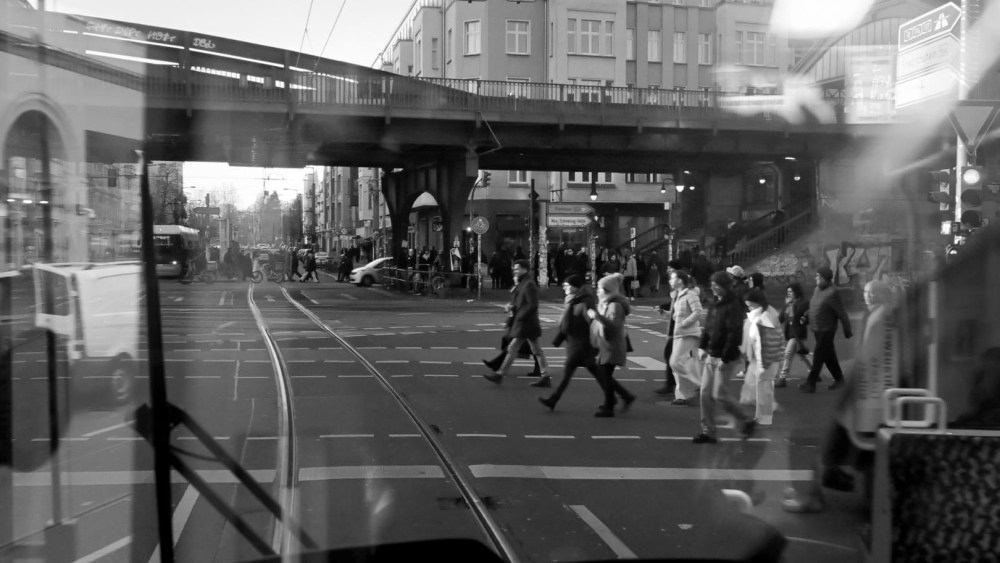
Thomas Heise‘s final film, “Übergang,” arrives at the Locarno Film Festival as both a portrait of one of Germany’s most influential documentary filmmakers and the completion of a project left unfinished by his death.
Premiering in the festival’s out of competition section, the film traces Heise’s life through newly shot footage, archival material and photographs, sewing together a meditation on time and transition.
Heise, whose body of work chronicled the lives of ordinary people across East Germany during reunification and the decades that followed, began developing “Übergang” as a portrait of Berlin’s Schönhauser Allee before his death in 2024. Longtime collaborators Peter Badel and Chris Wright ultimately completed the documentary, shaping a film that explores the filmmaker’s life and enduring relationship with German history.
Produced by Ma.ja.de. Filmproduktion, “Übergang” at once imports you to Schönhauser Allee through patient, black and white street-level scenes of normal life: commuters boarding a tram, quiet revelers at a carnival, a couple in conversation. Voice over paints the picture of the man behind the camera, and through carefully placed interview vignettes of Heise, the observer becomes the observed. “Übergang” draws together contemporary observations set against Heise’s experiences growing up in East Berlin to shed light on the political and social transformations that defined both his life and art.
Variety spoke with co-directors Peter Badel and Chris Wright ahead of the film’s world premiere at Locarno.
The title “Übergang” suggests a transition or a passage. When did this emerge as the central theme of the film?
Peter Badel: Here we are referring to a draft text that Thomas Heise wrote during the preparatory phase of the project. He was drawn to the dual meaning of the term “Übergang.” The film is largely shot around the station on Berlin’s Schönhauser Allee, a busy interchange between public transport lines, but the title also hints at the idea of change in society. Our film covers the period of transition from East Germany to the fall of the Wall and beyond. That includes the current climate of war and rearmament, and the shift away from the traditional politics of the left and right toward a direction that seeks to make us forget the lessons learned from two world wars and a Europe destroyed by the Nazis. For Chris and me, there was never any other title for the film than the one Thomas had chosen.
Was it difficult to preserve Thomas’s artistic voice and vision while creating a new work after his death?
Chris Wright: Thomas wanted work on the film to continue unchanged after his death. But of course, that was an impossible task, because his death changed everything. We decided it was vital that it become our own film, and that we make our own decisions about how to shape it. But at the same time, everyone working on the film had a long history of collaborating with Thomas. For me personally, that meant I could often almost hear his voice in the edit, saying, “Let’s try a scene like this. Let’s put that in. Let’s leave that out.” His aesthetic had become almost second nature.
Badel: Another big factor was Thomas’ personal archive, which his husband Michael gave us full access to. Going through all that material, Thomas remained a critical and productive partner for us even after his sudden death. Of course, we missed his proven ability to cut things and, in doing so, amplify the fragmentary nature of his work. But I believe we remained true to his playful spirit.
How did you bring the various elements of the film (new footage, archival material, photos and text) together into a single narrative?
Badel: First we explored approaches that proved to be dead ends. I shot lots of interviews with friends and collaborators, for example. We also tried to incorporate too many aspects of Thomas’ work. Then Chris had the idea to take a break and go through all the original archive recordings of Thomas we could find to see how they worked cinematically.
Wright: I wanted the film to incorporate as much unseen, or hardly seen, material as possible. So there are lots of outtakes (particularly from Thomas’ last film, “Heimat is a Space in Time”), VHS footage we found on tapes and hard drives, diary excerpts, unpublished texts and archive interviews. As much of the film as possible is told through new combinations of his own words and images. The fragmentary montage remains true to his approach. We don’t explain exactly where the materials come from. What is important is the dialogue they enter into with each other. At the same time, it was vital not to make a homage or an anecdotal work. We wanted the film to take a similar approach to Thomas as a character as “Heimat” took toward his own family. We tell a story of lived history, the way the emotions and experiences of a life can be shaped by the politics and society it takes place in.

Courtesy of Peter Badel, Chris Wright
The film’s final scene condenses a great deal of meaning into a single moment. Can you describe how you came across this interview and this quote?
Badel: During the many days of filming at Schönhauser Allee station, we frequently encountered Michael, whom we observed (sometimes up close, sometimes from a greater distance among all the passers-by) as he waited for spare change at his spot by the subway stairs. We talked with him about the social divide around the station and discovered that he knew Thomas Heise by sight. He had also heard about Thomas’ death.
Wright: Time and transience were two of Thomas’ biggest concerns in his filmmaking. And here, it is this homeless man, begging for change, who names them. Thomas often put unnoticed lives at the center of his films. So it only seemed fitting that Michael should have the last words in this film about Thomas.
What do you hope the audience will learn about Thomas Heise through “Übergang?”
Badel: I would be very pleased if Thomas’ remark about this film: “The author is a character in the film,” has become tangible and vivid through our work. And I hope that even people who don’t know much about him will find his fascinating way of thinking about and presenting time inspiring.
Wright: I think that, with Thomas, we’ve lost an important critical voice for our times. I hope the film will remind people that it’s vital to keep questioning the status quo. Otherwise, as Thomas says, things can easily change for the worse, and you won’t notice until it’s too late.
