






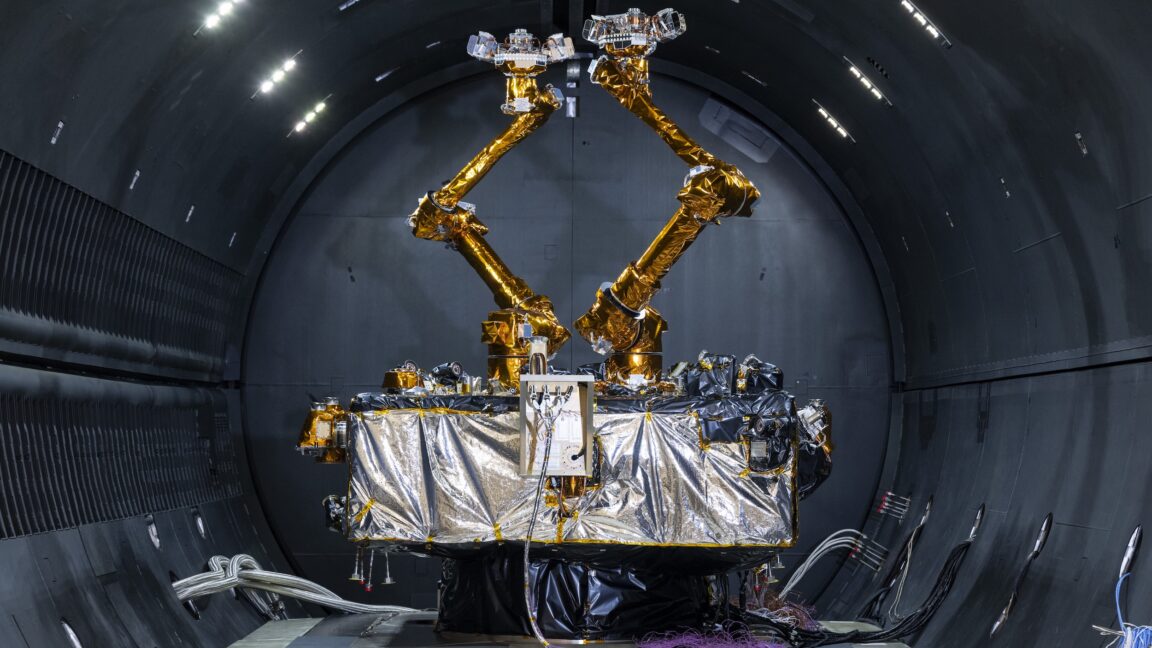

DARPA partnered with the Naval Research Laboratory to develop the RSGS robotics payload. More than 20 years in the making, the robotics system was designed to meet Defense Department reliability standards, including redundant robotic arms, avionics, and mission troops. The RSGS payload also features cameras and sensors to allow the MRV to autonomously approach, inspect, capture, and upgrade client satellites that weren’t designed for visitors.
“This journey to the launch pad represents the culmination of a multiple decades-long endeavor of vision, risk, and relentless engineering,” Bernard Kelm, acting director of NRL’s Naval Center for Space Technology, said in a statement. DARPA first funded NRL’s space robotics work in 2002, a small study for a concept called RescueSat. RSGS can trace its lineage back to that initiative.
“RSGS is designed to permanently change this ‘launch-and-abandon’ archetype,” Kelm said. “The RSGS program shifts this paradigm by enabling on-orbit interventions, including inspections, mechanical anomaly resolution, satellite relocation and upgrades.”

This isn’t DARPA’s first foray into satellite servicing. The agency’s Orbital Express mission, launched in 2007, completed several months of rendezvous and docking maneuvers, robotic arm tests, and other servicing demonstrations in low-Earth orbit. DARPA formally established the RSGS program in 2015, building on the robotics work already underway at the Naval Research Laboratory. DARPA initially selected Maxar—now Lanteris Space Systems—to partner on the RSGS program, but the company backed out, and DARPA replaced Maxar with Northrop Grumman in 2020.
NASA’s Goddard Space Flight Center also contributed its engineering expertise to the RSGS program after NASA canceled its own robotic satellite servicing mission in 2024. NASA’s support included the development of dynamic simulation and analysis tools, software verification, and a team of flight robot operators to assist ground controllers during mission operations.
“RSGS is designed to work on satellites that haven’t been prepared, and as a result, it has more complex robotics,” said Jim Shoemaker, RSGS program manager at DARPA. “This was designed as an operational system. Orbital Express had one arm. RSGS has two arms, which is good. It gives you more capability. Plus, it gives you some redundancy if you have an issue with one of the arms during the mission. The other difference here is DARPA is working to transition the capability to industry, so this is a private-public partnership.”


