


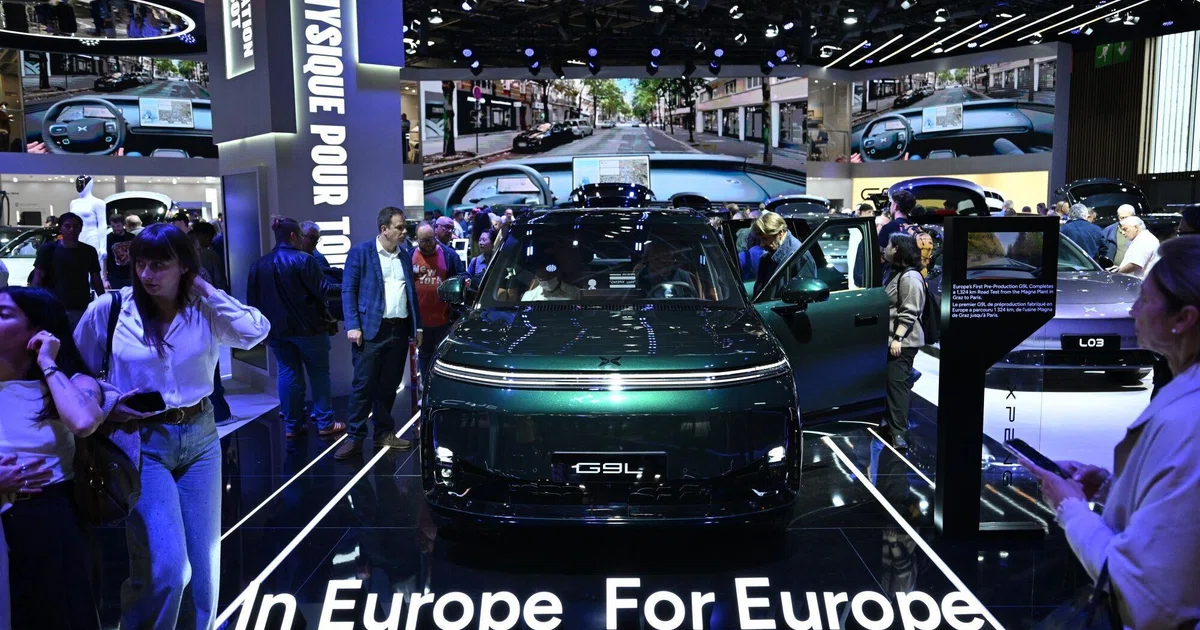
Beijing’s agreement to curb hybrid car imports into Europe is a calculated compromise to preserve access
WHENEVER Beijing is confronted with complaints about its industrial overcapacity, its standard response is to reject them, insisting that Chinese manufacturers owe their success to innovation and competitiveness rather than unfair state support.
Just earlier in September, China’s Commerce Ministry was denouncing voluntary export restraints as a violation of World Trade Organization rules.
Yet on Oct 9, China reached an understanding with the European Union that could substantially restrict its exports of hybrid cars to the bloc. Rather than curbing its own exports, Beijing appears to have accepted limits imposed by Europe on imports.
Under the reported arrangement, imports from China would initially be limited to 350,000 hybrid and plug-in hybrid vehicles annually, with the quota increasing by 6 per cent each year from 2028 to 2030.
European officials say the restrictions could cut Chinese exports by more than half compared with projected 2026 volumes. Beijing, however, has presented the arrangement as allowing continued export growth from its 2025 baseline.
The deal addresses a tactical shift in the market. When the EU imposed tariffs on pure battery electric vehicles in 2024, Chinese carmakers rapidly expanded their shipments of hybrid and plug-in hybrid models to maintain momentum in Europe without incurring high duty penalties. Capping hybrids closes that crucial loophole.
The Business Times turns 50
Five decades of milestones and moments that shaped Singapore’s success story – told through our headlines.
Explore BT50
The precise terms have yet to be finalised, but the concession raises a question: Why would Beijing accept limits on sales to one of its most important overseas markets, especially when Chinese carmakers face fierce competition and thin profit margins at home, and overseas demand has become increasingly important to China’s manufacturing sector?
A tactical concession
The answer lies in what China has not conceded.
Beijing has made no commitment to change the industrial policies that have helped turn it into a manufacturing powerhouse. Nor has it accepted Europe’s broader accusations of excess capacity.
SEE ALSO
Instead, China appears to have calculated that ceding ground on cars – an industry of enormous political importance to Europe – is preferable to risking a much wider confrontation over Chinese exports. The concession is costly, but carefully limited.
In Europe, the automotive industry is more than an economic sector; it is a major employer, a source of national industrial pride, and a politically powerful constituency.
Days before the Beijing talks, French President Emmanuel Macron and German Chancellor Friedrich Merz pushed for stronger European trade-defence measures, including more forceful restrictions on access to the EU’s single market.
Germany’s position was especially significant. Berlin has traditionally been more cautious than Paris about confronting China economically, not least because German automakers have substantial operations in China and remain vulnerable to retaliation.
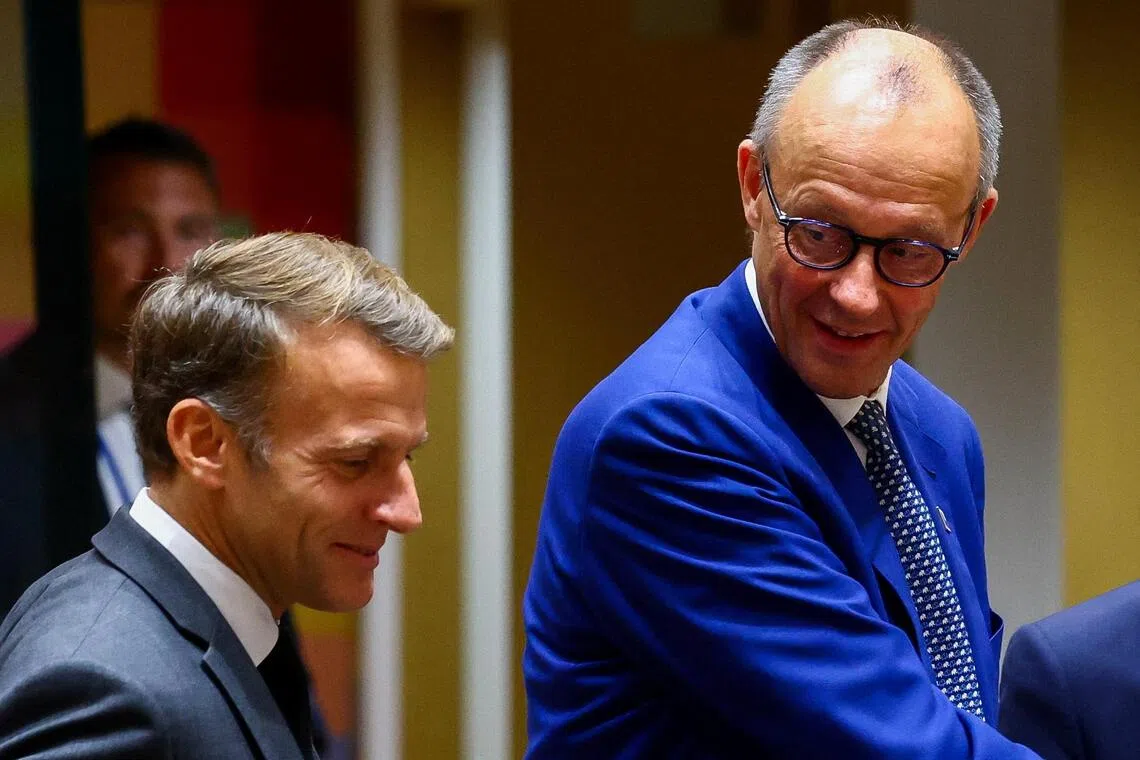
The negotiations were already under way, so the Franco-German intervention cannot be credited with bringing Beijing to the table. But it raised the prospect that a dispute over hybrid cars could become part of a broader European response to Chinese manufacturing competition across multiple sectors.
The agreement also came ahead of a European Council meeting on Oct 15 and 16, when EU leaders were expected to consider whether tougher trade measures are needed to address their widening trade imbalance with China. That was a risk Beijing had good reason to avoid.
The US has effectively closed much of its automotive market to Chinese imports through prohibitive tariffs, leaving Europe as one of the few major wealthy markets where Chinese carmakers can expand.
China also has far more at stake in Europe than vehicles. The EU recorded a goods trade deficit with China of about 360 billion euros (US$403.8 billion) in 2025, illustrating the massive scale of European demand for Chinese manufactured products.
With domestic consumption struggling to absorb China’s enormous output, Beijing must keep that market open. It faced a choice: Allow hybrid exports to surge and risk provoking stronger European retaliation, or accept limits in one sector to safeguard broader market access.
Shifting from exports to local production
The automotive industry also offers Beijing and Chinese manufacturers ways to adapt. Restrictions on imported vehicles are bound to accelerate a transition already under way: moving from exporting built cars to manufacturing them directly inside Europe.
BYD is preparing to begin production in Hungary and considering additional manufacturing sites in France and Spain, while aiming to employ over 40,000 people in Europe by 2030. Leapmotor is pursuing European assembly through its partnership with Stellantis.
For Chinese manufacturers, this trade-off is considerable. Building factories in Europe requires heavy capital expenditure and sacrifices some of the low-cost manufacturing advantages enjoyed at home. But local production offers a durable foothold in a lucrative market, insulating Chinese brands from trade protectionism.
For European policymakers, the results will be mixed. Chinese-owned factories create local jobs and support regional supply chains, but established European carmakers will now have to compete with Chinese rivals operating on European soil, bypassing import duties – although EU regulators are already exploring ways to prevent these plants from becoming simple assembly hubs for Chinese components.
Europe may succeed in reducing imports of Chinese-made cars without actually reducing the market share of Chinese brands; influencing where the cars are assembled, but not whether European consumers buy them.
European governments could even find themselves competing against one another to attract investment from the very Chinese manufacturers whose exports they sought to restrain.
There is also an internal complication for Beijing. Overseas manufacturing may help its leading carmakers expand internationally, but smaller manufacturers may lack the resources to follow. What serves China’s broader diplomatic interests may not serve every Chinese company’s commercial interests.
Pragmatism, not retreat
The automotive dispute is only one component of a friction-filled economic relationship spanning chemicals, plastics and green technology. Beijing, already managing severe trade tensions with Washington, has no desire to open a full-scale trade war with Brussels.
Other elements of the recent deal mirror this pragmatic calculus. China agreed to facilitate export licensing for rare earths and permanent magnets, whose supply bottlenecks have threatened European manufacturing.
For European companies, more predictable access to these materials would be valuable. But China has not agreed to abolish its export controls or guarantee specific quantities. It retains authority over the licensing system and therefore much of the economic leverage that comes with it.
Nor is economic dependence strictly one-sided. A 2026 study by the European think-tank, Jacques Delors Institute, identified 41 critical product categories where China relies on the EU for over 80 per cent of its imports, including specialised industrial machinery and advanced pharmaceuticals. Europe remains vital to Chinese industry as both a buyer and a supplier.
China’s agreement on hybrid vehicles suggests an acknowledgement that its manufacturing dominance no longer guarantees unrestricted access to foreign markets.
But the concession may not buy Beijing the breathing space it hopes for. The EU is already considering further restrictions on Chinese competition in chemicals, machinery and other industries, while tightening access to public procurement and state support.
Beijing has shown that it is prepared to negotiate limits on exports in a politically sensitive sector. It has not accepted Europe’s broader diagnosis of industrial overcapacity, much less agreed to change the economic policies behind it.
And if Europe continues to demand concessions across other industries, China will face an increasingly difficult choice: How much of its export growth is it prepared to sacrifice to preserve access to foreign markets? THE STRAITS TIMES
