


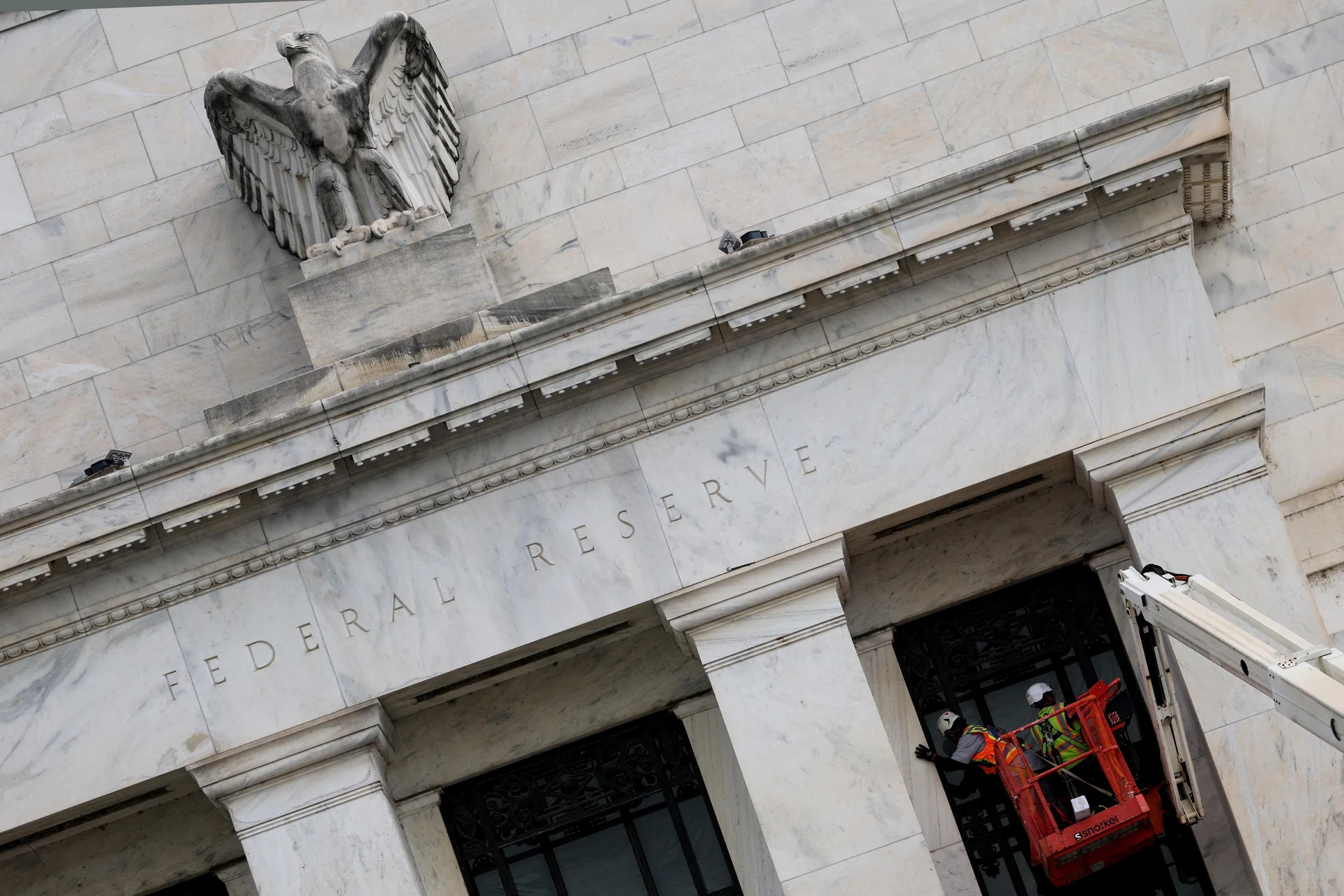
The proposal by US regulators to loosen banks’ equity requirements has ‘financial crisis risk’ written all over it
THE US Federal Reserve is much in the news currently, as White House pressure for lower interest rates calls the Fed’s independence into question.
But lurking just behind the headlines is another serious issue: the regulation of banks.
The Fed and other prudential regulators are proposing to reduce significantly the biggest US financial institutions’ capital requirements. This would be a dangerous move, and the CFA Institute Systemic Risk Council (an independent body comprised of former US and European officials, with whom we work closely) argues that this proposal should be withdrawn.
While banking regulation can feel (and likely is) endlessly complicated, one principle is simple: Banks need to be funded with equity capital.
Banks take deposits and make loans. But when banks suffer losses, those losses are in the first instance borne by their shareholders. When shareholder equity is insufficient to absorb those losses, then the bank is insolvent and needs to be wound down. Preventing bank insolvency and all the associated costs is a major goal of financial regulators.
Big banks like to borrow more, in part because their executives are compensated for return on equity, unadjusted for risk.
BT in your inbox

Start and end each day with the latest news stories and analyses delivered straight to your inbox.
When things go well, they get more upside. But when things go badly, banks that are more leveraged are more likely to fail, imposing costs on uninsured depositors and the deposit insurance fund, triggering broader runs across the financial sector, and contracting credit to businesses and households.
For regulators, there are two questions, now and always. How much bank leverage (debt relative to equity) is good for the economy? And how much leverage jeopardises the stability of the financial system?
This summer, the relevant US regulators (the Federal Reserve Board of Governors, the Federal Deposit Insurance Corporation, and the Office of the Comptroller of the Currency) decided to reopen that debate.
Amid a broader deregulatory push, they proposed to weaken the “enhanced supplementary leverage ratio” (eSLR), which applies only to the biggest US bank holding companies, known as global systemically important banks (GSIBs), along with their insured depository institution subsidiaries (IDIs).
Currently, GSIBs are required to have no less than 5 per cent equity (no more than 95 per cent debt), and IDIs must have at least 6 per cent equity relative to their overall leverage. The current proposal would reduce this to 3.84 per cent on average for both entities.
The leverage ratio is simple, entirely transparent, and eschews any assessment of the purported risk of various assets. This is important to bear in mind, because one could reasonably define a financial crisis as “what happens when the risk assessments are wrong”.
In the run-up to the 2008 global financial crisis, the private sector and regulators considered US mortgage-backed securities and many related derivatives low risk; that was a huge mistake. Nearly 10 million US families lost their homes and over US$10 trillion in household net worth was destroyed in a matter of months.
Likewise, in 2010, most eurozone sovereign debt was considered low risk – and then, suddenly, it wasn’t. The consequences of the euro debt crisis included politically difficult bailouts and deep austerity measures, and some eurozone countries’ unemployment rates reached 25 per cent.
That is why the risk-insensitive eSLR plays an essential role. There is an enormous human cost to getting the risk weights wrong, and we have paid it more than once.
Where will the risk weights next prove badly wrong? Stablecoins? Crypto more broadly? Non-bank financial institutions? Emerging markets? Nobody knows – and that’s the point. The systemically important parts of the banking system need to be protected against the “unknown unknowns”.
The Fed and other regulators continue to believe that risk-based capital requirements will protect banks’ safety and soundness.
But consider this: From 2015 to 2024, GSIBs’ balance sheets grew by almost 50 per cent, from US$10.5 trillion to US$15.5 trillion, while their “risk-weighted assets” increased by less than 10 per cent, from US$6.09 trillion to US$6.9 trillion.
This suggests that banks can and will optimise their asset mix to reduce capital requirements and potentially distribute that capital to shareholders – always aiming to boost return on equity unadjusted for risk. In addition, those same US regulators have publicly contemplated amending (read: weakening) those risk-based capital requirements.
The impending reduction in equity requirements will result in substantial additional risk to US financial stability. Unfortunately, the regulators’ proposal fails to consider many of the possible consequences in any meaningful way, much less attempt to quantify the attendant costs and benefits. It does not provide a sufficient basis for final regulatory action.
This proposal should be withdrawn and reintroduced in conjunction with whatever the regulators imagine should be the full framework for bank capital requirements. Then we can have a proper discussion.
Simon Johnson, a 2024 Nobel laureate in economics and a former chief economist at the International Monetary Fund, is a professor at the MIT Sloan School of Management and the co-author (with Daron Acemoglu) of Power and Progress: Our Thousand-Year Struggle Over Technology and Prosperity. Corey Klemmer is a former policy director at the Securities and Exchange Commission.
