


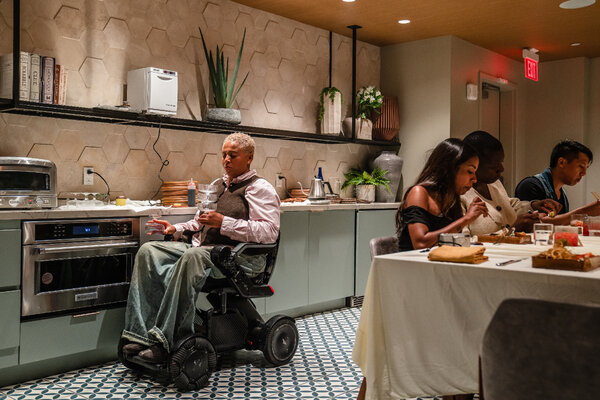
After a spinal cord injury left her unable to walk, Lay Alston turned to her first love: gathering for dinner.
One afternoon this spring, a recipe by Lay Alston, a San Diego-based chef, arrived in my inbox. The dish — charred shrimp coated with a condiment she calls “shimi sauce” — was easy enough for a cook of any level to master. But her instructions had a style all their own. “It starts with fire,” she wrote, “the kind that clings to shrimp just long enough to kiss the edges, dark and smoky, while the centers stay tender and sweet.”
As I read through the steps in my Brooklyn kitchen, I felt her voice reaching out to me from across the country. I marveled at her instructions, the detail and enthusiasm of the experience it promised. It all evoked my interest in its author, who I felt drawn to get to know.
On Instagram, I had seen Ms. Alston navigating her kitchen and hosting a dinner series, Yaya’s Crib. Following a spinal cord injury she endured in 2020, she, like me, navigates the world in a wheelchair. Watching her, I saw someone so thoroughly embodying much of what I am still learning to do.
When I spoke to Ms. Alston, 31, earlier this summer, we discussed our shared love of cooking and our past lives in restaurant kitchens. She grew up in Queens, the seventh of nine children, and every Sunday her family would gather at “grandma’s crib,” her grandmother’s home.
“I learned the power of food and how it can bring us all together and connect us on a deeper level,” she said.
Before guests arrive at Yaya’s Crib, she burns a stick of palo santo, setting the tone for the sensory experience to follow. Seating arrangements are intentional: Couples are sometimes separated to heighten the novelty of a meal among strangers. As the evening’s courses arrive, Ms. Alston guides diners to see each dish as part of a larger conversation. She aids the table’s conversation, too, providing cards with prompts for those seated together to connect.

A large, low table makes it easier for Ms. Alston to navigate her wheelchair through the dining room and interact with her guests.

Each meal at Yaya’s Crib, Ms. Alston’s dinner series, starts with the burning of palo santo and conversation prompts.Credit…Ariana Drehsler for The New York Times

Guest leave Ms. Alston’s dinners with handmade ceramics and a copy of the night’s menu.Credit…Ariana Drehsler for The New York Times
Accessibility for her guests is paramount. Chairs are removed for wheelchair users (one day she dreams of having dining tables with adjustable heights) and she offers a menu in Braille for visually impaired guests. She hopes to be able to accommodate hearing-impaired guests in the future as well.
These details were inspired by her own struggles with dining as a wheelchair user. She described not being able to fit comfortably at the table whenever she dines out and the awkward distance between herself and her plate.

Ms. Alston leads a short meditation before each dinner to center her guests.Credit…Ariana Drehsler for The New York Times

At a dinner this month, Ms. Alston served grilled mackerel in the style of Japanese bento boxes with a crispy potato salad.Credit…Ariana Drehsler for The New York Times

Green tea and peppermint tea are served during the meal.Credit…Ariana Drehsler for The New York Times
At age 8, Ms. Alston knew she wanted to be a chef. After enrolling in the culinary-focused program at the Food and Finance High School in Manhattan and earning a scholarship to attend the Culinary Institute of New York at Monroe University, she worked in professional kitchens. But, Ms. Alston recalled, these kitchens were heavily adversarial, and the ego-driven culture felt at odds with the deeper connections she knew food could foster. In 2018, she moved to Los Angeles and became an instructor at the Institute of Culinary Education.
“This is when I began feeling my passions are connected to my impact,” she said.
Soon, the pandemic would upend the culinary world. Furloughed in early 2020, Ms. Alston returned to Queens. The week before she was to return to California to teach, she sustained a traumatic spinal cord injury. She has now been a wheelchair user for six years. “Six years and three days,” she told me when we spoke.
Her recovery began the way I’ve come to understand most recoveries begin: with shock, grief, disbelief and unanswerable questions. “I was grieving my capability, I was grieving everything I was made up of,” she said. Ms. Alston wondered how she would navigate the workplaces she’d long known; a future in food felt like an impossible dream.
A turning point in her healing journey came during a visit to her rehabilitation facility’s kitchen space. Accompanied by her physical therapist, the visit was to measure if and how Ms. Alston could cook for herself at home. She placed a cutting board in her lap, and, working from the one rack in the oven she could reach, made a meal of roasted salmon, potatoes and broccoli.
What would her life as a chef look like from a “seated position?” The answer, and Yaya’s Crib, slowly came into focus. When speaking of her return to cooking so soon after her injury, she affirmed the power of food to heal us. “It’s the one thing that saved me in so many ways,” she said. “The community and connection I got from hosting dinners and pop-ups resparked my purpose.”
She also began writing Lomein Letters, a newsletter and the vehicle by which her recipe for charred shrimp arrived in my inbox. The recipe is laced with sensory directives like, “start where flavor begins: with friction in a mortar and pestle, or a food processor if that’s what you’ve got.”
“Add the cilantro, scallions, mint, lime zest and juice,” she writes. “The coconut sugar goes in next, dissolving slowly as you stir, softening the edges of the heat.” I could almost see the sugar crystals gently dissolving into a sweet puddle. Fish sauce and miso next, this “shimi” sauce is complex, I thought.
Today, she can barely reach her fridge’s top shelf and resorts to grabbing things with tongs. After working in different restaurant basement kitchens throughout her career, she envisions building a space that would be accessible, custom and intentional, one in which she could “maneuver and flow through with ease and confidence.” Refrigerators would be roll-in; countertops would be roll-under. Upper cabinets, if they exist at all, would descend from the wall by remote control. Pantries would be roll-in closets rather than cabinets.

For this dinner, Ms. Alston was aided by two assistant chefs, who help her execute each dish.Credit…Ariana Drehsler for The New York Times
“The more I experienced the world post-injury, the more I thought, ‘That could have been an easy fix,’” she said. “Or not even a fix. That could have been something that was designed intentionally from the beginning.” A new way of creating kitchens, dining rooms and restaurants is long overdue.
I am two years out of the hospital, and only one year returned to my kitchen. In speaking with Ms. Alston, I have started to see the hazier parts of the road ahead a little more clearly. The work she is doing is much larger than one dish can capture, but her shrimp with “shimi” sauce is a place to start.
“I always said that cooking was my passion,” Ms. Alston said, “but also the conduit to my purpose of inspiring others to live a life past the challenges they’ve endured.”
Follow New York Times Cooking on Instagram, Facebook, YouTube, TikTok and Pinterest. Get regular updates from New York Times Cooking, with recipe suggestions, cooking tips and shopping advice.
