


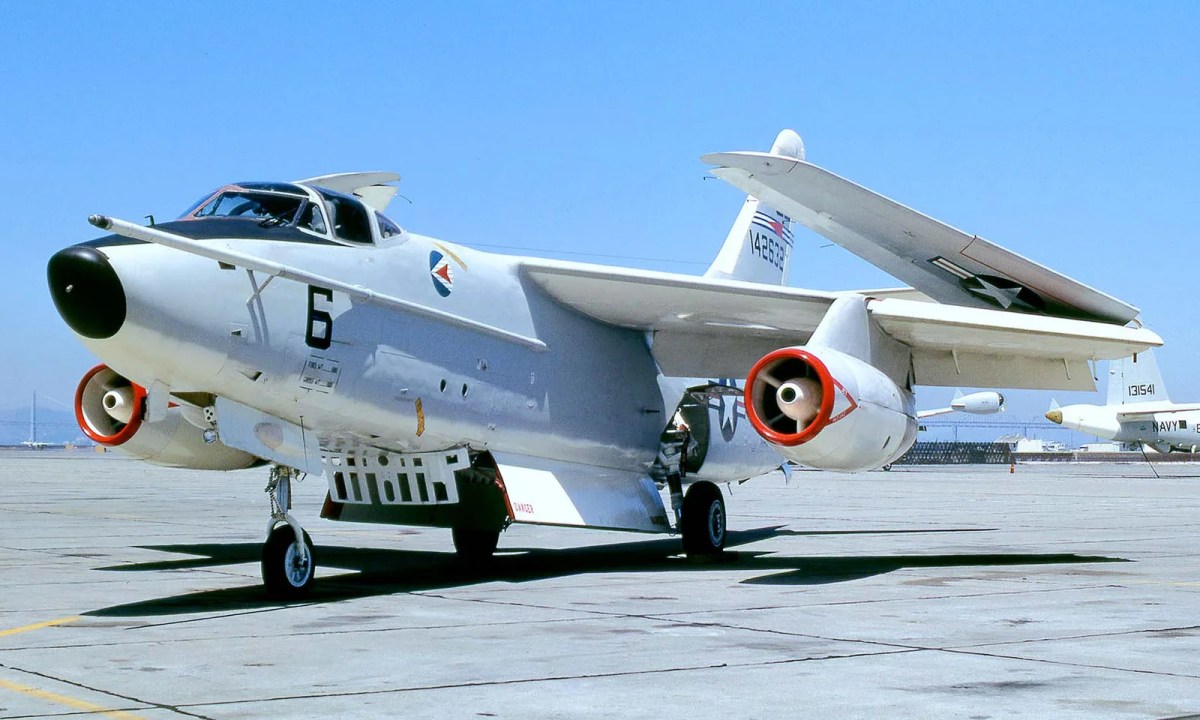

The Douglas A-3 Skywarrior, better known by sailors and fliers who flew with it as the “Whale,” was anything but conventional to launch off the deck of a U.S. Navy carrier. Built at the height of Cold War tensions, this fearsome jet was originally designed to carry nuclear bombs from carriers—no one had ever tried such a thing. In doing so, it was the largest jet ever to launch from a Navy flattop and went on to enjoy decades of service performing things far beyond those its creators could ever have imagined.

The concept for the A-3 in the immediate post-World War II period was conceived due to the fact that the Navy required a jet bomber capable of delivering nuclear strikes from the sea. The commanders were aware that future conflicts were likely to utilize bases in deep enemy country without access to land bases.

This challenge was embraced by Douglas Aircraft and celebrated designer Ed Heinemann. To be successful, they were compelled to reconcile heavy capacity weights with requirements for carrier flight operations. Its one unique characteristic was its tricycle landing gear, at the time unusual, which gave the heavier aircraft better control on crowded carrier decks.

Fundamentally, the Skywarrior boasted two sturdy Pratt & Whitney J57 turbojets at its back. These gave it enough power to carry almost 13,000 pounds of payload for more than 2,000 miles. Folding wings, advanced avionics, and very high reliability were features that allowed it to accomplish demanding missions but remain manageable for carrier deployment.

Physically, the A-3 was huge. It measured 76 feet long and 72 feet wide and weighed a whopping 82,000 pounds loaded—thus its “Whale” appellation among pilots and maintenance personnel who worked with it.

When initially employed in 1956 by Heavy Attack Squadron One, it was designed to be utilized to deter nuclear war. However, with the strategic emphasis shifting to missiles on submarines, the Skywarrior was revived for a second career. It was used as a bomber and a support general-purpose aircraft in the Vietnam War.

Among its most valued innovations was the KA-3B air tanker, which extended the reach of the Navy attack planes by refueling them mid-air. Thousands of pilots attributed these tankers with the rescue of planes and lives on long combat missions.

The modularity of the Skywarrior did not end there. Type models like the EKA-3B interfaced refueling with electronic jamming, guarding attacking units against detection by enemy radar on entrance and exit from enemy skies. Reconnaissance versions like the RA-3B and EA-3B included cameras, sensors, and electronics, giving intelligence and watching over enemy communications. Missions like these often made the A-3 an essential part of an attack package with fighters and bombers.

Because of its rugged construction and large bomb bay, the plane was redesigned to perform almost all of the missions that the Navy needed it to perform. It served as a bomber, tanker, electronic warfare aircraft, reconnaissance fighter, aggressor trainer, VIP transport, and even a flying testbed for new technology.

Even its popularity began in the U.S. Air Force, which developed one of its own—the B-66 Destroyer. While redesigned with new engines, wings, and cockpit arrangements, the B-66 carried on much of the same type of mission, including bombing, reconnaissance, and electronic warfare in the Vietnam War.

The A-3 Skywarrior operated for approximately 40 years, from the first flight in 1952 until its retirement in 1991. Its final combat flight was during the Gulf War, when it flew electronic intelligence sorties before ending the Navy’s book on big carrier-based bombers. Its legacy carried through to the tactics and technology that affected subsequent aircraft like the EA-18G Growler.

Today, fewer than a handful of Skywarriors rest in museums and memorials, reminders of a jet that pushed the boundaries of carrier flight. The A-3 was more than an attack bomber, proving that one plane design could adapt to evolving requirements of war and still fly successfully for decades. Its heritage is a testament to the engineers who created it, the men who flew it, and the period when the “Whale” was the epitome of flexibility in the skies.
