


This is a spoiler-free review of all eight episodes of Star Wars: Visions Presents – The Ninth Jedi. The entire series is live now on Disney+ and Hulu.
The Star Wars franchise is definitely in a bit of a slump lately. The Sequel Trilogy ended poorly, and Lucasfilm is still in the process of figuring out how to move forward in that era. Meanwhile, the mediocre performance of The Mandalorian and Grogu shows that even that once dependable pillar of the franchise is hemorrhaging support. But one thing fans can generally count on is that Star Wars will always deliver when it comes to new animated projects. Star Wars: Visions Presents – The Ninth Jedi does nothing to change that fact.
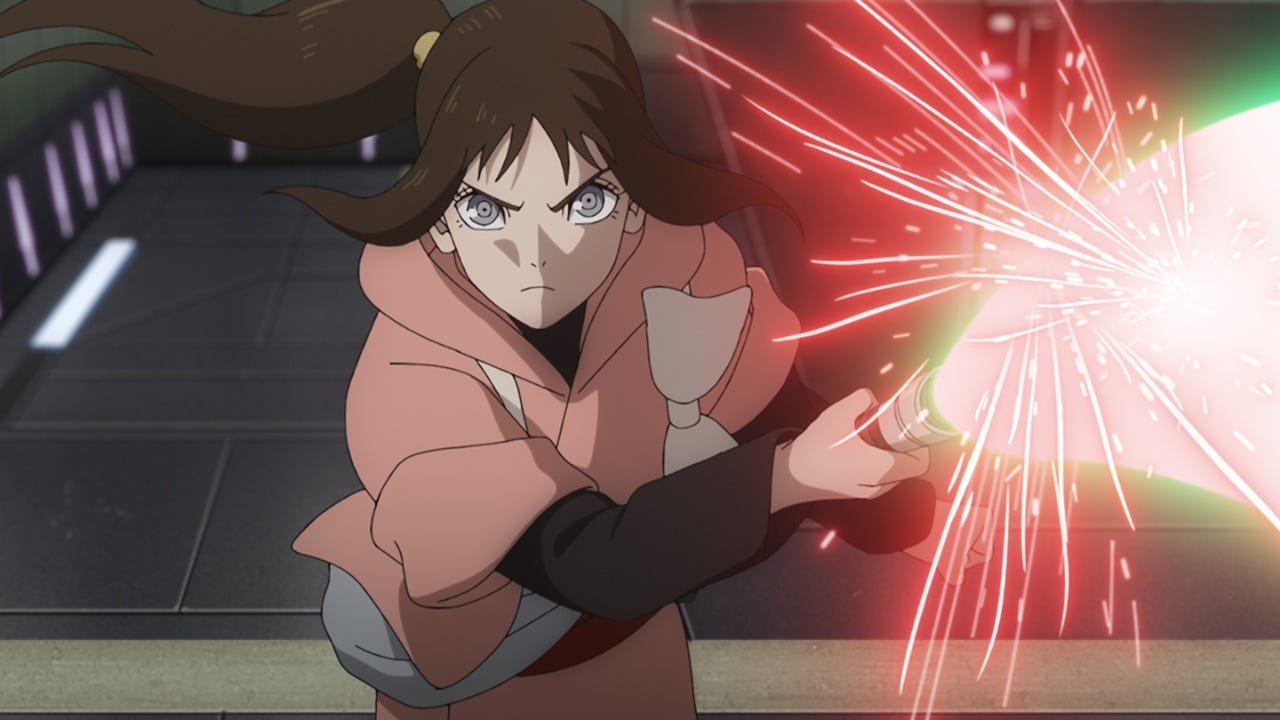
As the title implies, The Ninth Jedi is a spinoff of the two short films included in Seasons 1 and 3 of the Star Wars: Visions anthology series. As such, it’s best to watch those first and get a feel for this futuristic setting and cast of characters before diving into the new series. Building on those shorts, this new series follows up-and-coming Jedi Lah Kara (Chinatsu Akasaki/Kimiko Glenn) and her allies as they search for Kara’s father, Lah Zhima (Shin-ichiro Miki/Simu Liu), and battle the tyrannical Nawaam (Nao Omori/Young Mazino).
The core appeal of The Ninth Jedi is and always has been the blank canvas it offers. Many argue the best thing Lucasfilm can do for the franchise in its currently troubled state is to carve out a new storytelling era completely free of the baggage that is the Skywalker Saga. Well, that’s precisely what you get with The Ninth Jedi. The series is set centuries after the films, establishing a completely new blank canvas on which to paint.
Mind you, the picture it paints isn’t always that dramatically different from what’s come before. Despite the massive time jump, this is a series that deals in a lot of familiar elements. You have the wide-eyed neophyte Jedi coming of age under the watchful eyes of a grizzled Jedi Master. You have a galaxy plagued by war after the Jedi have been all but wiped out. You have an evil empire that trades in planet-destroying super-weapons and is ruled by a foreboding, lightsaber-wielding villain in black armor.
The Ninth Jedi walks a fine line between celebrating the tropes of the franchise and becoming bogged down by them. Early on, the series tends to fall on the wrong side of that divide. It gets off to a fairly sluggish start in the early episodes, which tend to highlight just how little has really changed in this galaxy after all this time. If you took umbrage with the Sequels and the idea that the ending of Return of the Jedi wasn’t a permanent victory over evil but merely a temporary reprieve in a neverending conflict, you may have a similarly hard time swallowing what this series has to offer.
But, eventually, The Ninth Jedi does find its groove, and with it, opportunities to take advantage of this wide-open new era. The show builds steam as it pivots away from simply focusing on the ragtag rebels fighting the evil empire and more into the motivations of figures like Zhima and Nawaam. With time, they become more than simply recycled archetypes, but fascinating characters with their own, unique views on the Force and the dichotomy between Light and Dark. Kara herself develops into a compelling protagonist whose journey doesn’t simply mirror that of Luke and Rey Skywalker. One caveat, though – definitely watch the show in subtitled Japanese language form, as the English dubbed voices are mostly flat and bland by comparison.
Technically, The Ninth Jedi is a non-canon series (not that this distinction matters much when the setting is so far removed from the rest of the franchise). Regardless, it manages to hit on and develop some of the same ideas and themes that have been slowly percolating in other contemporary Star Wars projects. There’s the notion of democratizing the Force. Here, being a Jedi is less a question of innate ability than courage and a willingness to fight in defense of others. There’s also the concept of lightsaber blades changing colors and serving as a window into the wielder’s psychology and moral compass.
Most interestingly, The Ninth Jedi dabbles with the concept of Gray Jedi in a more direct way than we’ve seen anywhere else in the Disney Star Wars era. In that sense, the lack of canonicity may actually be a boon, because it gives the writers and animators room to dig into an idea that the Lucasfilm Story Group still seems hesitant to embrace. This series is very interested in exploring that struggle to achieve a state of enlightenment beyond good or evil. There’s power in embracing both the Light Side and Dark Side together. But is that the true endgame for a Force user? Is pure detachment a desirable state, or must it be tempered with compassion? All of these questions are explored over the course of the season. For a show that initially starts out on such familiar turf, it’s satisfying to discover that The Ninth Jedi has so much on its mind.
And even when the show is at its most predictable, it does have the benefit of not looking like any of Lucasfilm’s more traditional Star Wars projects. The Ninth Jedi is once again animated by Production I.G, and they bring a very distinct look and feel to the franchise. The ships and droids are very different. The general vibe is more purely fantasy-oriented. Heck, there’s an entire group of characters that are basically Tolkien-style dwarf space miners. Compare this to something like the MMORPG Star Wars: The Old Republic, where many of the character and ship designs feel right out of the movies despite the game being set thousands of years beforehand. This fresh take is greatly appreciated.
It’s also worth pointing out how much the score adds to the whole endeavor. Composers Nobuko Toda & Kazuma Jinnouchi manage to capture the majesty and scope of the classic John Williams music without actually recycling any of Williams’ leitmotifs. The music is both fresh and unique and deeply Star Wars-y, which is ultimately a solid metaphor for the show as a whole.
