


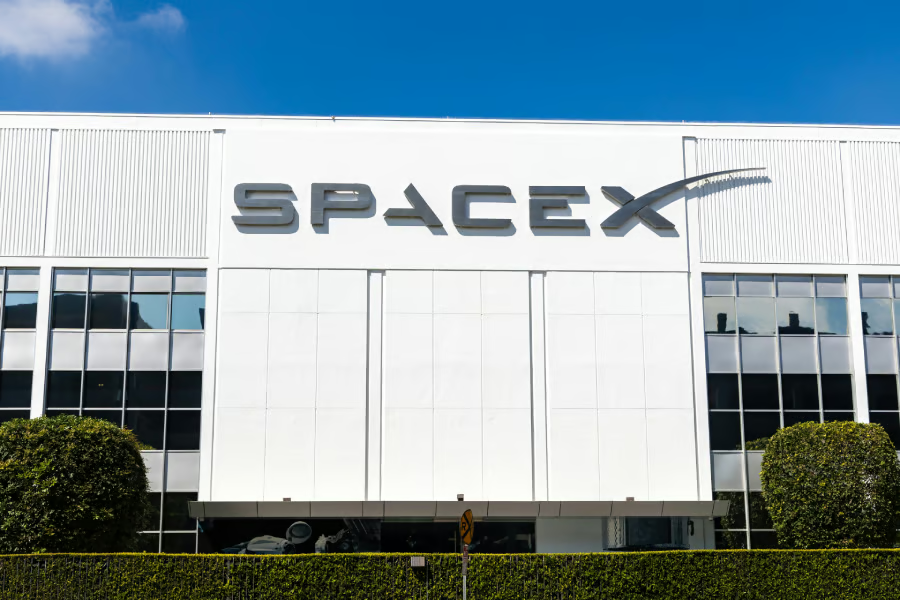
SpaceX is reportedly in talks with the US Department of Defense to provide billions of dollars’ worth of data center capacity for artificial intelligence workloads, a move that could significantly expand the company’s role in the government’s AI strategy.
The proposed agreement would allow the Pentagon to access SpaceX’s data center infrastructure to train and run AI models. With discussions ongoing, people familiar with the matter said a deal has not yet been finalized.
If an agreement is reached, it would represent another step in SpaceX‘s transformation from a launch provider into a broader technology infrastructure company. While the company remains best known for its rockets and Starlink satellite network, it has increasingly invested in AI computing, positioning itself to compete in one of technology’s fastest-growing markets.
SpaceX expands beyond aerospace
The Pentagon is already one of SpaceX’s largest customers. According to The Wall Street Journal, the company launches national security payloads, operates satellite communications through Starlink, and supports military missile-tracking efforts.
Providing AI computing infrastructure would deepen that relationship by moving the company beyond physical assets and into the digital infrastructure powering next-generation defense technologies.
The expansion also shows the growing importance of compute as a strategic resource. As organizations deploy increasingly sophisticated AI models, demand for GPU-powered computing infrastructure continues to outpace supply.
Companies that can offer large-scale data center capacity are becoming increasingly important as access to high-performance graphics processing units and large-scale data centers becomes one of the industry’s biggest competitive advantages.
SpaceX has reportedly already begun leasing computing capacity to commercial AI companies, including Google, Anthropic, and Reflection AI. Those partnerships suggest the company has ambitions that extend well beyond supporting its own AI initiatives.
Challenging the cloud computing giants
A Pentagon contract would put SpaceX in direct competition with established cloud providers that have spent years building secure infrastructure for government agencies.
Today, Amazon Web Services (AWS), Microsoft Azure, Google Cloud, and Oracle all provide cloud services to the Department of Defense through the Joint Warfighting Cloud Capability (JWCC) program. Those companies have invested heavily in hyperscale data centers designed to support both enterprise and government workloads.
Rather than competing only in aerospace, SpaceX would be entering one of the most competitive segments of enterprise technology. Success would likely depend on whether SpaceX can deliver AI compute at attractive pricing while meeting the Defense Department’s stringent security and reliability requirements.
According to reports, SpaceX has discussed offering lower-cost computing capacity to compete more aggressively with AI infrastructure providers, potentially challenging companies such as CoreWeave that specialize in GPU infrastructure.
Pentagon’s AI infrastructure push accelerates
The reported talks come as the Defense Department continues rapidly expanding its AI capabilities across intelligence, logistics, planning, and military operations. Supporting those initiatives requires enormous amounts of computing power, making access to reliable AI infrastructure a growing priority.
The Pentagon has emphasized the need for access to reliable computing infrastructure as AI becomes increasingly integrated into defense systems. Officials have also sought to avoid becoming overly dependent on a single technology provider.
Earlier this year, the department approved multiple vendors for use in classified AI environments while encouraging greater competition among suppliers.
Meanwhile, the Defense Department is also pursuing $30 billion in funding for its proposed Artificial Intelligence Arsenal initiative, which is aimed at securing advanced AI chips and expanding the computing resources needed for future defense applications. While the proposal remains subject to congressional approval, it illustrates the scale of the government’s long-term AI ambitions.
Strategic and political questions
A potential agreement would likely attract additional scrutiny because of SpaceX’s expanding relationship with the federal government. SpaceX already plays a central role in US national security through launch services and satellite communications, prompting some policymakers to question whether the government has become too dependent on a single company.
Elon Musk’s political activity has also generated conflict-of-interest concerns, though administration officials have pushed back against those claims.
Beyond politics, the talks underscore a broader transformation taking place across the technology industry. AI infrastructure is becoming as strategically important as cloud computing itself, prompting companies outside traditional enterprise software to invest heavily in data centers and compute capacity.
For SpaceX, entering the AI infrastructure market could diversify its revenue beyond launch services and satellite internet. For the Pentagon, adding another large compute provider could increase competition and expand access to the processing power needed for next-generation military AI applications.
Also read: China’s Xingshu AI satellite network shows how compute infrastructure is expanding beyond traditional data centers.
