






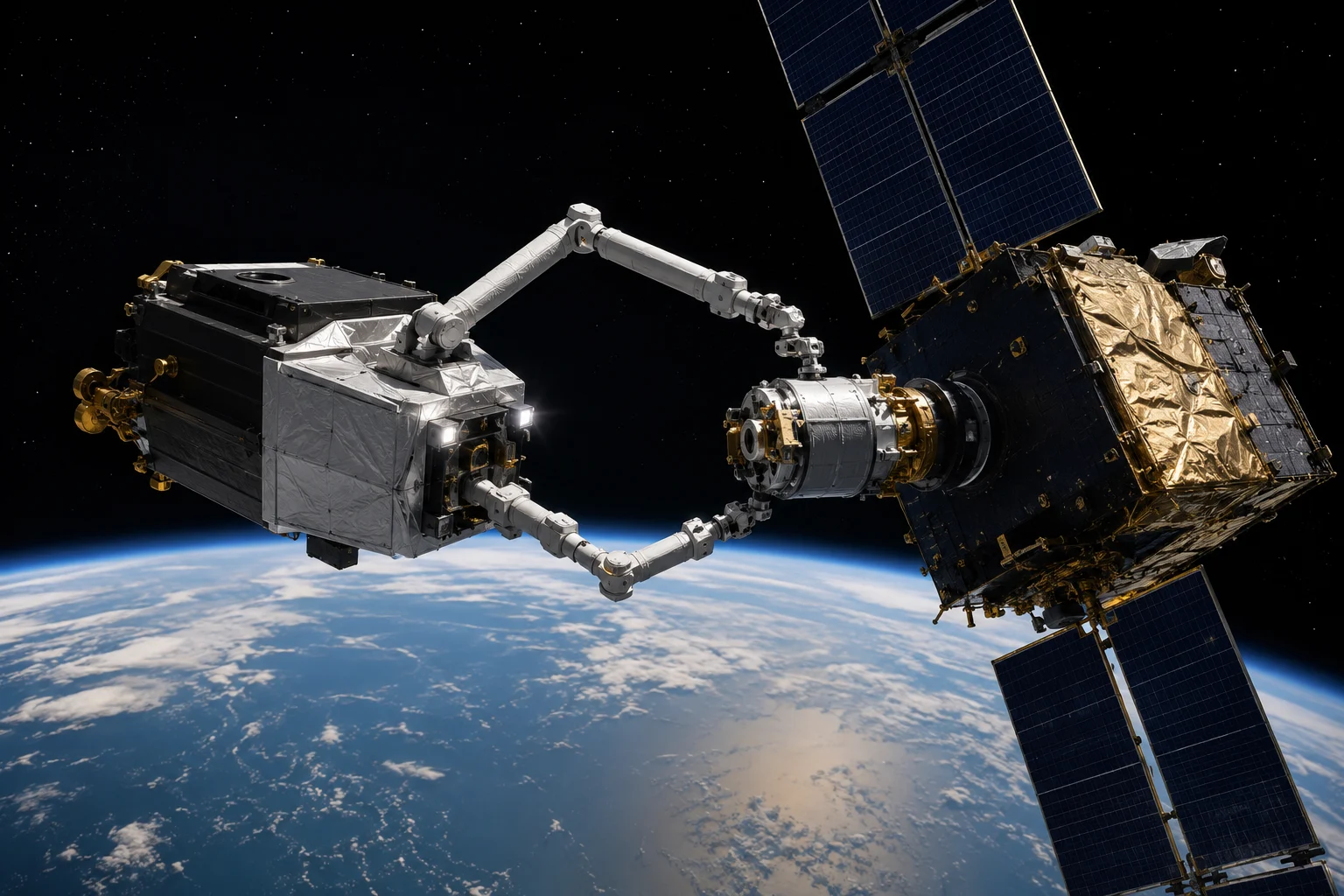
Running out of fuel does not always mean a satellite has stopped working. Sometimes, it just needs a little help staying in the right place.
SpaceX launched Northrop Grumman’s Mission Robotic Vehicle and three propulsion pods on July 21 from Cape Canaveral, Florida. Once the spacecraft reaches geostationary orbit in 2027, its two robotic arms will attach the pods to aging communications satellites, giving them added propulsion and potentially extending their working lives by up to eight years.
The mission could save operators millions in replacement costs while testing whether robotic servicing can become a practical way to maintain satellites already in orbit.
How the satellite-servicing mission will work
A Falcon 9 rocket carried the Mission Robotic Vehicle, or MRV, and three Mission Extension Pods into space. SpaceX deployed the MRV about 35 minutes after liftoff, followed by the three pods at roughly 10-minute intervals, according to Space.com.
The spacecraft will spend about a year traveling to geostationary orbit, approximately 22,300 miles above Earth. Satellites at that altitude match Earth’s rotation, allowing them to remain above the same region and provide continuous communications, weather monitoring, or surveillance coverage.
Once it reaches its destination, the minivan-sized MRV will use two 10-foot robotic arms to collect the pods and attach them to three aging satellites. Each washing-machine-sized pod will act as a jetpack, providing propulsion and helping its assigned satellite maintain the correct orbit.
Northrop Grumman said a pod could add up to eight years to the operational life of a typical 2,000-kilogram satellite. The customer will control the pod through its own telemetry and command system after installation.
Why satellite life extension could save millions
Satellites can remain functional even after they run low on the fuel needed to control their position. Losing that maneuvering ability can force operators to retire otherwise usable hardware and spend millions of dollars developing, launching, and commissioning a replacement.
Reports differ on the customers: The Associated Press identified SES and Optus, while Space.com, citing Tech Times, said Optus booked one pod and Intelsat the other two. The conflicting reports leave the allocation unclear.
Northrop Grumman has already demonstrated a different version of satellite life extension. Its first-generation Mission Extension Vehicles dock directly with client satellites and remain attached to provide propulsion.
The company said its two vehicles have docked with three commercial satellites and delivered more than 10 years of combined mission-extension service.
The new design separates the reusable servicing robot from the smaller propulsion pods. After installing all three, the MRV can remain in orbit and wait for additional pods or servicing assignments rather than staying permanently attached to one customer.
A robot built for more than jetpack delivery
Northrop Grumman noted that the MRV could eventually inspect, relocate, repair, refuel, and upgrade satellites. The company also listed debris removal, experimentation, and in-space assembly among its potential uses.
The vehicle carries a US Space Force-approved refueling interface, which could allow it to replenish its own fuel supply and continue operating. It also launched with processing hardware intended to support future AI-powered operations, although Northrop Grumman did not detail when those capabilities would be activated.
The first pod installation is expected by mid-2027. Its success will help determine whether robotic servicing can become a repeatable business rather than a specialized rescue mission, potentially changing how operators plan the cost and lifespan of satellites already in orbit.
Read how SpaceX could emerge as a rival to AWS, Microsoft, and Google in a Pentagon AI deal.


