


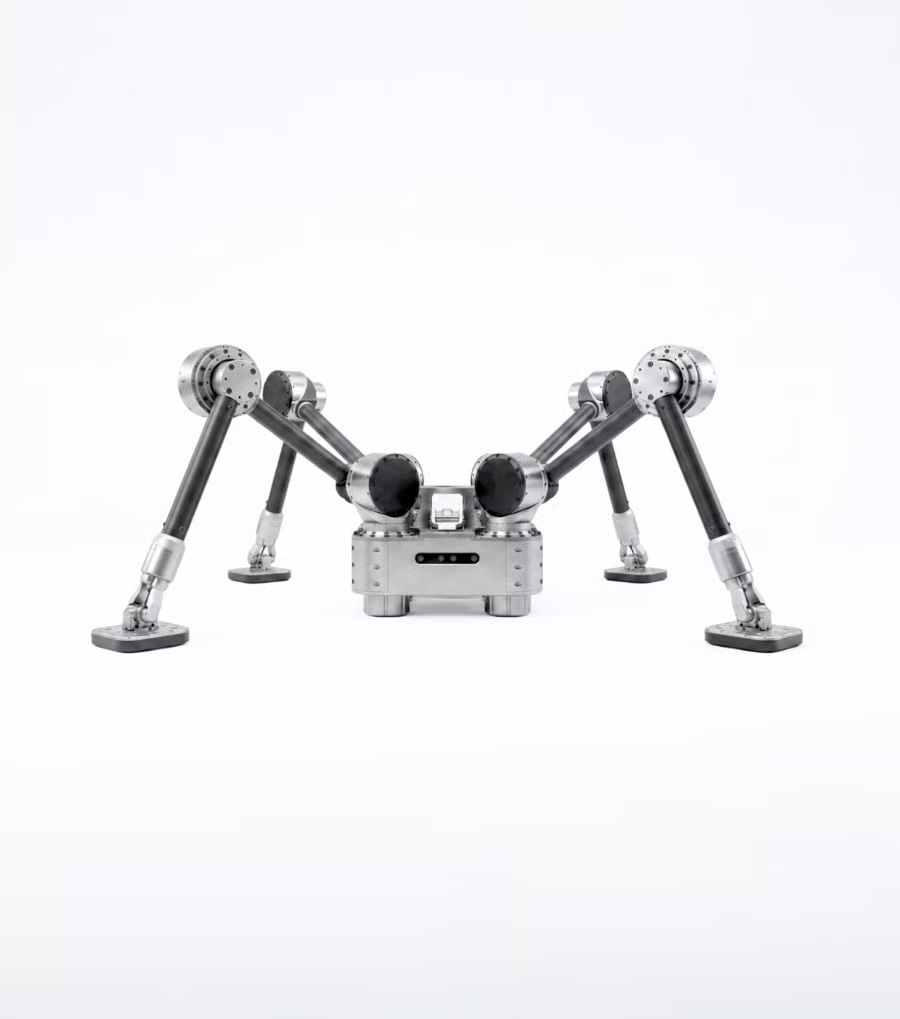
A four-legged robot that can climb walls, walk across ceilings and carry welding equipment is bringing a new meaning to working on all fours.
South Korean startup Diden Robotics has unveiled the Spider 30, a magnetic-footed industrial robot designed for steel-heavy environments such as shipyards. The machine can move across floors, vertical walls and overhead structures while carrying tools for welding, inspection and other industrial tasks.
The concept targets a familiar shipbuilding problem: some of the most important work happens in spaces that are difficult, awkward or hazardous for people to reach.
Magnetic feet let the robot walk upside down
The Spider 30 combines a four-legged walking system with electro-permanent magnet (EPM) feet that allow it to attach to steel structures. This gives it access to surfaces that conventional wheeled robots cannot traverse, including curved sections of ship hulls and overhead structures.
According to Diden Robotics, the system delivers magnetic adhesion of up to 1,500 newtons, with the company highlighting rapid switching between attachment and release. Its magnetic control system can reportedly switch states in as little as 7 milliseconds.
Diden says the robot can transition between floors and walls in under 30 seconds and clear obstacles in less than a minute while adjusting its posture to fit through confined spaces.
The Spider 30 measures 958 × 460 × 494 millimeters and weighs 45 kilograms. Its four legs contain 12 actuators, while its payload capacity reaches 30 kilograms.
That carrying capacity allows operators to equip the robot with tools for welding, inspection and other industrial processes. Rather than deploying separate machines for different jobs, shipyards could potentially use one mobile platform to perform multiple tasks across complex steel structures.
Diden says the robot is designed to operate in temperatures from minus 10 to 60 degrees Celsius, while its power and communications connectors carry an IP54 protection rating.
The company has demonstrated the robot in shipyard-related environments. Reports from WION have also linked the technology to trials involving Samsung Heavy Industries, although details about the scope and duration of those tests remain limited.
What eWeek found: The real challenge is beyond climbing
The Spider 30’s magnetic adhesion is impressive, but its industrial value will depend on more than its ability to stick to steel.
At speeds of up to 0.1 meters per second, the robot is designed for controlled movement rather than rapid traversal. Its performance during actual operations will also depend on how effectively it can maintain stability while carrying tools, navigate changing surfaces and complete tasks without frequent human intervention.
For shipbuilders, the potential benefit is a mobile work platform that could reduce the need to send employees into difficult-to-access areas for certain inspection and welding jobs. However, the available demonstrations do not establish how much time or money the robot could save, or whether it can operate reliably across extended production shifts.
The technology also has a clear limitation: Its magnetic locomotion is designed for steel structures, restricting its usefulness on nonferrous surfaces and other materials.
Still, the Spider 30 reflects a broader shift in industrial automation: instead of moving giant workpieces to stationary robots, manufacturers can increasingly send robots directly to the structure. In shipyards, where the work itself can span enormous steel surfaces, that mobility may be the more important innovation.
Other news: The global industrial robot population has passed 5 million, with China accounting for 59% of new installations in 2025 while India continues to emerge as one of Asia’s fastest-growing automation markets.
