


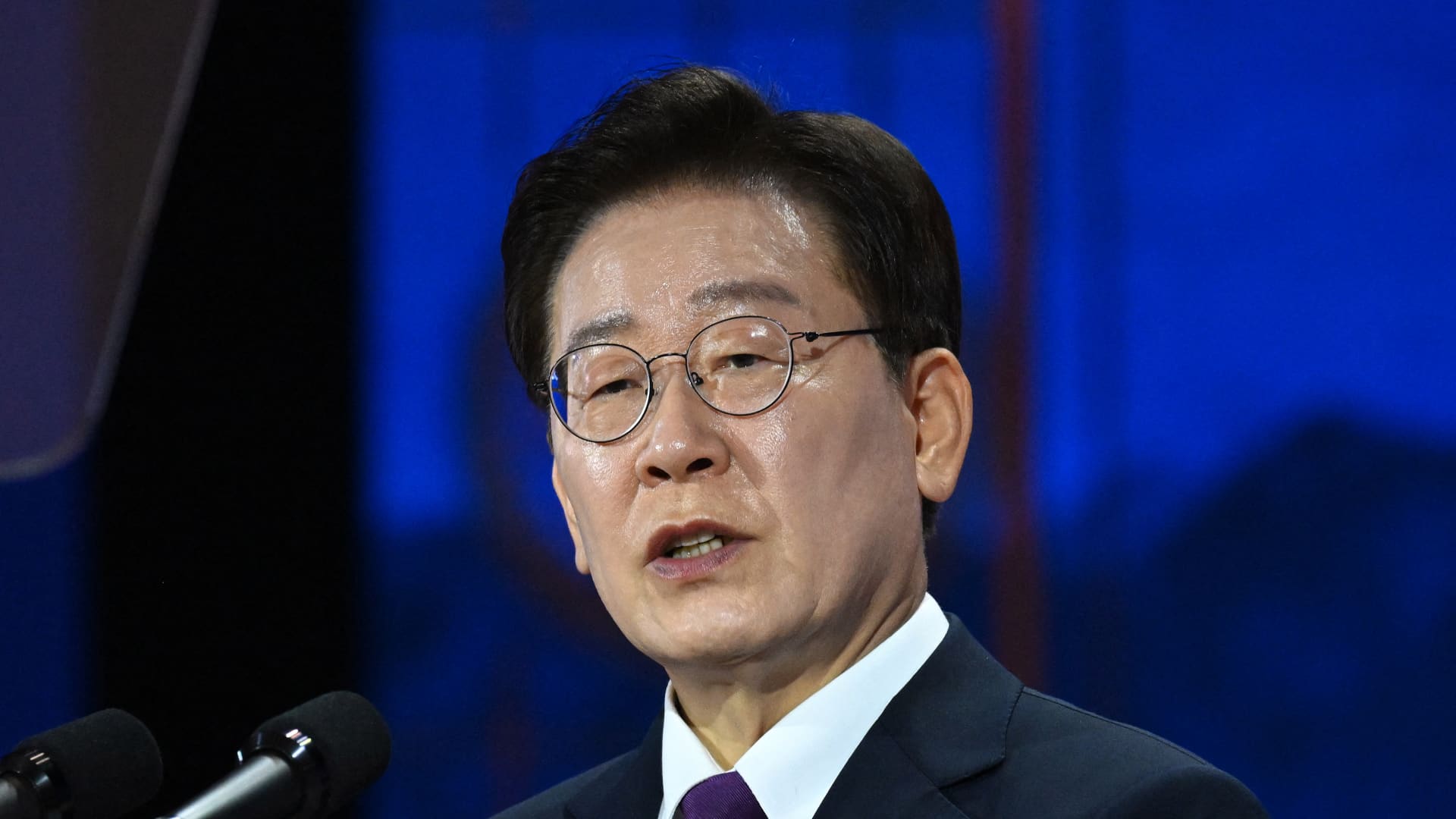
South Korean President Lee Jae Myung delivers a speech during the opening ceremony of the 48th session of the UNESCO World Heritage Committee at BEXCO convention and exhibition centre in Busan on July 19, 2026. (Photo by JUNG YEON-JE / POOL / AFP via Getty Images)
Jung Yeon-je | Afp | Getty Images
South Korean President Lee Jae Myung invoked Japan’s epochal property crash in the early 1990s, stoking concerns about Seoul’s real estate market as he prepares to revise taxes aimed at stabilizing the housing sector.
Lee said “quite a few people” were concerned the country could face Japan’s “lost” 20 or 30 years, according to a CNBC translation. Lee was referring to Japan’s “lost decades,” when growth slowed following a real asset and stock market crash.
He pointed out in a public discussion on real estate policy Thursday that Tokyo’s housing market had “burst like a balloon” in the early 1990s, as he sought to highlight South Korea’s overheating real estate market.
Real estate accounts for the largest share of South Korean household wealth, Lee added, saying data shows that South Korea is among the countries with the highest proportion of household wealth concentrated in real estate globally.
As of end-March 2025, real assets accounted for 75.8% of Korean household assets, compared with 24.2% for financial assets.

The South Korean president has a history of making bold calls.
Ahead of the 2025 presidential election, when the benchmark Kospi index was near 2,500, Lee, then a candidate, reportedly set a target of 5,000 for the Kospi during his term by pledging to resolve the so-called “Korea discount.”
The Kospi briefly crossed 5,000 in January 2026, just over six months after he took office, riding the AI-powered chip boom.

Lee’s government has tried to steer household wealth away from an overheated housing sector and into financial markets, a strategy which has only partially worked.
The South Korean benchmark now hovers at around 6,700, having experienced volatile swings due to the heavy dependence on heavyweights Samsung Electronics and SK Hynix.
Concerns are overblown
Economists told CNBC that the comparison with Japan overstates the immediate danger.
“I think the probability of a real asset bubble burst in Korea is limited,” Kang Min Joo, senior economist for South Korea and Japan at ING, told CNBC.
She said that mortgage lending conditions have been relatively tight for several years, and authorities have maintained strict controls on loan-to-valuation and debt-to-income ratios. “While the LTV ratio was previously as high as 80%, it has fallen to below 40% and lower in Seoul area.”
The household debt-to-GDP ratio in the country stands at 90.14 as of 2024. Although it has fallen from the record high of 98.67 in 2021, it still is the second highest in Asia behind Australia.
Lee’s comments reflect concerns about the recent rise in housing prices, rather than a real asset bubble is about to burst, Kang said.
That view is also shared by Gareth Leather, senior economist for Asia at Capital Economics, who said “fears of a bubble appear exaggerated.”
He pointed out that only property prices in Seoul are rising rapidly, but even in the capital, they are only 10% above the level they were at in January 2022. In cities like Busan, prices have fallen to almost 80% of January 2022 prices.
Leather said that risks to financial stability are also limited by the fact that house buyers are required to put down a large down payment, “so the risks of them getting into negative equity and the banks getting into difficulty are small.”
Experts said that while South Korea is unlikely to see a dual asset and market collapse like Japan in 1990, the country shares several financial and demographic characteristics with Japan.
Ma Tieying, senior economist at DBS Group Research, said South Korea has as a high credit-to-GDP ratio and stock market capitalization, similar to Japan pre-crash, which leaves it exposed to higher rates, tighter credit and global shocks.
But Korea is not experiencing large capital inflows or persistent currency appreciation seen in Japan a few years before the bubble burst, giving the Bank of Korea greater flexibility to calibrate policy.
Ma said the central bank has also responded pre-emptively to inflation and financial imbalances than Japan did before its bubble burst.
Following a period of extreme speculation in real estate and stocks during the 1980s, Japan saw a financial market implosion in the 1990s when its central bank started raising interest rates in December 1989, starting decades of slow growth.
— CNBC’s Jenny Lee contributed to this report.
