






YouTube is rolling out new requirements for creators who want to make money on the platform. Starting in February 2027, creators who wish to join the revenue-sharing tier of the YouTube Partner Program will need at least 8,000 hours watched over the last 12 months or 20 million views on YouTube Shorts over the last 90 days. These new totals are double the previous requirements, and the increase has put those aspiring to earn money through YouTube on notice; either make partner soon before the new rules go into effect, or have that potential income stream possibly put out of reach.
🙃
Awesome. I love when platforms make it even harder to succeed… https://t.co/h0WQtVcuie pic.twitter.com/4Kf7QyxUUn
— Nanaru 🥀🌙Spider lilly wolfie🌙🥀SpiritVeil (@nanaruultaru) August 11, 2026

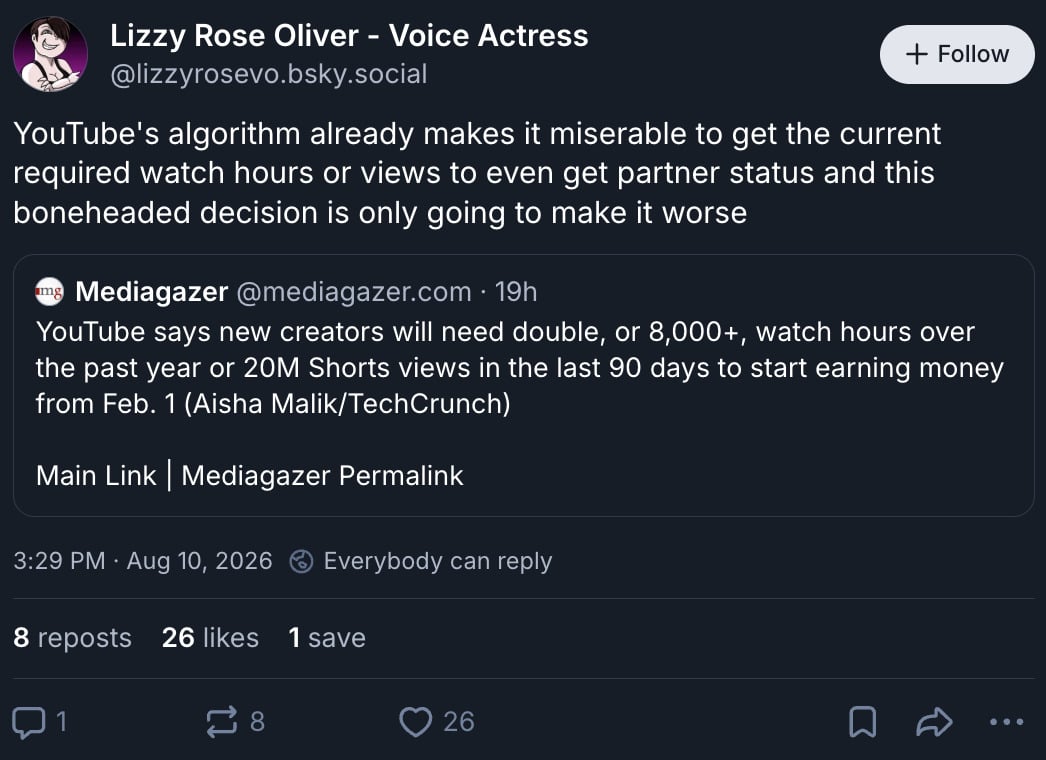
Some creators on social media have pointed out that while achieving 8,000 hours watched is a high bar to clear, it’s reasonably achievable. The new requirements also don’t apply to creators already in the program, and those who fall below that threshold won’t be kicked out. But the biggest, most worrying change, creators say, is to the YouTube Shorts ad monetization program. Right now, ad revenue for YouTube Shorts is pooled and allocated to creators based on a short’s number of views, whether it uses licensed music, and other factors.
But when the new rules go into effect, YouTube will only pay out ad revenue to creators who meet a cumulative 10 million Shorts views across 90 days—a feat creators say is much harder to reach. Those who fall below the Shorts threshold will not lose ad revenue for their long-form content, they simply will miss out on Shorts ad money until they get their numbers up. What’s worse is that YouTube itself will still be able to run ads against those shorts, but won’t have to pay out creators if they don’t meet the new threshold.
The funniest part about being a creator is that the goalposts never stop moving.
YouTube has apparently decided that 10 million Shorts views every 90 days is a reasonable minimum performance requirement to keep earning from Shorts.
lol wtf are we doing anymore https://t.co/KgVeObfcFC
— Kommander Karl (@kommanderkarl) August 10, 2026
welp, worked hard to get monetized and started making money on shorts, but won’t be for long. rocket league content is a bit hard to get 10 million views on shorts content in 90 days. this reallllly sucks https://t.co/9JsKcF8nNB
— landen (@landen_rl) August 10, 2026
So if I’m reading this correctly, despite already being in the YPP for a few years now, I’ll no longer be receiving any ad revenue from shorts? My channel has never crossed 10M views in 90 days. If true, this is comically unfair. Please clarify. @TeamYouTube pic.twitter.com/7zEmfXZpZJ
— Mystic Aidan 🌺💥 (@MysticAidanYT) August 10, 2026
YouTube says the changes are to “reward creators who drive conversation and engagement on YouTube.” Some have said that the higher bar of entry to the partnership program is an effort to make it harder for AI-slop farms to quickly spin up new accounts and start making money off YouTube. But the changes to Shorts seem like they would primarily reward high-volume, low-effort creators.
AI slop comes in and abuses the system and YouTube’s solution to combat this is to punish the regular people especially smaller channels just starting out. This is bullshit. https://t.co/Txrpw968UD
— HARU REN (@HaruRen364) August 11, 2026
Genuinely an awful change, this will only make the Ai issue worse
Ai channels can easily double their output and reach these insane requirements, meanwhile human channels have to find a way to put in double the time and double the effort
6 months to revert this
— mizu (@mizu_to_gohan) August 11, 2026
In today’s attention economy, short-form video has been declared king, and YouTube Shorts is Google’s attempt at challenging the god-emperor of short-form, TikTok. The new program incentivizes creators (or AI-slop farms, since it’s obvious what kind of creator is most effectively set up to take advantage of this change) to make more Shorts, increasing the overall volume on YouTube and, as the platform likely hopes, finally making it a competitor worthy of the ad dollars TikTok has sucked up. But the plan may backfire as creators realize the juice isn’t worth the squeeze. If monetization and ad revenue are locked behind what creators feel is an impossible goal, why try?
They want you to treat YouTube like a full time job but pay you absolutely nothing at the same time by the way whilst you work yourself into the ground 👋 https://t.co/gYbamOVJ8y
— Puggapillar (@puggapillar) August 11, 2026
The truth is, we are already pushing ourselves harder than ever just to make a few £ and while I’ve never done this for money, I still feel like we are being crushed. Add this to the government plan to push mainstream media on YT over actual creators… we are basically doomed https://t.co/W9hgjKg6BQ
— The Planetary Pilots ✨ (@Planetary_Pilot) August 11, 2026


