


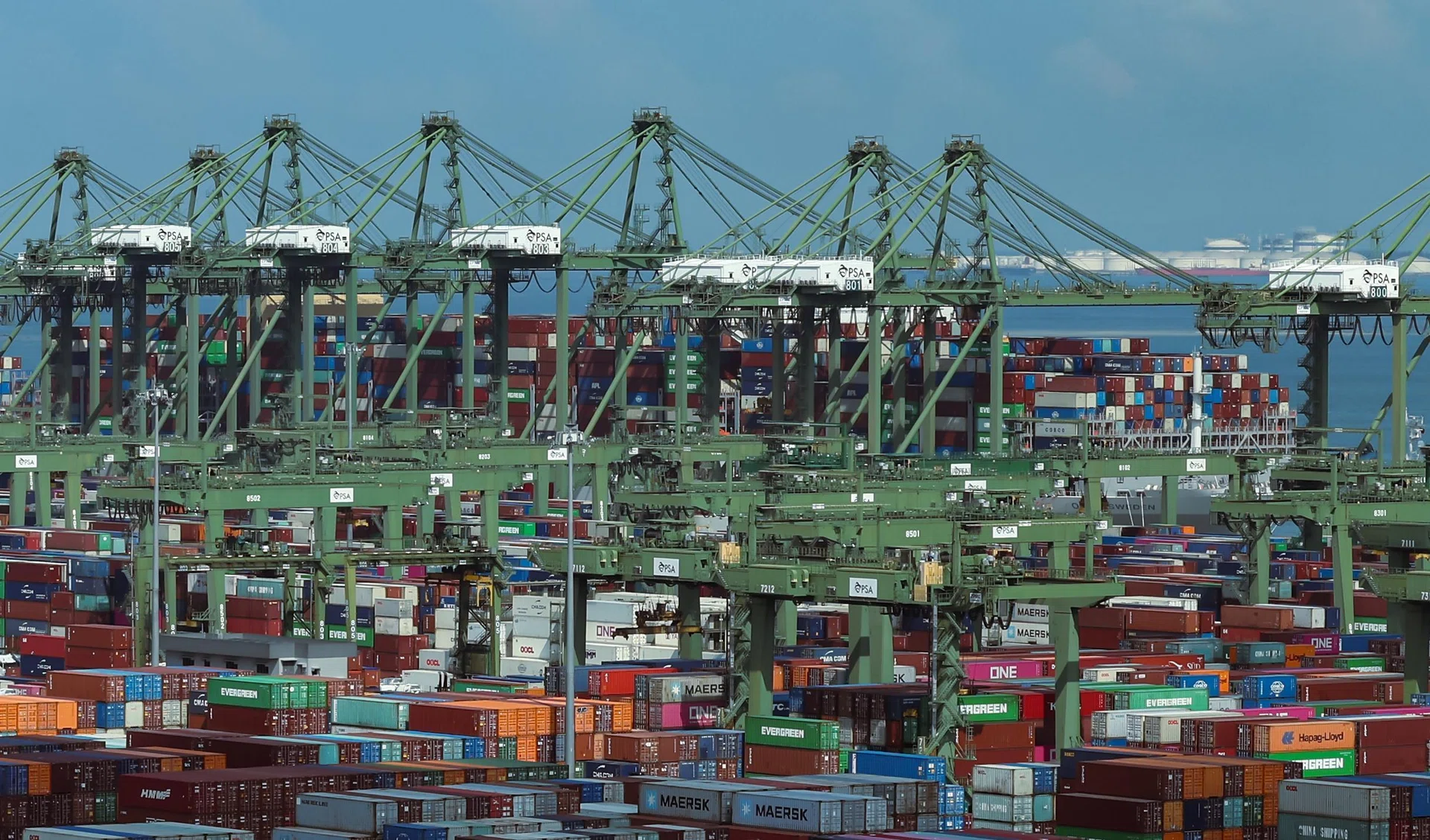
[SINGAPORE] The Republic’s key exports expanded by a slower-than-expected 9.3 per cent year on year in January, driven by electronics shipments due to strong artificial intelligence (AI)-related demand and a low base, showed data from Enterprise Singapore (EnterpriseSG) on Monday (Feb 16).
January’s expansion extends December’s 6.1 per cent growth, even as it fell short of economists’ expectations. Private-sector economists had projected a 12.5 per cent year-on-year increase for non-oil domestic exports (NODX), according to a Bloomberg poll.
Electronics exports grew in January, but non-electronics exports declined.
Electronics exports jumped 56.1 per cent on the year, more than double the preceding month’s 24.9 per cent increase. This was supported by strong AI-related demand and a low base from a year ago, stemming from the Chinese New Year (CNY) period falling in January last year.
Integrated circuits (80.5 per cent), disk media products (70.2 per cent) and PCs (24 per cent) contributed the most to the expansion in electronics NODX.
Meanwhile, non-electronics shipments fell 3 per cent, after December’s 0.8 per cent increase. The biggest declines came from specialised machinery (-15.6 per cent), food preparations (- 49.2 per cent) and petrochemicals (-24.5 per cent).
Navigate Asia in
a new global order
Get the insights delivered to your inbox.
Overall, total trade increased by 23.8 per cent year on year in January as both exports and imports rose. This extends the 12.3 per cent growth in December.
Sustained AI boom in the near term
Economists flagged the seasonal impact of the CNY holidays in February on Singapore’s near-term NODX performance.
But they expect the growth of electronics exports to be propped up by the global AI boom, while noting that non-electronics exports remain subject to downside risks.
SEE ALSO
Selena Ling, chief economist at OCBC, expects February’s key exports to contract 0.4 per cent due to effects from the timing of the CNY holidays, before rebounding to 3.5 per cent in March. This would bring NODX growth for the first quarter of 2026 to 4.3 per cent year on year.
“The near-term prognosis for electronics demand, especially semiconductors, remains underpinned by the global upswing for AI, cloud and high-performance computing chip demand,” she said.
She added that though non-electronics products such as pharmaceuticals and gold may continue to be supported, they remain more sensitive to cyclical global demand and market sentiment fluctuations, respectively.
Ling’s 2026 NODX growth forecast stands at 2 to 4 per cent, in line with EnterpriseSG’s official forecast range.
Earlier last week, the statutory board had raised Singapore’s NODX growth forecast for 2026 to 2 to 4 per cent, from zero to 2 per cent previously. This was on the back of a slightly improved global economic outlook.
DBS senior economist Chua Han Teng noted that NODX growth is likely to be “volatile” in the near term owing to the usual CNY fluctuations.
Nevertheless, he expects “superior performance” of electronics exports – relative to weaker non-electronics shipments – to persist in the immediate future, with the former supported by sustained global AI-related tailwinds and demand for the Republic’s server products and memory chips.
On the other hand, non-electronics exports could face downside pressures from the lagged and lingering impact of higher US tariffs worldwide, he added.
UOB associate economist Jester Koh expects AI-related tailwinds to persist at least through the first half of 2026. This is evident from the uptick in Singapore’s purchasing managers’ index reading in January, which points to “firm demand momentum” in the coming months.
Elsewhere in Asia, he noted the continued acceleration of Taiwan’s tech exports to the US in January, as well as significant increases in data-centre capital expenditure by major tech players for 2026.
In view of these developments, he has upgraded his full-year NODX growth projection to 5 per cent from 3 per cent previously, above the official forecast range.
However, Sheana Yue, senior economist at Oxford Economics, cautioned that growth is likely to moderate over the course of the year, as the strength of the AI-driven tech cycle eases.
She added that risks to Singapore’s shipments “remain tilted to the downside” from US trade policy, though some resilience in re-exports and intra-Asian trade should provide partial offset.
Market performance
In January, key exports to all but two of Singapore’s top 10 markets grew.
NODX to the United States contracted by the largest extent at 45.3 per cent, worsening from its 36.3 per cent decline the previous month. This possibly reflected the lagged impact of US tariffs, noted Koh.
Indonesia registered the second-biggest contraction at 16.9 per cent, extending the 27.9 per cent decline the month before.
In contrast, NODX to all other markets posted growth in January. This was led by the European Union at 43.7 per cent, reversing from a 5.4 per cent decline in the previous month. Thailand followed with a 39.3 per cent rise, reversing from a 17.9 per cent decline.
Shipments to Taiwan and South Korea expanded by 34.2 per cent and 31.6 per cent, respectively, supported by sustained AI-related tailwinds, said Koh.
Decoding Asia newsletter: your guide to navigating Asia in a new global order. Sign up here to get Decoding Asia newsletter. Delivered to your inbox. Free.
