


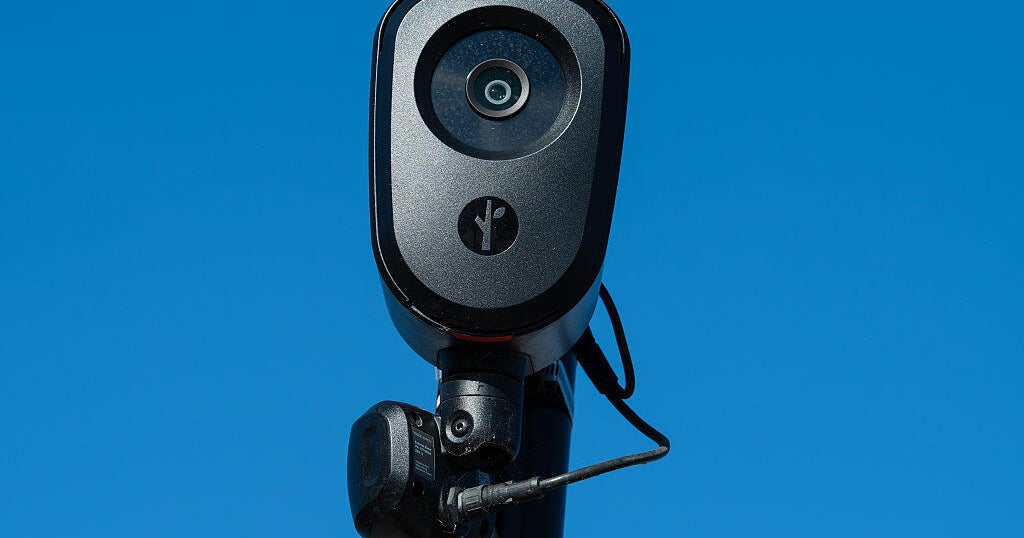
Sen. Josh Hawley is unveiling legislation to establish guardrails for Flock cameras and other artificial intelligence-powered surveillance technology, CBS News has learned.
The bill, dubbed the Stop Flock Abuse Act, would regulate automated license plate readers (ALPR) by imposing stricter limits on data, security and search functions. The cameras, which have become a popular tool among local governments, businesses and law enforcement, can record a vehicle’s make, model and color but have come under increasing scrutiny over security and privacy concerns.
“AI-powered cameras produced by Flock and its competitors are tracking and creating digital footprints of everyday Americans — a nightmare for individual liberties unless Congress enacts meaningful rules and accountability,” Hawley, a Missouri Republican, said in a statement to CBS News. “That’s why I’m introducing the STOP Flock Abuse Act to establish basic safeguards for AI-powered cameras and protect Americans’ fundamental constitutional rights. Law-abiding Americans should not be treated like criminals.”
The legislation, which could be introduced as soon as Wednesday, would restrict local governments from selling or sharing any vehicle data the cameras collect, and agencies would be required to permanently delete driver data within 10 days unless a criminal investigation is being conducted. In addition, surveillance networks would be banned from using facial recognition technology.
The measure seeks to prevent unauthorized or rogue searches by requiring written approval and preserving an audit log to track searches. Data would have to be encrypted and remain in the United States.
In August, Hawley launched an investigation into Flock and other surveillance technology companies. He chaired a Senate Judiciary subcommittee hearing last week and invited executives from Flock, Axon, Motorola and Verkada to testify, but they declined.
“I think that that’s unfortunate and I think we need to hear from them about what their networks do,” Hawley said during the hearing.
In a letter to the panel, Flock Safety CEO Garrett Langley outlined some safeguards the company has implemented but acknowledged that Congress should create a federal framework.
“Effective frameworks should preserve law enforcement’s ability to use an important public safety tool while requiring accountability, oversight and responsible data practices,” the company, which maintains a network of 120,000 cameras in 49 states, notes on its website.
Among witnesses who did testify was Lindsey Isaacs, a Florida woman who was wrongfully accused of fleeing a fatal accident and jailed in solitary confinement after her Dodge Durango was misidentified on a Flock camera.
“I was terrified I was facing the possibility of spending the rest of my life in prison for a crash that I knew I had not been involved in,” Isaacs tearfully recalled.
Hawley said the hearing exposed the “threat” AI-powered cameras could pose to “national security and privacy of everyday Americans.”
The issue has garnered attention from other lawmakers. Sens. Raphael Warnock, a Georgia Democrat, and Katie Britt, an Alabama Republican, penned a letter this month to Attorney General Todd Blanche urging the Department of Justice to provide more guidance to state and local governments about how to prevent the misuse of Flock cameras and automatic license plate readers. Several bills have also been introduced in the House to limit camera usage or restrict federal funding for the surveillance tracking systems.
