



AIThis post was created with the assistance of artificial intelligence (AI).
📊 Full opportunity report: Self-Directed Investors: How A Dollar Cost Calculator Can Help You on IdeaNavigator AI — validation score, market gap, and execution plan.
TL;DR
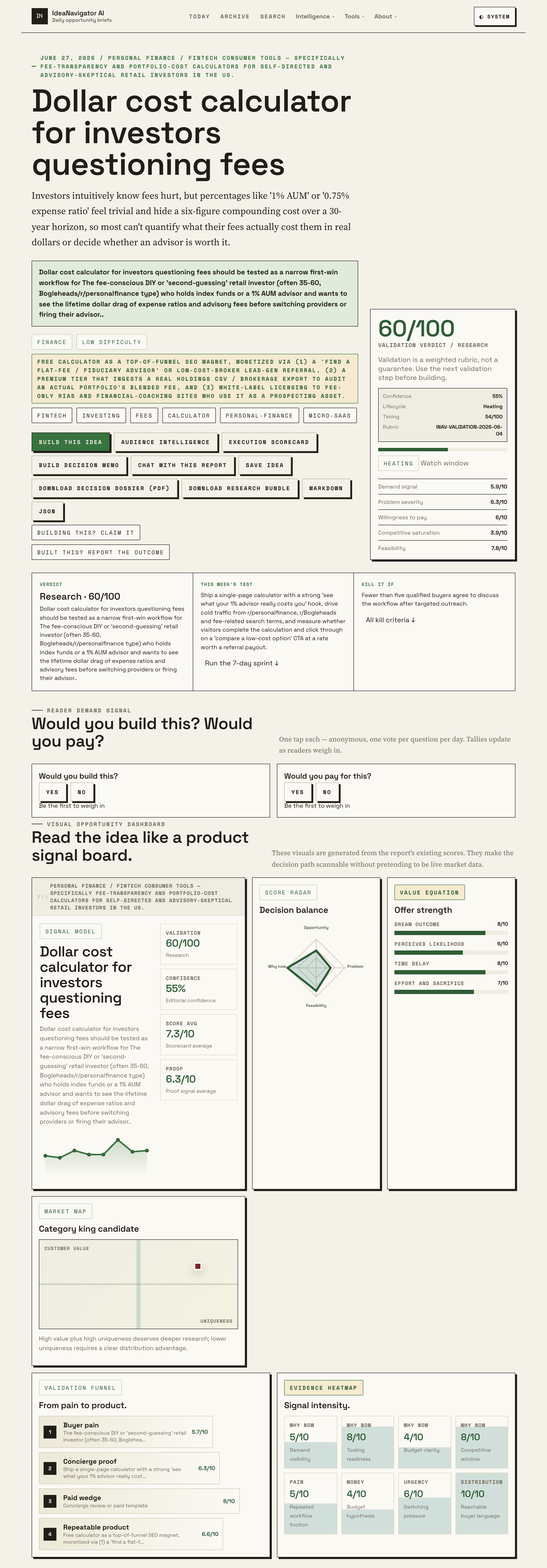
A newly launched dollar cost calculator enables retail investors to estimate the total dollar impact of investment fees over their lifetime. This tool aims to help fee-conscious investors understand the real cost of expense ratios and advisory fees, supporting more informed decisions. Its release responds to increased fee awareness and shifting regulatory landscapes.
A new web-based dollar cost calculator has been launched to help retail investors quantify the total dollar impact of investment fees over a lifetime. Designed primarily for fee-conscious DIY investors and those questioning their advisors, this tool offers a clear view of how expense ratios and advisory fees can erode wealth over decades. Its release comes amid rising fee awareness and regulatory shifts affecting advice models, making it a timely resource for millions of Americans managing their retirement savings.
The calculator, developed as a simple single-page web app, allows users to input key parameters such as current balance, monthly contributions, investment horizon, expected returns, and fees—including expense ratios and AUM advisory fees. It then outputs the estimated total dollars lost to fees over the specified period, compares the ending balance with a low-cost baseline, and shows how fees impact retirement withdrawals. The tool does not require login and can generate shareable PDFs or charts to facilitate discussions with financial advisors or for personal review.
According to developers, the primary target audience is the 35-60 age group, particularly those holding index funds or paying 1% AUM fees, who often underestimate the long-term dollar drag of fees. The goal is to give these investors a tangible, dollar-based understanding of the costs they incur, enabling more informed decisions about switching providers or firing advisors. The calculator also aims to serve as a lead-generation tool for fee-only advisors and low-cost brokerages, with monetization options including referral links, premium portfolio auditing features, and licensing for financial service providers.
At a glance
reportWhen: announced March 2024
The developmentA new online calculator has been introduced to help retail investors quantify the lifetime dollar cost of investment fees, promoting transparency and better decision-making.
Why a Dollar Cost Calculator Matters for Investors
This tool addresses a key challenge for retail investors: understanding how seemingly small percentage fees translate into significant dollar losses over time. As low-cost index funds and robo-advisors become more common, fee awareness is rising, and many investors are questioning whether their current advice or fund choices are cost-effective. By providing a clear dollar estimate, the calculator helps investors see the real impact of fees, potentially motivating them to seek lower-cost alternatives or renegotiate their advice arrangements. This transparency could influence millions of Americans managing their retirement savings, especially as regulatory changes in 2024 and 2026 have shifted the landscape of fee disclosure and advice legality.
Financial literacy experts say that many investors underestimate the power of compounding fees, which can total six figures over a 30-year horizon. This tool aims to bridge that gap, making the costs tangible and fostering more cost-conscious investment behavior. Its release also coincides with a broader push toward fee transparency in personal finance, aligning with trends toward democratizing access to affordable investing options.
investment fee calculator
As an affiliate, we earn on qualifying purchases.
As an affiliate, we earn on qualifying purchases.
Rising Fee Awareness and Regulatory Shifts Drive Need for Transparency Tools
Over recent years, there has been a growing movement among retail investors to scrutinize investment fees, driven by the proliferation of low-cost index funds, robo-advisors, and increased media coverage of fee-related pitfalls. Meanwhile, regulatory changes—such as the vacating of the 2024 DOL Retirement Security Rule—have reintroduced non-fiduciary advice models, placing the burden of fee scrutiny back onto investors. Historically, many investors have relied on advisors who charge 1% AUM or paid expense ratios, often without fully understanding the long-term dollar impact of these fees.
Recent surveys indicate that while investors recognize fees are a concern, few can accurately estimate their total dollar cost over decades. The new calculator aims to fill this gap by translating percentage fees into concrete dollar amounts, making the impact more relatable and actionable. Its timing aligns with a surge in fee-awareness campaigns and the increasing popularity of DIY investing, especially among middle-aged Americans preparing for retirement.
Remaining Questions About the Calculator’s Adoption and Impact
It is still unclear how widely the calculator will be adopted among retail investors or how effectively it will influence their decisions. The actual behavioral impact remains to be seen, as does its ability to drive meaningful shifts toward lower-cost options. Additionally, questions remain about how the tool will be integrated into broader financial planning workflows or whether it will be adopted by professional advisors for client use. Further data is needed to assess its real-world effectiveness and long-term influence on fee-related decision-making.
Next Steps for Deployment and User Engagement
The calculator is expected to be launched with targeted outreach through personal finance communities such as r/personalfinance and r/Bogleheads. Developers plan to monitor user engagement, completion rates, and click-throughs to recommended low-cost providers. Future updates may include integration with brokerage accounts via CSV uploads, more personalized scenarios, and expanded educational content. Success will be measured by the number of users who complete calculations and take action based on the insights gained.
Key Questions
How accurate is the calculator in estimating long-term fees?
The calculator uses standard assumptions about returns and contributions, providing estimates rather than precise predictions. Its primary value lies in illustrating the relative impact of fees over time.
Can I use the calculator for my existing portfolio?
Yes, users can input their current balances, contributions, and fees to see an estimate of lifetime costs. However, more advanced features like CSV uploads are planned for future updates.
Will the calculator recommend specific low-cost providers?
The tool itself does not endorse specific providers but includes links and prompts to explore low-cost options, including fiduciary and flat-fee advisors.
Is this tool free to use?
Yes, the calculator is currently offered free of charge as a lead-generation and educational resource.
How will this impact my decision to switch advisors?
By quantifying the dollar cost of current fees, the calculator can provide compelling evidence to consider switching to lower-cost alternatives or negotiating fees with your current provider.
Source: IdeaNavigator AI
