


COLUMBIA, S.C. — As Democrats try to take back control of Congress, they’re trying a familiar tactic to win over voters in conservative areas — they’re criticizing their own party.
They’re complaining about former President Joe Biden, promising to work with President Donald Trump to secure the border, insisting they’ll never defund the police and criticizing democratic socialists as too extreme.
Taking shots at the left is one way that Democrats are trying to distance themselves from their party’s tarnished brand. It’s also a reflection of how the midterms are increasingly playing out in red states. Although progressives notched notable wins in Democratic primaries this year, the path to a majority in the House and the Senate runs through places where Trump won two years ago, such as North Carolina, Alaska, Kansas and Iowa.
“You need to own values that are where the center of the party is,” said Adam Frisch, the finance director for Welcome PAC, which tries to boost Democrats in Republican-leaning districts. He previously ran twice for Congress in Colorado.
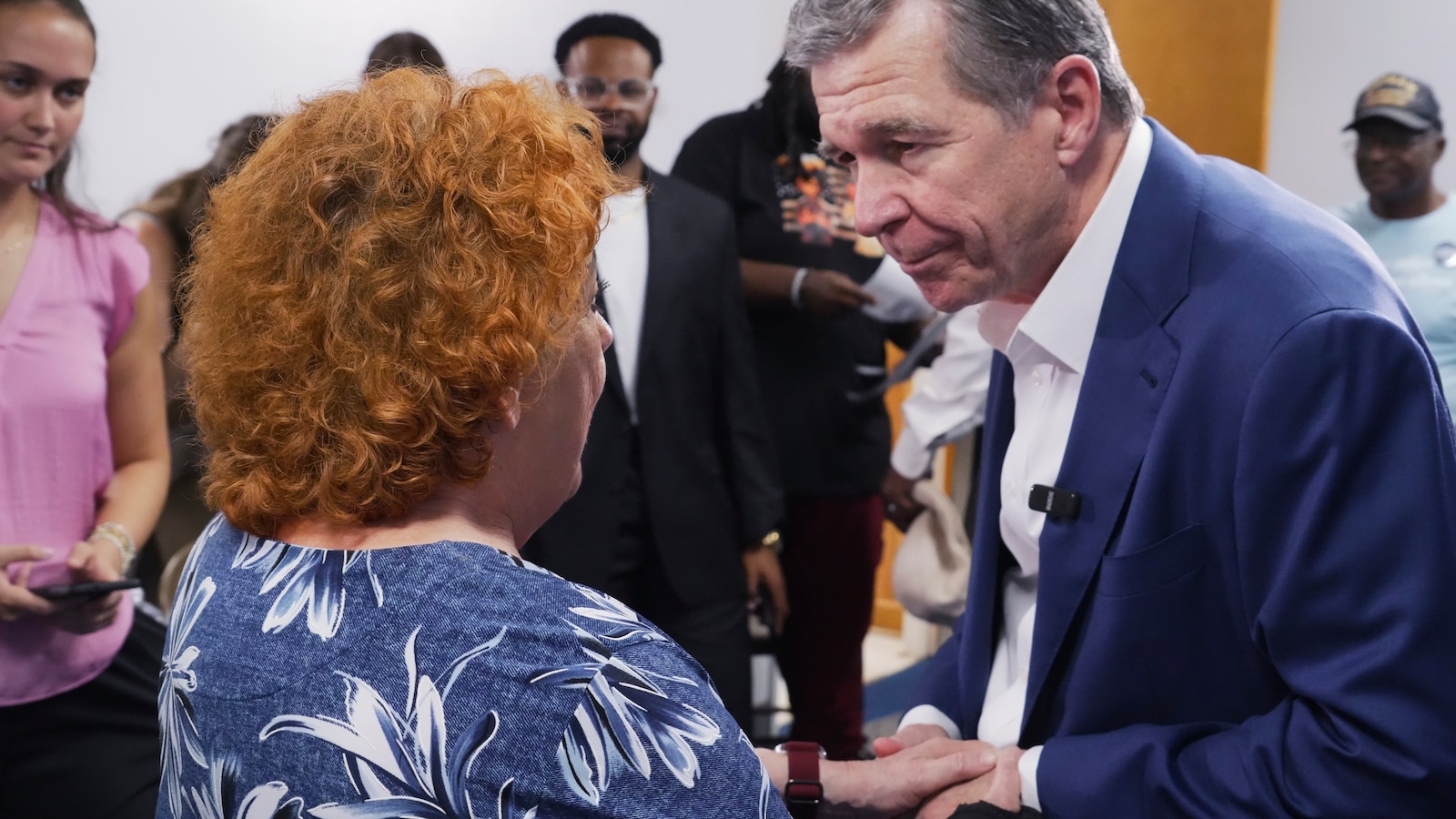
Known for forging compromise with the Republican-led legislature during his two terms as governor, Roy Cooper argues in his Senate campaign that Democrats should be willing to do the same in Congress.
Cooper also served as state attorney general, and one of his ads says he “toughened bail laws, went after drug dealers pushing fentanyl and said, ‘No way do we defund the police.’” Another says Cooper “bucked his own party to oppose defunding the police” and “partnered” with the Republican president to crack down on drugs.
Conservatives and allies of Republican nominee Michael Whatley, former chairman of the Republican National Committee, have tried to link Cooper to national progressive figures like New York Rep. Alexandria Ocasio-Cortez, former Vice President Kamala Harris and Vermont Sen. Bernie Sanders, an independent who caucuses with Democrats.
When Cooper entered the race more than a year ago, the Senate Leadership Fund — a Republican super PAC affiliated with Senate Majority Leader John Thune — swiftly attacked him by saying he “masquerades as a moderate” but is ”just another radical, D.C. liberal in disguise.”
Earlier this month, Cooper explained a bit of his strategy to CNN, saying that he felt that “there are enough people who are skeptical of national Democrats” in North Carolina, a factor he cited in the state’s tendency to elect Democrats to statewide offices more often than its congressional offices.
In Alaska, former Rep. Mary Peltola has tried to steer the same centrist path as in her House campaigns, reviving her “fish, family, freedom” slogan and expressing support for Second Amendment rights and border security — two issues that traditionally resonate with more conservative voters.
“I’ll take on anyone, including Democrats, anyone in the Lower 48 who doesn’t understand what Alaska needs,” she said in one campaign advertisement that mentioned her support for the massive Willow oil project on Alaska’s petroleum-rich North Slope that was opposed by environmentalists. “When both parties are attacking you, you’re doing something right.”
Peltola’s tone hasn’t kept incumbent Republican Sen. Dan Sullivan from seeking to align Peltola with “D.C. Democrats,” as well as characterizing her as ineffective during her time in Congress.
Meanwhile, in Iowa, Democratic nominee Josh Turek has emphasized his commitment to bipartisanship, highlighting hundreds of times he voted with Republicans as a state legislator. He represented a district won by Trump, and he leaned on that experience in this year’s Senate race as evidence that he could appeal to independent and moderate Republican voters in November.
As he vies with Republican Rep. Ashley Hinson for the seat of retiring Republican Sen. Joni Ernst, Turek is also running an ad decrying the U.S.’ “broken immigration system,” saying, “I’ll work with anyone to fix it, including President Trump.”
After Turek won the nomination, Hinson told delegates at Republicans’ state convention that he was “masquerading as a moderate,” calling her opponent “a far-left fraud.”
Pastor of a Kansas megachurch, Democratic Senate nominee Adam Hamilton describes himself as a centrist, running partly on “bringing people together” and noting that his congregation is nearly evenly split among Democrats, Republicans and independents.
That’s the tenor Hamilton has brought to his campaign against Republican incumbent Sen. Roger Marshall, running ads noting that Kansas is “proud of being in the middle politically” and “about a million miles away from the extreme politics of Washington that are tearing us apart and driving up prices.”
“On one side, the far left pushes socialism and open borders,” he said. “On the other side, Roger Marshall gives us higher gas and grocery prices, while slashing our healthcare.”
In a debate earlier this month at the Kansas state fair, Hamilton also wasn’t shy to blame Biden for immigration problems while also criticizing Trump’s policies.
“Immigration at the border under Biden was a disaster,” Hamilton said. “That is how we ended up where we are today.”
Marshall has said Hamilton is “too woke for Kansas.”
It’s not just Senate contests in which Democratic candidates are seeking to chart a new course.
Back in Iowa — where Democrats see an opportunity to win in a once-competitive state, with high costs, manufacturing job losses and a struggling agricultural economy weighing on voters — Democrat Rob Sand says he can win over independents and Republicans frustrated with party politics.
Central to his campaign message is the premise that America’s political system is broken “largely because it’s run by two private clubs” — the two major parties — “the well fed versus the fed up.”
Republican nominee Zach Lahn has said Sand’s critique of his own party isn’t genuine. Appearing on the “Ruthless” podcast this summer, he said that Democrats “are realizing that their ideas don’t sell” and ”have to pretend to be somebody they’re not.”
___
Meg Kinnard can be reached at http://x.com/MegKinnardAP.
