






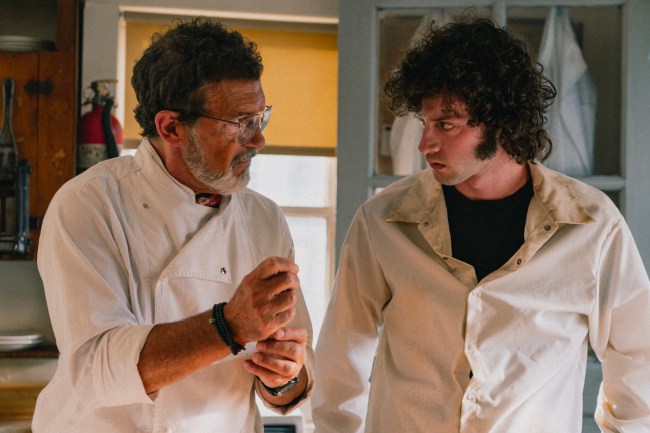
The second and third chapter of Anthony Bourdain’s best-selling book “Kitchen Confidential: Adventures in the Culinary Underbelly” tell the story of the famous chef’s three college summers working in Provincetown restaurants on Cape Cod in the mid-‘70s. Those three summers — along with borrowing details and characters from later “Kitchen Confidential” chapters of Bourdain’s time in New York, along with writer/director Matt Johnson’s own research — are combined into the story of one summer, in 1975, in the new A24 biopic “Tony.”
The film stars Dominic Sessa as a young Bourdain, who — as the author, chef, and TV personality once described himself — was a “spoiled, miserable, narcissistic, self-destructive, and thoughtless young lout.”


With “Tony,” Johnson partially fictionalizes the story of Bourdain’s Cape Cod summers to explore how that miserable Vassar College student started becoming the beloved personality who first broke into the public consciousness with “Kitchen Confidential,” and later became a star with his television series “No Reservations” and “Parts Unknown.”
“We’ve restricted our timeline to be one summer, but this movie really is about the genesis of an adult persona,” said Johnson on an upcoming episode of the Filmmaker Toolkit Podcast. “And so I need actually to draw more in to compress this.”
On the podcast, Johnson broke down what was real, and where and why he took poetic license in this unique biopic.
Bourdain’s Self-Mythologizing and Girlfriend


In his memoir, Bourdain often doesn’t go too far into details about his personal life during his Cape Cod years. For example, he informs the reader he initially followed a college girlfriend to Provincetown, but adds, “the less said about that the better.”
“Don’t think I didn’t love that line,” laughed Johnson, in discussing how Bourdain’s book gave permission to fill in the blanks and fictionalize. Johnson created the story of Nancy (Emilia Jones), who is not a girlfriend, but a crush who Bourdain foolhardily (and under false pretenses) follows to Provincetown after not getting a writing fellowship. But it wasn’t only Bourdain’s omissions in the two short Provincetown chapters that gave Johnson permission to creatively fill in the gaps, but also the fact Bourdain was concocting the legend of himself.
“The attraction here was that there was so little information about it, and 95 percent of it was Bourdain’s own self-report. And so not only am I getting a list of facts, dates, details, and places from Anthony Bourdain, I’m also getting it through the psychology of him as a 40-year-old man mythologizing his own youth,” said Johnson. “And so it’s doing this double duty for me, where not only do I get to compose a story around the details that he gives me, I also get to understand, almost through inversion, his feelings about it.”
In other words, Bourdain himself took poetic license in telling his story of his college years through the lense of who he became at age 40, something Johnson felt gave him himself permission to do the same.
“The publisher did this amazing thing, they released a 25th anniversary edition of the book, where Bourdain himself goes through it with a big, black marker, and he writes- over the things that he was lying about,” said Johnson. “And so it’s this rich psychological text where he’s trying to present himself, but he’s self-conscious about it. And it formed the basis of the movie. And it was lucky that, there was so little [detail].”
Bourdain’s Mother: Johnson’s Own Life
Bourdain is similar to other Johnson protagonists, often played by the director himself (“Tony” is the first time Johnson doesn’t act in one of his own films), who take part in the art of self-mythologizing and trying on different masks of projecting who they want to become as adults.
“The movies I make, people think they’re about me, but really they’re about a kind of superhero persona that I play. I am not Matt from ‘Nirvanna the Band,’ I’m not Matt from ‘The Dirties,’ I’m much closer to Dominic Sessa’s portrayal of Anthony Bourdain in this film.”
It’s in this sense that some of the gaps Johnson fills in with “Tony” are from his own life. This is especially true of the fictionalize role of Bourdain’s disapproving mother (Dagmara Dominczyk), whose dismissiveness and disapproval in the film drives Bourdain to run away to Provincetown, and Johnson admits is based on his own biography, not Bourdain’s.
“The uncomfortable truth is I struggle in my other films to be honest about what my life was actually like, what my childhood was like,” said Johnson. “[The story of Bourdain and his mother] really is the story of what it was like to be me when I was this exact age. And so I found it useful, it helped me understand the movie I was making by making it about myself and my own childhood as much as I possibly could.”
The Restaurant and Banderas’ Chef


No, Bourdain’s inexperience did not result in the destruction of a Provincetown restaurant, nor did he spend the summer sleeping on the hammock of his employer, the chef character played by Antonio Banderas. And while there were a number of Cape Cod chefs and kitchen workers who did leave a lasting impression on Bourdain, the Banderas character is based on a chef from a different period of Bourdain’s life.
“I also took some stuff from the later New York [chapters in ‘Kitchen Confidential’] pages as well, and Antonio Banderas’ character is really informed by Bigfoot, Bourdain’s first big boss in New York,” said Johnson, referencing the never-named, strict manager of a West Village restaurant where Bourdain worked while studying at the Culinary Institute of America.
The Flagship, the restaurant Banderas’s owns and operates in “Tony,” is an amalgam of two different, real-life Provincetown restaurants where Bourdain worked: “The restaurant The Flagship, which Bourdain calls The Dreadnaught [the establishment switched names] in ‘Kitchen Confidential,’ which has since shut down and has now become a very expensive summer home, and I combined it with Ciro and Sal’s, and I turned it into one restaurant.”
According to Johnson, the real-life Flagship was far more similar to the seafood restuarant in “Tony,” explaining, “Ciro and Sal’s is an Italian restaurant that was, in Bourdain’s own words, much more popular.” This reason for including details from Bourdain’s Ciro and Sal’s kitchen is it represented the chef’s first job and experience as dishwasher, before rising through the kitchen ranks — a real-life, three summer trajectory that is condensed into one summer in “Tony.”
Provincetown: Johnson’s Own Research
If you are familiar with Johnson’s work, you are aware of the vital role his beloved hometown of Toronto plays in his films, especially in his most recent film “Nirvanna the Band the Show the Movie.” “Tony” would be his first film not set in Toronto, and Johnson felt the need to move to Provincetown in the off-season — following the 2025 SXSW premiere of “Nirvanna the Band the Show the Movie” — and live on Commercial Street where Bourdain worked, while writing a draft of the screenplay.
“I made it my mission to meet every single person who knew Anthony Bourdain,” said Johnson. “I heard amazing new stories, both confirming and denying accounts of what Bourdain writes about, places he went. I got taken everywhere, and all the things that I heard wound up in the screenplay.”
“Tony” opens in select theaters today, and goes nationwide on Friday, August 21.
To hear Johnson’s full interview, publishing on August 20, subscribe to the Filmmaker Toolkit podcast on Apple, Spotify, or your favorite podcast platform.


