


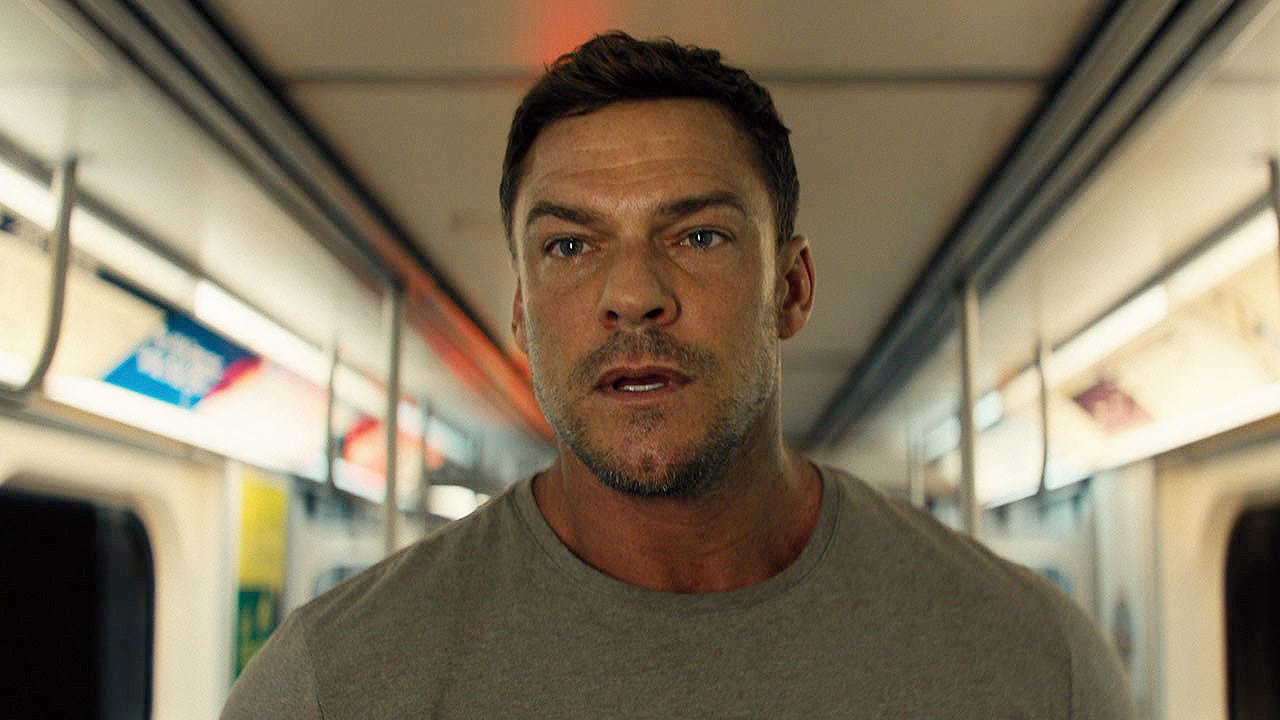
Season 4 of Reacher premieres Wednesday, August 12, on Prime with the first three episodes; subsequent episodes debut each Wednesday until September 16.
Adapting Lee Child’s 13th Jack Reacher novel, Gone Tomorrow, was never going to be an entirely straightforward exercise in 2026. Obviously, I can’t quite explain why; if I did, non-readers would still be able to connect enough dots to ruin at least one of the twists in the latest live-action adventure of Prime’s premier skull-pounding ex-MP. Broadly, however, the backgrounds and motivations of Gone Tomorrow’s villains simply weren’t going to work in the present day, with 17 years having passed since the book’s publication.
As such, Reacher Season 4 takes more creative liberties than ever before while unfurling its eight-episode story. However, it doesn’t just change the entire aforementioned backstory and motivations of the core bad guys; it also weaves in a far grander ultimate threat as well as entire stretches of plot that are completely unique to the TV adaptation. The upshot is that this is perhaps the least predictable season yet for entrenched fans who’ve already devoured the novels. However, it’s also arguably the most frustrating, seeing as these alterations have resulted in the show sidelining at least a couple crucial components of the Reacher formula.
Season 4 finds Alan Ritchson’s always-wandering Jack Reacher in Philadelphia. The novel was set in New York, but Philadelphia seems similar enough; besides, Season 2 already did New York (despite the source novel for that being set in California). The long-running book series has seen Reacher in the Big Apple on multiple occasions, but it certainly wouldn’t make sense for the city to suddenly be the primary setting for half the Prime Video series aired to date.
At any rate, I will say that the “small town, big city, small town, and back again” cadence definitely doesn’t feel coincidental at this point, especially since we know that Season 5’s source novel — 2015’s Make Me — has already been locked in and will again return Reacher to small-town America. I continue to believe that it’s the right play to swing between backdrops; it makes the series feel like it’s truly shifting gears between seasons.

As Season 4’s story begins, Reacher finds himself drawn into a random encounter in a sparsely filled subway carriage, as his training compels him to approach a visibly distressed woman named Anna Merrick. She’s showcasing a number of signs that Reacher immediately finds impossible to ignore, but while his instincts initially steer him towards an incorrect assumption, Anna’s next move drags Reacher into a police investigation. This quickly widens into a twisted and wide-reaching conspiracy, with a shady government agency, hired mercenaries, a pair of foreign nationals, and a former special forces operator-turned-US congressman clashing with Reacher as they work to track down a USB drive Anna is purported to have had in her possession. This MacGuffin drives the bedlam (and the body count) for some time, until the season quickly mashes the throttle for an escalation that leaves the original novel in the rearview mirror. I can concede it makes for a more traditionally explosive television finale, but I’d argue that it arrives as a pretty worn out crescendo we’ve seen a hundred times before.
As with previous seasons, Reacher picks up a number of new allies, including Philly detective Tamara Green (GLOW’s Sydelle Noel) and Anna’s brother Jacob (Christopher Rodriguez-Marquette), who is a small-town cop himself. They’re actually a lot more present in this season than I’d expected considering Gone Tomorrow the novel is a slightly more solitary affair that sees Reacher slogging his way through most of the story’s encounters solo.
It’s a competent supporting cast, and their characters carry credibility as investigators thanks to their law enforcement background, but the only memorable standout is Tamara’s partner Docherty, played by veteran character actor Kevin Corrigan (True Romance, Superbad, The Pineapple Express). Corrigan absolutely nails his role as an exhausted veteran detective with limited patience for Reacher’s schtick. He doesn’t get a ton of screen time, but what he does receive is actually a little more in line with what I’d expected for the side characters this season.
Unfortunately, Season 4’s villains are far less convincing. They’re ruthless and awful — the perfect combination for a Jack Reacher death sentence — but they’re thinly drawn. It takes a while to wheel them out, but this is admittedly in line with the Gone Tomorrow novel. They don’t have much in the way of great dialogue; in fact, some of it is quite poor, with one particularly exposition-heavy exchange coming across as unnecessarily detailed and rather forced considering how long they’ve apparently known each other.
They also seem to have survived way longer than their decision-making skills should have allowed. At one stage, they bring literal knives to a gunfight, and only live because the script lets them monologue when the novel Reacher would have just made sure they were each shot in the face. Ritchson’s TV Reacher definitely also began life as an uncompromising force that doesn’t fight fair and never waits until the count of three, so scenes like this continue to play as disappointingly off-brand. I’m sorry, but knives do not move faster than bullets.
Fortunately, Season 4 still regularly lets its man mountain off the leash, and the best thing about the series unambiguously remains Ritchson’s Reacher himself and the crunching fight scenes he finds himself in. Reacher is still a principled yet completely remorseless killer when the situation requires, and I live for his largely emotionless pre- and post-action ultimatums. These quips are always delivered unironically with a mix of ice-cold military sternness and almost child-like honesty: “I’m good at not letting people get away with things,” he says early on. While his expressions are typically blank, they always leave me grinning, and I commend the show’s habit of wheeling them out at the perfect moments and not overusing them to the point of parody. Frankly, I love how uncomplicated they tend to be too; hell, Reacher’s remarks are at their very best when he loads the promise of a dramatically shortened lifetime of pain into a single word.
“What’s the signal?” asks one of Reacher’s allies as Reacher prepares to split from the group and attack an encroaching group of goons from behind. His reply is one, deeply satisfying word: “Screaming.”
