



A team of researchers has identified a possible atmosphere around an Earth-sized planet.
The researchers, from the University of St Andrews, have today published two separate papers on planet TRAPPIST-1e.
They say liquid water, in the form of a global ocean or icy expanse, might exist on its surface.
Published in the Astrophysical Journal Letters, researchers say the James Webb Space Telescope (JWST) is a step closer to solving whether or not the planet has an atmosphere.
TRAPPIST-1e is the fourth planet in the red dwarf star system TRAPPIST-1, which is located in the constellation Aquarius, and is around 40 light years away from Earth.
The planet orbits firmly within the star’s habitable zone, and has a mass comparable to that of Earth.
This is the first search for an atmosphere and surface habitability on the planet with the JWST.
Planet 1e is of particular interest because the presence of liquid water is theoretically viable, but only if the planet has an atmosphere.
The initial results indicate several potential scenarios, including the possibility of an atmosphere.
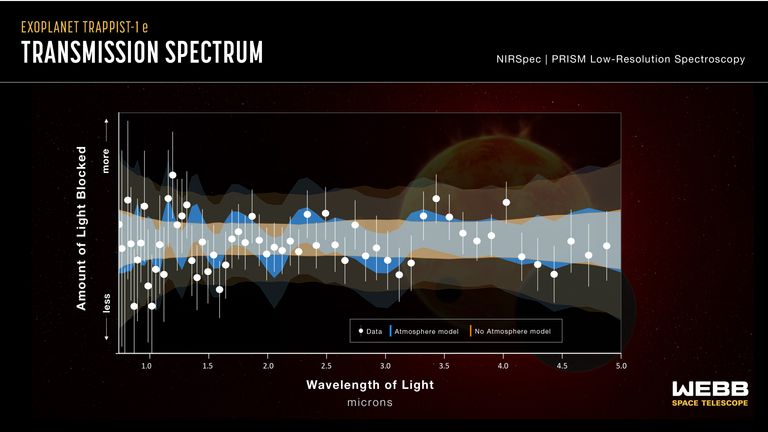
Researchers can’t yet confidently rule out an atmosphere since many of the data points fit either scenario. Pic: NASA, ESA, CSA, J. Olmsted (STScI)
These findings are a significant moment in the search for habitable conditions beyond Earth.
Dr Ryan MacDonald, lecturer in extrasolar planets in the School of Physics and Astronomy at the University of St Andrews, said: “TRAPPIST-1e has long been considered one of the best habitable zone planets to search for an atmosphere.
“But when our observations came down in 2023, we quickly realised that the system’s red dwarf star was contaminating our data in ways that made the search for an atmosphere extremely challenging.”
Read more from Sky News:
‘Blood moon’ captured in photos across the world
Goodbye summer – get ready for a wet and windy autumn
The researchers aimed the JWS telescope’s powerful NIRSpec (Near-Infrared Spectrograph) instrument at the system as planet 1e passed in front of its star.
Starlight passing through the planet’s atmosphere, if there is one, will be partially absorbed and the corresponding changes in the light spectrum that reaches the JWST tell astronomers what chemicals are found there.
But astronomers must also carefully account for starspots, spots created by local magnetic fields on the surfaces of stars, from the red dwarf star.
The team spent over a year correcting the data for the star’s contamination before they could zero in on the planet’s atmosphere.
Dr MacDonald, who contributed to the analysis of TRAPPIST-1e’s spectrum, added: “We are seeing two possible explanations.
“The most exciting possibility is that TRAPPIST-1e could have a so-called secondary atmosphere containing heavy gases like nitrogen.
“But our initial observations cannot yet rule out a bare rock with no atmosphere.”
The researchers are now obtaining further JWST observations of the planet to enable a deeper search for an atmosphere.
With each additional transit, the atmospheric contents become clearer.
Dr MacDonald added: “In the coming years we will go from four JWST observations of TRAPPIST-1e to nearly 20.
“We finally have the telescope and tools to search for habitable conditions in other star systems, which makes today one of the most exciting times for astronomy.”
