






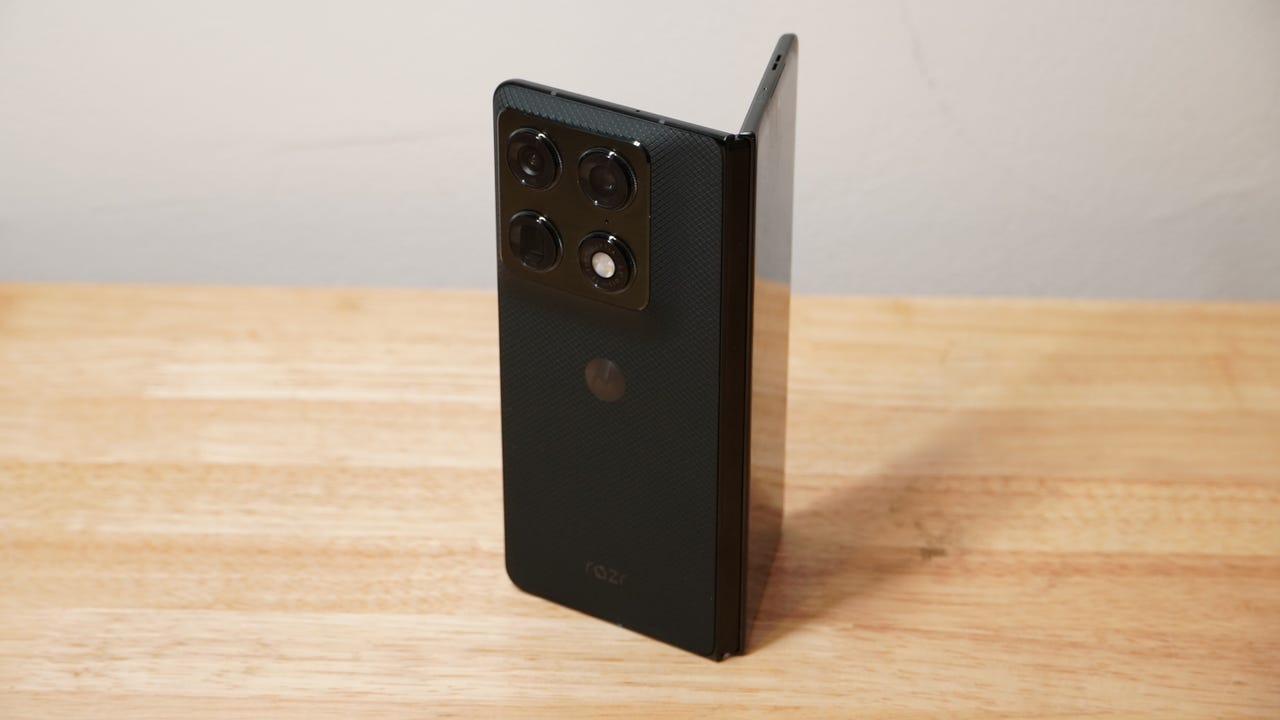
The Motorola Razr Fold takes the Razr family to a new dimension. While earlier foldables from Motorola followed in the footsteps of the original Razr, offering a flip-phone style footprint, the Razr Fold opts for a hotdog fold, akin to what Samsung has offered from its Galaxy Z Fold lineup. Motorola hasn’t taken generations of iterations on this design to get to a very solid point, though. The Razr Fold is impressively thin and looks like all the experience gained from the earlier Razr foldables is paying off big. At $1,899, it’s not a cheap option, but it may still have what it takes to earn your money or at least due consideration.
Motorola Razr Fold – Design and Features
As mentioned, the Razr Fold opens like a book rather than an old school flip phone. Where Samsung’s early folders were normal-size while open and double the thickness of a typical smartphone while closed, the Razr Fold has jumped straight to ultra-thin dimensions.
Closed up, it looks almost like any other smartphone, and it’s a pretty one with a textured, rubberized back. It’s a little thicker than most, and the camera bump adds quite a bit of depth (that’ll prove worthwhile), but it doesn’t feel unusually large. Unfolded, it becomes impressively thin at 0.19 inches to edge out even the Samsung Galaxy S25 Edge or iPhone Air – camera bumps aside. The hints that it’s a foldable are the asymmetry and the seem running around the perimeter of the phone. It is a bit on the heavy side at 8.6 ounces, but that’s not so crazy next to the 8 ounce iPhone 16 Pro Max.


Folded shut, the 21:9 exterior display is a large 6.6-inch, 1080×2520 panel, and it opens up to reveal an even larger, nearly square 8.1-inch, 2232×2484 internal display. Both screens are sharp and bright LTPO pOLED displays with the internal reaching 120Hz and the external hitting 165Hz. For ultra-wide cinema, the external display will probably be the one to go with, and then it won’t really stand out from the crowd of bigger flagship phone displays. But for the wealth of 16:9 content out there (or even squarer formats like 4:3 or The Snyder Cut), the internal display can provide a larger surface for viewing than the competition. That inner seam where the phone folds remains a minor nuisance. It shows glare readily, and it’s all the more apparent when displaying dark content or viewed at an off angle. You can also easily feel it when swiping across. That said, when the screen is lit up and you face it head-on, the seam mostly vanishes.
Either way, both screens can look gorgeous in the right conditions, and even though they love to show finger oils and glare on the interior folding seam is apparent, they push out enough brightness to easily get past that glare. You won’t want to treat the two displays the same, though. The exterior has Gorilla Glass Ceramic 3 that should withstand drops and scrapes a lot better than the internal display’s Ultra Thin Glass.
While you’ll want to be gentle with the phone, it’s still tougher than early foldables. It has an IP49 rating to keep a good deal of dust and debris out (just don’t fold it closed with a bunch of crud inside. It can also withstand submersion in freshwater and water jets.
It’s truly a shame we as a body of consumers let smartphone makers get away with killing the microSD card slot, because the Razr Fold likely could have had one. The SIM try in the phone is extra long, with easily enough space to accommodate two SIMs or a SIM and a microSD card, yet it only holds one SIM card. I might have accepted space constraints as an excuse if the SIM tray didn’t just have dead space built in.
Motorola includes facial recognition for sign-in. It also has a fingerprint scanner built into the power button, which makes it conveniently accessible whether using the phone folded open or closed.
Motorola has a bonus for creatives and handwriting enthusiasts. The Razr Fold supports a pressure-sensitive active stylus, and it worked quite well in my brief testing with it. I’d be careful about pushing too hard on the internal display, though. It’s also an optional accessory (i.e., even more money out of your pocket), and it doesn’t attach to the phone or charge from it either. It has its own separate charging sleeve that it inserts into for storage and recharging.
The speakers on the Razr Fold are decent, offering loud stereo sound that’s a decent match for the display.
Motorola has fitted a 5Gbps USB-C port with DisplayPort 1.2 output, letting the Razr Fold connect to an external display and work as something of a portable computer.
Motorola Razr Fold – Software
The Razr Fold is pricey, so it’s good to see that Motorola isn’t holding back on long-term support. The company is promising seven years of Android OS and security updates, which helps keep it competitive with Samsung and Google on those fronts.
The software itself is a tame implementation of Android. The phone came running Android 16, and it’s not heavy handed about AI features or bloated with unwanted software, though there is a button dedicated to recording notes, making images and quickly tapping into other AI features. The OS is fairly flexible with customization as well. I found the default quick setting buttons a little large, but the OS let me shrink some of them down. I could also go from a 4×6 home screen app grid to a 5×7 to get more apps just a tap away.
Motorola Razr Fold – Gaming and Performance
The Razr Fold doesn’t feature Qualcomm’s top-of-the-line chip, but it comes close with the Snapdragon 8 Gen 5, which gets 16GB of memory and 512GB of storage. This is a chip I saw in the OnePlus 15R, which mustered solid performance, and though the Razr Fold is wielding this chip in a much thinner chassis, it nearly keeps up. It’s not quite up to iPhone 17 or OnePlus 15 speeds, but it’s no slouch. The sustain is also impressive.
The phone performed surprisingly well for how thin it is. I played over a half hour of Neverness to Everness with the graphics settings at their max cinematic level, and though there was the occasional stutter, the game generally ran smoothly at 60FPS. At the end of my session, the phone wasn’t even noticeably warm. It even managed 70% consistency in 3DMark’s Steel Nomad Light stress test.
The Razr Fold’s performance is enough to rival the Galaxy Z Fold 7 and even the new Galaxy Z Fold 8 Ultra despite the latter’s more advanced Snapdragon 8 Elite Gen 5 chip. In my colleague Jackie’s review, the Galaxy Z Fold 8 Ultra could struggle under sustained loads. It started the Steel Nomad Light stress test with a high score of 1641 and sank down to 1,296 by the end of the 20-run gauntlet. That may have been more stable technically, but the Razr Fold started out higher at 2289 and finished with a low of 1600 points. It had also settled into a groove after 5 runs, so it seemed unlikely to ever sink as low as Samsung’s fold in the test.
The fact that Jackie found the Galaxy Z Fold 8 Ultra uncomfortably warm to the touch after gaming while the Razr Fold was chilling puts the Razr in a great position to be the better gaming device.
The phone has a sizable 6,000mAh battery despite its thinness, and it’s even willing to take some pretty fast charging. It can juice back up at 80W from a wired connection of 50W from a wireless one. Sadly, even with some magnetism going on at the back of the phone, it doesn’t support Qi2. While battery life can vary dramatically from person to person, I was easily able to get through the day even while squeezing in some time gaming on the big screen.
Motorola Razr Fold – Cameras
Motorola didn’t skimp on the cameras included in the Razr Fold. It decked out the rear with a triple-sensor setup to rival Samsung, OnePlus, and Google, and it even has a couple of sharp selfie shooters. Here’s a quick rundown of what’s on deck:
- 50MP wide, f/1.6, 2.44-micron, 1/1.28”, OIS
- 50MP ultrawide, f/2.0, 1.28-micron, 1/2.76”
- 50MP telephoto, 3x optical zoom, f/2.4, 1.6-micron, 1/1.95, OIS
- 20MP exterior selfie, f/2.4, 1.22-micron, 90-degree FOV
- 32MP interior selfie, f/2.4, 1.28-micron, 88.5-degree FOV
I can’t say that the camera system is faultless, as it occasionally exhibits some oversharpening on the telephoto sensor, and it can get a bit soft and noisy in dimmer settings, but beyond those fairly common faults, it is excellent.
The cameras blend together well, matching one another’s color and dynamic range for a great consistency between shots. The sensors capture vivid color, bringing life to nature shots and street scenes alike. The cameras also snap sharp photos for loads of detail even when zooming in on them a bit. It’s just a bonus that the internal display’s squarer aspect ratio is all the better for previewing and reviewing the 3:2 photos that cameras will take.
The zoom is actually exceedingly strong. Though it has just a 3x optical, the 50MP sensor is happy to keep cropping in a bit further, and it has some impressive results. I could snap photos of details well beyond what I could see with my own eyes.
The sensors also do a great job handling macro shots, letting me get much closer to small subjects than I’m used to. The selfie sensors are no slouches either, snapping crisp photos with natural exposure. All of this combines to make the Razr Fold a rather excellent all around shooter for big and small subjects near and far.
The Samsung Galaxy Z Fold 8 Ultra may have added in some higher-end cameras for this generation, but it will likely have its work cut out for it beating the Razr Fold. Motorola included a bigger, higher-res telephoto sensor than the Z Fold 8 Ultra’s 10 megapixels, and the main sensor here may be lower resolution, but it’s offering a slightly wider aperture, bigger sensor, and bigger pixels.


