








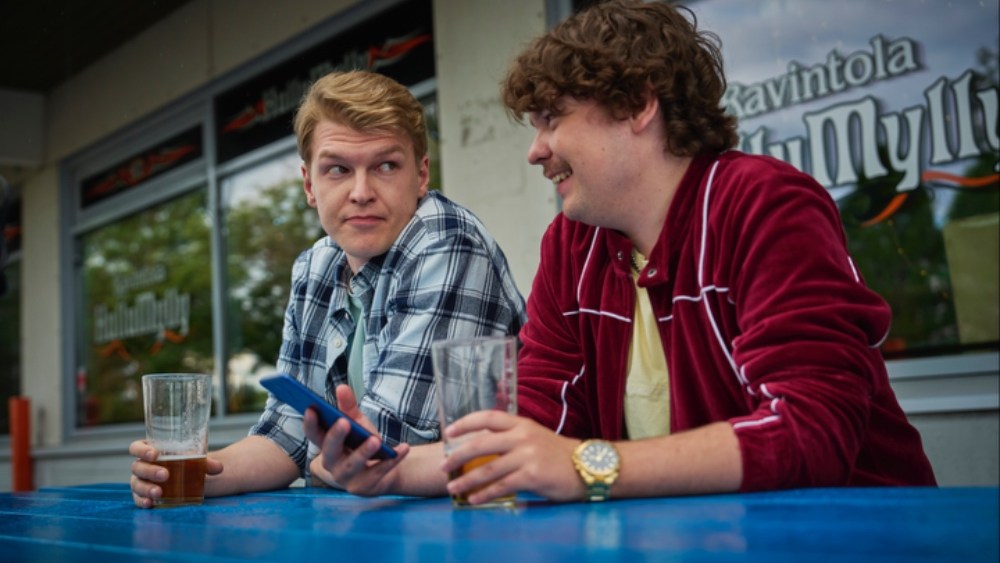
Finnish production company Whatever Pictures has signed a new global sales deal with ORF-Enterprise, part of Austrian braodcaster ORF, which has acquired international distribution rights to the comedy drama “Crème de la Crème.”
Commissioned domestically by Finnish broadcaster YLE, the show is written and directed by showrunner Jukka Vidgrén, Topi Koljonen, Henna Rinnekangas, Juuso Laatio and Anna Heinämaa. Vidgrén and Antti Kaarlela produce.
It follows Joonas, a young farmer, who lives on his childhood dairy farm and takes pride in the rural lifestyle. He enjoys the work, but the farm is on the brink of collapse, with no clear future in sight. That is until he sets up a booming sperm bank business with the help of his friends.
Armin Luttenberger, Head of Content Sales International at ORF-Enterprise, noted that it is the “Finnish identity” of the show that makes it distinctive.
“Still, the underlying themes are highly universal: ambition, economic pressure, friendship and the question of how far you are willing to go to secure your future. It feels very local without being culturally closed, which is often a strong combination for international audiences,” he said.
It’s not exactly what most viewers would expect from the Nordics.
“Yes, and that is one of its strengths. Nordic drama is still often associated internationally with crime, darker tones and a certain visual restraint. ‘Crème de la Crème’ brings a much more playful and irreverent energy. It is still unmistakably Nordic in its setting and sensibility, but it shows a different, more humorous side of the region.”
That doesn’t mean that crime doesn’t pay anymore.
At Mipcom, Whatever Pictures presented “Three Fires,” a border thriller set in North Karelia, and “Ice House,” an international assassin thriller co-written by Marteinn Thorisson and Puranen.
The company is also joining forces with Norway’s Rein Film on the new scripted crime series “Silent Herd,” currently in development.
Set in a contemporary Sápmi community – during the polar night – it shows an investigator who is forced to return to the village they fled in their youth after a traumatic childhood marked by bullying and exclusion.
“When suspicious deaths begin to expose old wounds within a powerful reindeer-herding family, the investigation becomes both a murder mystery and a personal reckoning,” said producer Aleksi Puranen.
“We want the series to be gripping and atmospheric, but also more specific than a traditional Nordic noir. The landscape, the darkness, the family histories, the silence of the community and the pressure of unresolved trauma are all part of the storytelling.”
Rein Films’ Mathis Ståhle Mathisen explained that the collaboration felt “very natural” – for several reasons.
“Firstly, Sápmi is a region that extends across national borders, including both Norway and Finland, so a Finnish-Norwegian collaboration is a logical creative and production choice for a story rooted in that world.”
Secondly, Whatever Pictures and Rein Film had already worked together on “A Midnight Sun Affair.”
“We discovered that the two companies share similar ambitions: to tell stories from the North with authenticity, strong local voices and international ambition. ‘The Silent Herd’ felt like the natural next step.”
They will once again be working with director Ken Are Bongo and writer Jens Martin Mienna.
According to Kaarlela, the Sápmi world, its language, land, family, reindeer herding, sense of belonging and silence are all integral to the story.
“At the same time, we’re very aware that this world must be approached with care. We are not looking at the Sámi community from the outside. Key creatives on the project, including Ken Are Bongo and Jens Martin Mienna, are Sámi themselves, and we are developing the series closely with them. As with ‘A Midnight Sun Affair,’ we carefully follow Sámi guidelines and cultural protocols.”
Fittingly for a crime thriller, the series explores “darker human territory: violence, shame, revenge and power within a small community.” But these are not presented as “Sámi traits,” he emphasized.
“They are the dramatic territory of the genre, explored through specific Sámi characters and a specific Sápmi setting. The important thing for us is that the world is truthful, the authorship is connected to the community, and the characters are people first.”


