








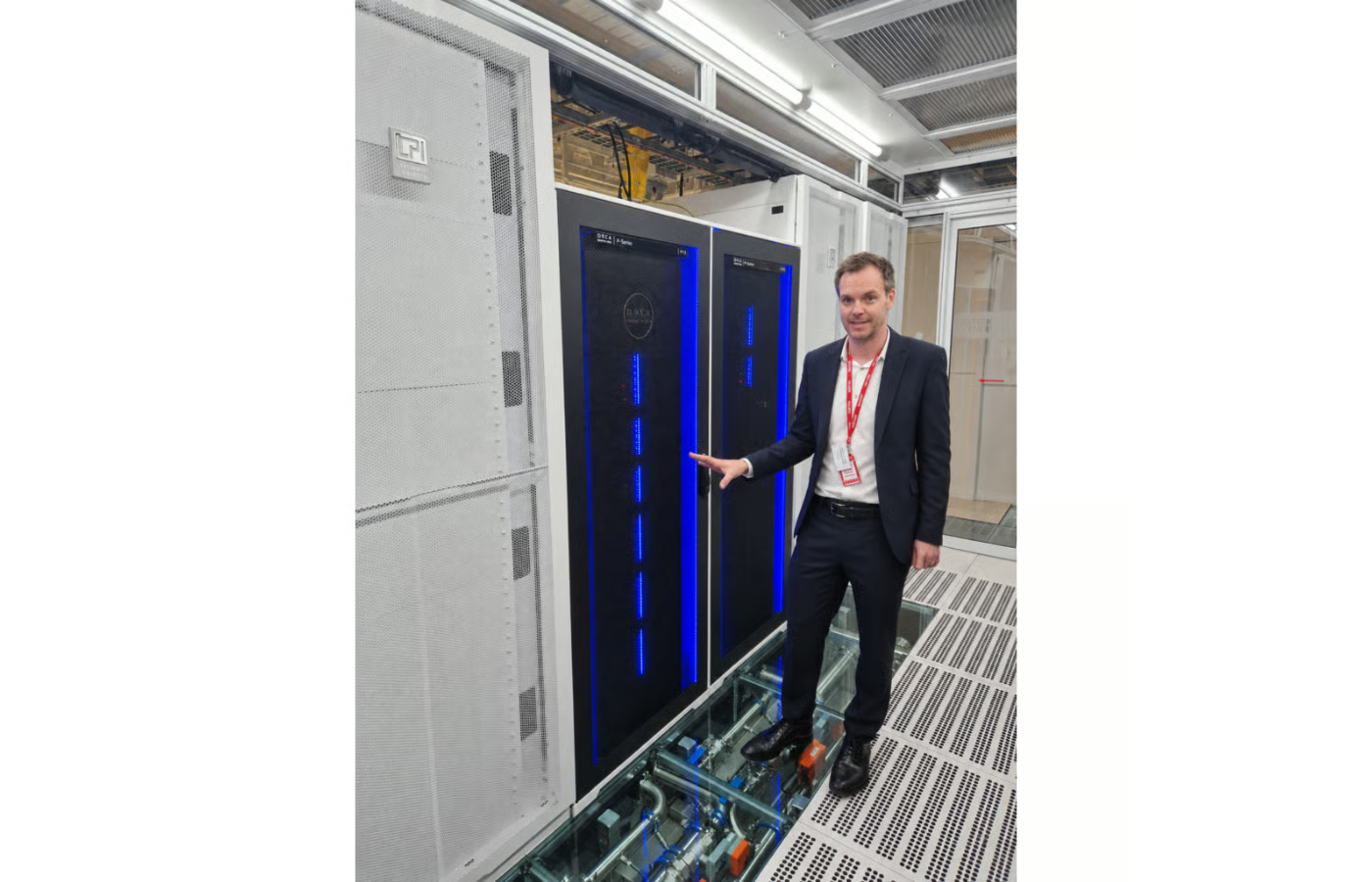
ORCA Computing has launched the PT-3, the third generation of its photonic quantum computer, and the first system is running beside NVIDIA GPUs at Digital Realty’s Innovation Lab in London.
The London company calls the PT-3 the first quantum computer built to deliver commercial quantum advantage. In its Oct. 15 launch announcement, ORCA reported a 20% improvement in its protein-designability metric and an energy-scheduling workflow that now runs more than 12 times faster than on its predecessor.
Both results use baselines ORCA selected, and the announcement does not report the PT-3’s runtime against a leading classical solver on the same problem. For data center operators, the more immediate change is physical: the system runs at room temperature in standard racks.
What the PT-3 Brings to a Data Center Rack
The PT-3’s deployment profile looks closer to server hardware than to most quantum systems:
Footprint: Two standard data center racks drawing about 6 kW at room temperature, according to Quantum Computing Report.
Weight: About 800 kg, according to DatacenterDynamics, which reported the system sits in Digital Realty’s LHR19 facility in London Docklands.
Installation: Three hours to install and fully operational within 24 hours, according to James Fletcher, ORCA’s head of solutions architecture. That timeline describes the London installation; preparation requirements and costs at other customer sites may differ.
Upgrades: Field-upgradeable, so customers keep the same system as ORCA adds capability, according to the company.
That profile contrasts with superconducting machines, which depend on dilution refrigerators, one of the main differences between trapped-ion, superconducting, and photonic systems. Some photonic systems also require cryogenic components: Xanadu and Bluefors are developing compact cooling for single-photon detectors.
ORCA also argues that location matters. Richard Murray, ORCA’s co-founder and CEO, told reporters at the launch that the AI model the PT-3 serves “does not operate anywhere near as effectively over a remote link,” according to DatacenterDynamics.
Two Benchmarks Behind the Advantage Claim
| Workload | Setup | Reported result | Compared against |
|---|---|---|---|
| Protein design | Hybrid extension of NVIDIA Proteína, trained on 32 NVIDIA Hopper GPUs with a PT-3 using 64 photons in 128 qumodes | 20% improvement in the protein-designability metric, according to ORCA | Classical Proteína baseline |
| Energy scheduling (25,755-variable unit commitment problem) | JIJ hybrid quantum-classical solver running on PT-3 | About one hour per run | ORCA’s PT-2 at the same solution quality; reported speedup exceeds 12x |
Source: ORCA Computing, Oct. 15, 2026.
The protein work extends NVIDIA’s Proteína generative model for protein design. The scheduling benchmark comes from a project led by JIJ with ORCA and the UK National Quantum Computing Centre, with bp participating as an observer.
The project’s white paper reports that Gurobi performed best within a five-minute window, while the PT-2 hybrid workflow produced the best solutions at longer runtimes. Its PT-3 results were projections rather than measurements from the new system.
What eWeek Found: The 12x Speedup Measures ORCA Against Itself
The most important takeaway from the launch may be the 12x figure, which measures the PT-3 against ORCA’s own previous generation rather than a traditional computer.
Assessing commercial advantage requires comparing the complete PT-3 workflow with strong classical alternatives under comparable conditions. For energy scheduling, that means measuring solution quality within the same time budget, or total runtime to reach the same quality, alongside computing costs. The earlier white paper tested PT-2 hardware and projected PT-3 performance. ORCA’s launch announcement reports a PT-3 runtime without a corresponding classical runtime at the same solution quality.
ORCA’s framing still differs from the usual hardware race. Most vendors lead with qubit counts or fidelity figures. ORCA leads with application results and a rack-level installation, which is closer to how enterprise teams evaluate infrastructure.
For enterprise teams, a short installation is only one part of evaluating a trial. Buyers still need to account for system access, software integration, supporting classical hardware, and operating costs. A useful pilot would compare the hybrid workflow with the organization’s existing tools against a defined target, such as better schedules within an operational deadline.
Competition in hybrid quantum computing is moving toward physical placement next to GPUs. IonQ, for example, plans to connect its Superion 256 processor to NVIDIA GB200 GPUs in 2027 at an NVIDIA quantum research center.
The concrete test is the customer trials ORCA says are underway in life sciences, defense, energy, and logistics. The result to watch for is a published PT-3 comparison against strong classical solvers on the same industrially relevant problem, reporting solution quality, total runtime, and computing cost. That would help enterprises decide whether the system’s deployment convenience translates into business value.
Read more: The US Department of Energy’s quantum computing roadmap examines how useful results could guide the technology’s next stage of development.


