









[SINGAPORE] Less than one-fifth of workers in Singapore feel their jobs are secure, reflecting growing anxiety over how artificial intelligence and workplace transformation could reshape careers, ADP said in its People at Work 2026 report.
The 15 per cent figure falls below the Asia-Pacific average of 18 per cent and the global average of 22 per cent.
Singapore ranked among the least confident markets in the region, coming in ahead of only South Korea (9 per cent), Taiwan (11 per cent) and Japan (5 per cent).
Jessica Zhang, senior vice-president for the Asia-Pacific at ADP, said the findings reveal a widening gap between “actual employment conditions and how secure workers feel about their future”.

“In Singapore, employees are not only thinking about whether they have a job today, but also whether their roles will remain relevant tomorrow,” she said, adding that AI is reshaping work by creating new jobs while transforming existing ones.
ADP’s findings were drawn from its annual Global Workforce Survey, which polled more than 39,000 working adults in 36 markets worldwide, including 13,136 respondents from the Asia-Pacific region.
None of the markets surveyed had a majority of workers who felt their jobs were secure, said ADP, noting that this came despite “relatively low unemployment in many markets”.
Younger workers in Singapore aged between 18 and 26 were the most optimistic about their prospects, with 22 per cent saying they felt secure in their jobs – the highest among all age groups surveyed.
Occupation type matters
Perceptions of job security varied significantly by occupation type.
SEE ALSO



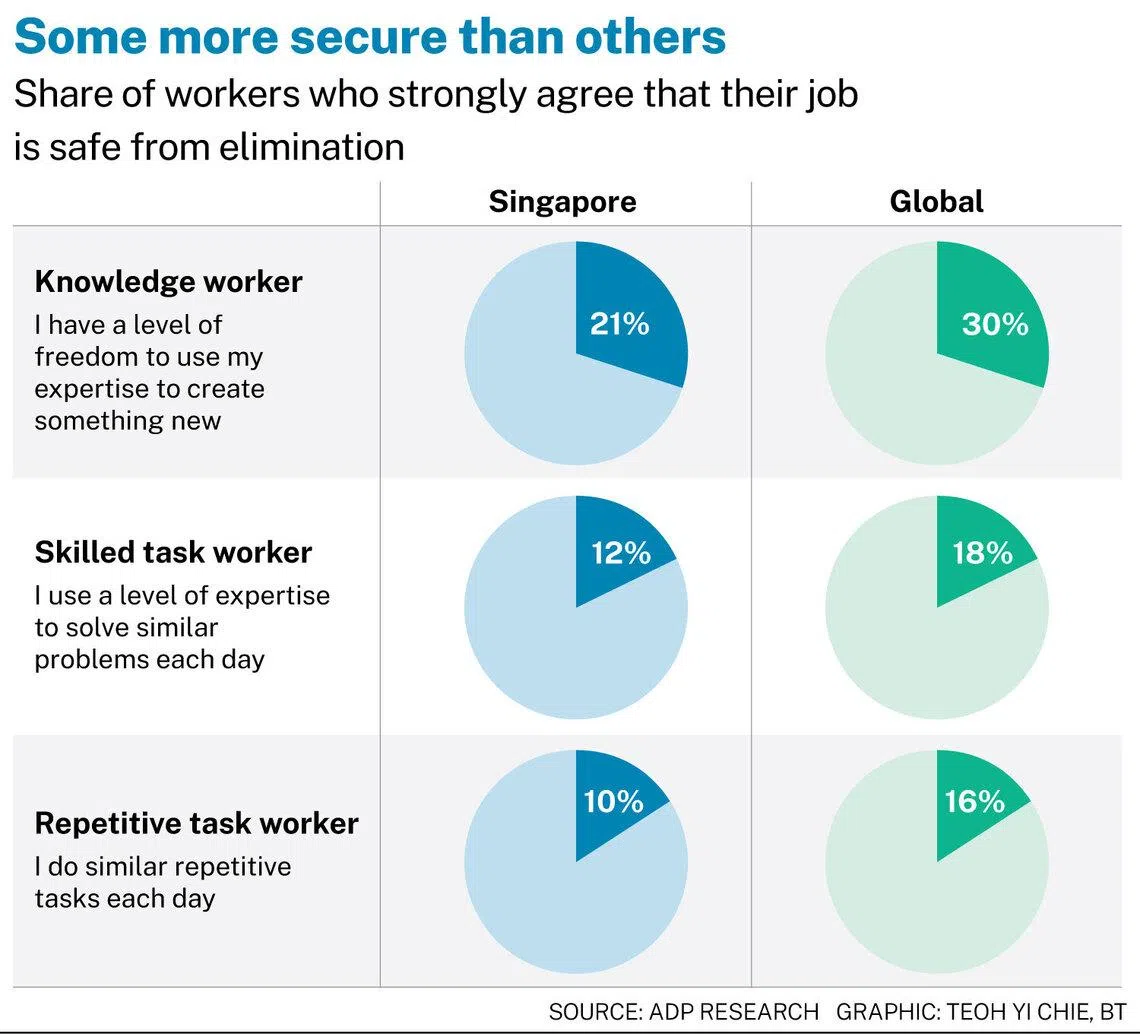
In the Republic, knowledge workers – defined as those with the freedom to apply their expertise to create something new – were the most confident, with 21 per cent expressing confidence in their job stability.
The figure came in at 12 per cent for skilled task workers – those who use their expertise to solve similar problems each day – and 10 per cent for repetitive task workers, who do similar, repetitive tasks daily.
The pattern among workers in Singapore aligns with broader trends.
Globally, knowledge workers in finance and insurance, education, healthcare and technology reported the strongest confidence in their job security.
By contrast, employees in transportation and warehousing, agriculture, manufacturing and food services – sectors with a higher number of repetitive task workers – were among the least confident.
Engagement, productivity at stake
ADP warned that job insecurity could have significant business implications.
Employees who felt secure in their roles were six times more likely to be fully engaged at work and 3.3 times more likely to report higher productivity levels.
In contrast, workers who were worried about losing their jobs were found to be less engaged, more stressed, less productive and more likely to seek alternative employment opportunities.
“Job security has become a business issue, not just a workforce sentiment measure,” said Dr Nela Richardson, chief economist at ADP.
She added that employers that “pair honest communication with meaningful skills investment” will be in a much stronger position to build a resilient workforce.
ADP also identified upskilling as a key workforce strategy to reassure employees, noting that workers reached a “sweet spot” for productivity and retention when they felt engaged, motivated and committed without being overwhelmed by stress.
Employees who strongly believed they had the skills needed to advance their careers were five times more likely to feel their jobs were secure. Those who felt their employers had invested in their professional development were 5.3 times more likely to express confidence in their job stability.
Career mobility, long-term employability
ADP also highlighted growing concerns around career mobility and long-term employability amid growing technological change.
Globally, 26 per cent of workers said they were confident that they had the skills needed to advance to the next level in their careers; nearly half felt that changing jobs had become more difficult compared with a year earlier.
“But workers 26 and younger were less likely than older workers to say job-changing had grown more difficult,” ADP noted. “This sentiment was even stronger among young workers with a college degree or its equivalent.”
Dr Richardson said that while AI has the potential to improve productivity and reshape the future of work, employers would need to invest in both “technology-based and people-based skills” to fully unlock its benefits.
She added that companies that keep “employees at the centre of change” would be better positioned to build an “AI-powered and fully engaged workforce”.
Decoding Asia newsletter: your guide to navigating Asia in a new global order. Sign up here to get Decoding Asia newsletter. Delivered to your inbox. Free.


