






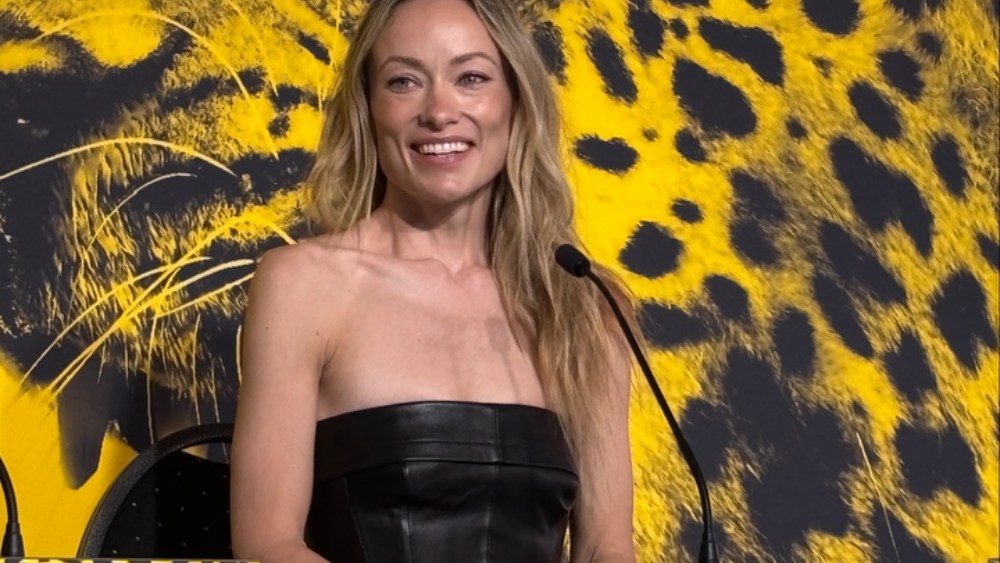
Olivia Wilde said she has become “so much more romantic” because of “The Invite.”
“It’s melted the cynic out of me,” she said at Locarno.
“I have spoken to people who have been through so much with their partners, and people have been in marriages for 40, 50, 60 years. They told me it was a very honest depiction of their own experience of really having several relationships with the same person.”
It’s Wilde’s third feature after “Booksmart” and “Don’t Worry Darling.”
“The Invite,” where she also stars alongside Seth Rogen, Penélope Cruz and Edward Norton, takes place one evening when Joe and Angela (Rogen and Wilde) invite their upstairs neighbours Piña and Hawk for a dinner party.
At first, she thought her hit film was about the end of a relationship.
“Now, I feel that it’s much more about whether a relationship can begin again with the same person, whether you can have multiple relationships with one person, and actually whether there’s more merit to that than I would have thought before,” she said.
The other unexpected thing?
“I did not think we were making this movie for all ages. I thought that this would probably hit people in a very specific part of their lives that were somewhere similar to our parts of lives, and then I’ve been blown away by meeting all these young people. In the States, our biggest audience is under 35, and a huge chunk of them are in their twenties,” she admitted.
“Their questions are not based in regret. They’re based in hope, and I have just been blown away by how advanced, how mature these audience members are in terms of the way they’re thinking about who they want to be individually, who they want to be in relationship to someone else. It’s made me less cynical across the board.”
She added: “In terms of the reality of cinema today and the theatrical landscape, in terms of romance and whether or not it’s dead, in terms of young people and their appetite for adult kinds of storytelling, this whole experience has made me much more optimistic.”
Wilde fought for the film’s theatrical release.
“It’s an ancient part of our culture as humans. We used to gather and tell stories, and laugh together – for thousands of years. But comedies have been relegated to this second tier that didn’t deserve theatres,” she noted.
“I have the benefit of hearing from audiences and hearing how cathartic they have found it to laugh at some of these things and to laugh with strangers, which is why we fought for theatrical.”
“Today is very special for me, and for all of us, because I was hoping we’d be seen in a few theaters. Tonight, we’re going to watch it with 8,000 people and I actually can’t believe it.”
Wilde admitted that seeing the film at Sundance convinced her it was the right choice.
“We felt the film had that chemical reaction with the audience. I thought: ‘This was magic, we have to listen to this and fight for it. If you don’t fight for it, they ‘bribe’ you to not take theatrical. But we were really lucky that our financier gave me the opportunity to make this decision, which is something I don’t take lightly.”
“We really believed that audiences deserve to discover this together. I’m obviously really passionate about it, but I was passionate about it with a lot of support, which was great because we were able to take the correct offer from A24 and they really do believe in the theatrical game. Filmnation Entertainment has made international deals around the world – all theatrical.”
She also called directing “the most thrilling and most fun job anyone could have.”
“I love it more than anything. I’ve been waiting to do it my whole life and I took a long time to actually have the confidence to do it. I was 35 when I directed my first movie [‘Booksmart’], and I feel like my training in acting allowed me to speak the language of actors in a way that has been integral to the way I direct. I can empathize completely.”
“I always say that directing is like being multilingual – you have to be able to speak to each actor in the language of their specific training and experience. I think that the job of acting never actually ends, even if you’re not in the movie.”
According to Wilde, each of the characters ended up being created by the actors.
“Penélope gave her so much specificity and Edward really transformed that character and gave him nuance. Seth is such a genius that he understood, at every point, how to make this mad both maddening and totally lovable. He mixed all this vulnerability with sad rage. For me, it was a masterclass. There’s alchemy to it. I don’t know if it’s something you can create and as a director, you can only pray for an experience like that.”
Initially, she wasn’t supposed to play Angela.
“It was the cast that asked me to play that role! I’m really happy they bullied me into it because I didn’t realize how much I needed to play her. It was very cathartic and fun, and I love her. I’ve never had this experience before where it felt like I knew her. She was so different than me in many ways, but I knew her completely,” she recalled.
“This project was really singular because we had such a unique kind of chemistry. There was this like-minded dedication to the project that made the process of acting and directing, I think, a lot smoother. There was also the benefit of being able to be in the scenes and to, at times, make a fool of myself so that they knew it was okay for them to make a fool of themselves. You kind of jump first so everyone else is a little less nervous,” she laughed.
“I had an extraordinary cinematographer, Adam Newport-Berra, who had my back in a way that made it possible, as well as the rest of the crew. But I don’t know if I could ever do it again. I think I probably won’t! But I’m glad I did it this time.”
Also because she discovered a new side to her acting
“I think because I was directing myself, I didn’t tell myself not to be as expressive. I feel like I’ve been told to be less expressive since I was really young. It’s not necessarily ‘beautiful,’ in the very superficial sense of that word,” she said.
“It sometimes involved directors telling me: ‘Your face can look quite intense.’ So many actors, so many women and probably just people in general, are told to be less. Part of getting older is getting rid of that.”
She wanted the audience to see Angela’s “heart beating.”
“It was liberating to play someone that vulnerable. I think that people have always asked me to play tough people, and I don’t know why. I’m not very tough. I think that if most actresses direct, they do often show a side of themselves that they feel they haven’t been allowed to.”


