


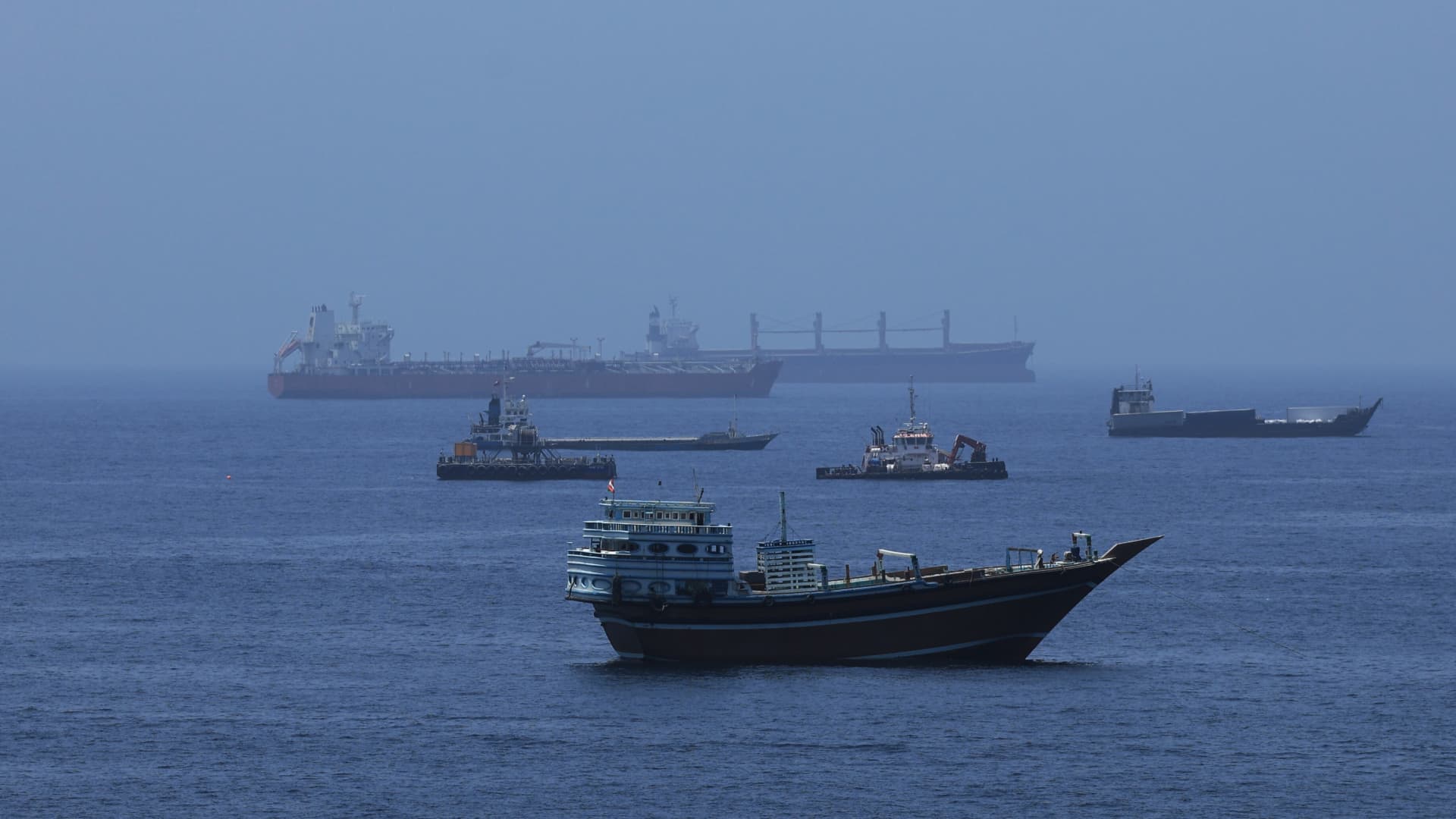
A view of commercial cargo vessels and crude oil tankers are anchored in the Gulf of Oman, off the coast of Muscat, Oman, on June 21, 2026, as they prepare to transit through the critical Strait of Hormuz.
Shady Alassar | Anadolu | Getty Images
Oil prices remain below their recent peaks even as prospects for a quick reopening of the Strait of Hormuz fade, a disconnect analysts warn may not last.
Brent crude futures ended last week down more than 7% following signals from Washington that an agreement with Tehran to unblock the vital maritime chokepoint was in sight.
An agreement is yet to materialize, with prospects for a deal appearing to deteriorate over the weekend.
Tehran is now adamant that Washington must adhere to several conditions before the strait can reopen. U.S. President Donald Trump, meanwhile, has signaled a shift in strategy, telling news outlet Axios on Sunday that Washington was “low-keying it” and hinting the administration would rely on mounting economic pressure on Tehran rather than immediate fresh military strikes.
International benchmark Brent crude was closing in on $88 a barrel in early trading on Tuesday, up from around $83 at the end of last week. That rise still leaves prices well below last month’s surge above $100 a barrel and the peak above $110 recorded in May.
Why analysts think crude oil prices could rise further
Energy markets drew short-term confidence from indications that negotiations between Iran and Oman over a temporary shipping route through the strait are continuing, alongside expectations that near-term military escalation between the U.S. and Iran may be held in check.
For now, traders are “confident that we can get to some sort of agreement, even if it may be a fudge,” Modupe Adegbembo, an economist at Jefferies, told CNBC’s “Squawk Box Europe” on Monday. “It may not be a great agreement, but it may be something that allows more oil and more things to flow through the Strait of Hormuz.”
However, that reaction will be “time-sensitive,” Adegbembo added. “If we see things remain as they are right now, I don’t think we’ll still see oil prices move in such a benign way if this continues over the end of this week or into next week.”
Kieran Tompkins, senior climate and commodities economist at Capital Economics, said the relatively “low” level of oil prices reflects that investors have continued to factor in two opposing scenarios — a quick and imminent resumption in energy flows, and a prolonged Hormuz closure.
If the deadlock rumbles on in its current form for much longer, traders will be forced to ratchet up the implied chance of a prolonged closure, Tompkins told CNBC by email.
“I would naturally expect front-month oil futures prices to increase, especially if attention on a so-called ‘tipping point’ in the oil market is renewed,” he said. “This is the point at which the market’s ability to absorb the supply shock through inventory drawdowns is exhausted and demand will have to adjust downwards to match supply through much higher prices.”
“If the strait remains closed and oil inventories in OECD countries continue to be depleted quickly, the oil market could reach a tipping point around the start of Q4. This would be consistent with much higher prices, possibly in the region of $120-140 per barrel based on historical form.”

There are mounting questions over how long wider market factors — such as alternative export routes bypassing the strait, lower demand, a surge in production and a temporary slump in Chinese oil imports — can continue to cushion against supply shortfalls.
China “singlehandedly balanced the market in May with its cut-back in [oil] imports,” Amrita Sen, founder and director of research at consultancy Energy Aspects, told CNBC’s “Morning Call” on Friday. However, with Chinese crude imports recovering in July and set to rise further in August, Sen warned that “crude can’t stay down forever.”
Markets have recently been quick to price in the prospective normalization of shipping flows on any hint of a deal, rather than the full reality of ongoing physical supply constraints, Sen said. That also includes continued Houthi strikes on infrastructure in Saudi Arabia, a key source of market stability.
“The crude set-up is more bullish on a fundamental basis,” Sen said.

