


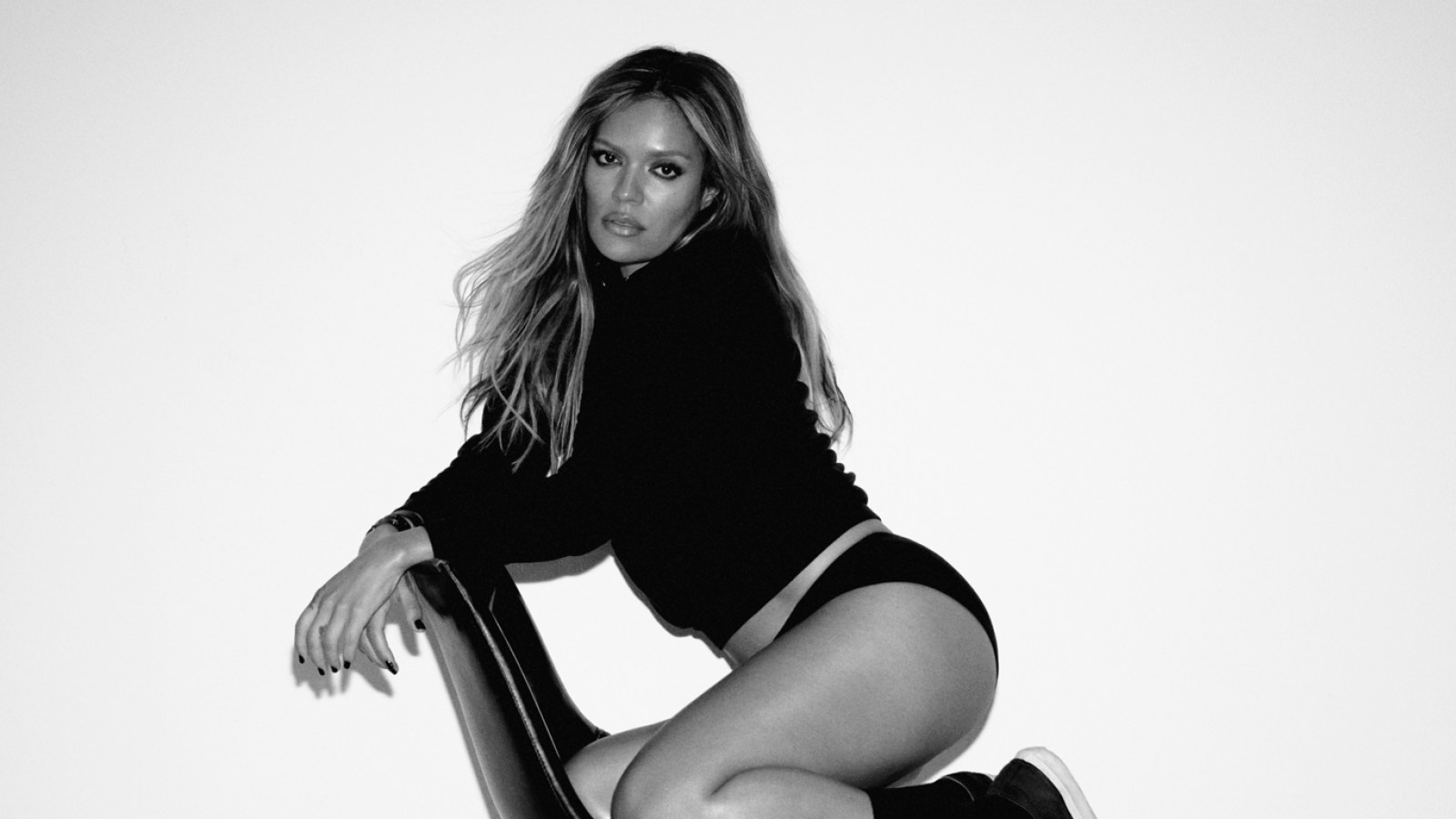
It’s Tuesday afternoon, and Karol G just landed in Las Vegas, where she’s getting ready for a massive show at the Allegiant Stadium. She’s on a Zoom call from her hotel room, bubbly, ebullient, and excited as ever. Part of this is because a ton is happening: She’s in the middle of her Viajando Por El Mundo Tropitour, which is taking on a wild ride across the globe. If that weren’t enough, she’s releasing No Me Arrepiento de Sentir Tanto, an album that shocked fans when she surprise-announced it this month. She’s practically radiating as she talks about how excited she is to share it with the world.
But huge news aside, that constantly upbeat, vivacious personality is just who Karol is. Yet she’s not afraid to admit that last year, she felt a little like a different person. She’d had a packed couple of years: She’d released Tropicoqueta, she made history as the first Latina to headline Coachella, and she’d played stages from Crazy Horse in Paris to the Vatican. Yet behind the scenes, she was going through a lot, including a highly public break-up, family drama, and tons of criticism around her album. She needed a break.
“In the midst of everything, I canceled a lot of things with the team. I told them during Grammys week, ’I need to stop.’ I had never spoken to them so honestly before, but I told them that I had a lot of chaos in my head, a lot of chaos in my heart, that I needed to pause,” she says. “The very next day after the Grammys, I went to Hawaii and I lived there for about a month and two weeks.”
The Colombian star, who is usually the bright center of every party, wanted to be alone. She was completely by herself and sat in her room, constantly writing. “I kept myself busy with my notebooks, and I wrote a lot of lyrics, poems, and things,” she remembers. “I didn’t feel like this was going to be like an album, but I did start writing a lot of music because, like, as an artist and as a composer, you really experience a lot of catharsis through music.” She built a little insular world, listening to her favorite band Cigarettes After Sex, plus the Marias, Latin Mafia, and Oklou.
But she still didn’t feel right. “I don’t know myself. It’s like I’m a different person. I’ve become super cold. I didn’t want to talk to my friends, I didn’t want to talk to anyone,” Karol remembers thinking. The only thing that helped were letters from fans her team would bring her. Reading what they’d written her gave the singer motivation to talk about what she was feeling, and soon, she was back in the studio, with an outpouring of feelings.
The result ended up beingNo Me Arrepiento de Sentir Tanto, Karol’s most vulnerable, emotional album yet. It’s also a wayfaring, experimental mix of pop sounds, bouncing between electronic production, aching balladry, and huge star-studded swings. She teams up with Drake, Bruno Mars, Judeline, Rusowsky, and more, creating an intimate portrait of heartbreak intended for fans to listen to from beginning to end. With her producers, who include longtime collaborators Ovy on the Drums, Sky Rompiendo, Edgar Barrera, and Tainy, she refines the tender-hearted sounds on the album (Oklou, who she kept listening to throughout the process, joins on one song.)
The album, Karol admits, was finished for months, but she wanted to wait for the right time to share it. “This album has been ready for a long time, but to be honest, I didn’t want it to feel like I was exploiting a personal situation. I didn’t want it to feel like this album was part of some marketing campaign. It was very personal to me. It was so personal that I didn’t even feel ready to release it,” she says. However, now that she’s found catharsis — and constant warmth from her fans on her tour every night, she decided it felt like the right time.
“The reason I decided to put the record outside is simply so that people let themselves feel,” Karol says. “The point of this album is for people to understand that to truly live, we have to feel. If we limit ourselves and let ourselves go, ‘I don’t want to feel, I’m not going to fall in love, I’m not going to give myself the chance, I’m not going to speak up, I’m not going to say anything,’ then we’re not going to live. Living is about feeling — feeling things, feeling every moment, and feeling it to the fullest.”
Below, she breaks down all the songs on the album and shares how the music helped her heal and ultimately find herself again.
“Te Llevas To’”
This song is a mix of things. I kept telling Tainy, “This has to sound chaotic,” because the emotion I was feeling was anger that comes from chaos. I was in my head like, “I need to get out what I want to say, and I feel like the production has to sound like chaos.” We started with the person in the song looking back, and everything is over: There’s no faith, no future, nothing. Everything has happened. But then it says, “Let me tell you all the good things I’m left with, even though you broke this.” We started with a synthesizer and then we went to these intense drums which are super chaotic. By the end, you just exhale. You’re like, “I let it out.” And that song was the perfect one to start with.
“Maybe”
The second track was putting things into context a little more and explaining what was happening. In the first one, I vented my anger. In the second, it’s almost like I’m telling a story through the songs, and that’s when we get to “Maybe.” In “Maybe,” I wanted to start with that phrase, “This time I’m not going to lose you,” which is a phrase that’s repeated a million times in relationships on the brink and it’s never realistic. Like, the relationship gets more and more broken each time, but you’re like, “This time, yes, this time yes, it’ll work.” But in the end, it’s like when you can’t take it anymore, you just can’t. It was super important for me to start the song with that lyric. “Maybe” explains a little bit like, “We couldn’t build anything more here.”
“Bebiendo Lágrimas”
“Bebiendo Lagrimas” is when you tell yourself, “I don’t want to go through that again, never again. Love is over.” I said in the trailer I released a few days ago, sometimes you just stop believing in everything. Why? Because pain, specifically, makes you doubt everything, like empathy or kindness in life. I feel like in life, it’s not just one situation. Life changes you little by little, little by little. As humans, we see that people, for some reason, change or give off a different kind of energy, and we sometimes don’t ask ourselves what’s happening to them, what they’re going through, and what we could do for that person to make them feel different. What we do instead is to punish them. So the message of that song is, “I’ve reached my limit in matters of love. I’m burying it, and at least for now, I’m going to enjoy my peace, myself, being alone, enjoying who I am — my career, my friends. But at the moment, I have locked it all away, I’m peaceful, and I prefer it that way. I prefer to be like this.” That’s what I was telling myself. This was one of the first tracks for the album, if not the first.
“Ahí” (feat. Drake)
This is like when you’re no longer in a relationship and you can meet people. But you have to give yourself the space to recover, give yourself time. So, it’s the feeling of saying, “Thank you, you’re an amazing person. I’m probably denying myself the chance to experience something amazing, but for now, I can’t. But I’ll keep it there in case it happens in the future.”
I wrote that song on Dec. 31. I didn’t celebrate Christmas partying and all that, but I went to a place in Colombia called Guatapé, and it was more of a retreat. [My producer] Ovy came with me. He went with his family, and I was with mine. Drake singing in Spanish has always been incredible to me; it never seems forced, and I’d had an interaction with him before. He’d written to me once on Instagram to ask me to send a video to his masseuse who was a huge fan so I sent it and then we kept talking about how cool it would be to do something together. But that was a long time ago so when this song happened, I had that conversation in mind. We started talking about making it a duet, like the verses responding to each other. And I was like, “I don’t know, but I’d love it if Drake sang it in Spanish.”
The first week of January, we sent him the song and he loved it. By like January 8, he was in the Bahamas making Iceman and our teams met up for like three days to work out the track. I guided him through the recording so I could help him with the pronunciation. It was literally just him, his engineer, and me in the studio. There was no one else. I was with him in the booth, like, “You have to say it more like this. You have to say it.” The pronunciation was super important to him, and he was constantly like, “Please, I have to get the pronunciation down.” I feel like it turned out amazing. A little bit of the song leaked, so people were like, “Karol G is on Iceman,” and in one of his songs he mentions me. I think that people have been waiting for this collaboration.
“Final Feliz”
Oklou did the production, but originally, it was just a song on guitar. I wrote it with Judeline and it was all acoustic. But Oklou’s stimulates my brain, my emotions, and she uses a lot of ambient sounds, very much in keeping with her production style. It sounds very fresh, very distinct. I told my sister, “I have this song and I feel like what I’m imagining for the production could be done by her.” Plus, I admire her because she just became a mom, she’s on tour, she inspires me so much. “Final Feliz” is a song that talks about when you decide to leave someone because you know where things are headed. And it’s the hardest moment when you decide to leave because you’re not going to wait for the harder blow later. So you’re like “This can’t go on. It’s going to go badly, badly, badly, badly.” It’s that pain of someone you really want, but it just can’t happen. It’s that duality. “It could have been a happy ending, but it wasn’t.” When I submitted the song to Oklou, she immediately asked for my personal number. She wrote to me like, “Wow. I have to be honest, I was surprised because I haven’t heard this side of you before, and I’m so excited to be a part of it.” It’s one of my favorite songs on the album. She made it special and it still resonates with me.
“Still” (feat. Bruno Mars)
I’ve always had it in mind to make music in English, but it’s something I’ve never pushed for, and this song found me. I’m really excited about the idea of a song like this in English, not because I want to change who I am, but because I also have so many fans whose first language is English, and one day I wanted to be able to speak to them from that perspective.
When the composers Isabel and Tomás [LaRosa] sent me this song, I felt something very strange. It was as if someone had written exactly what I was going through. We tried to imagine it in other ways, but the truth is, I never felt that anything needed to be changed. The song already had a soul, and I couldn’t stop listening to it and feeling it that way. Then we sent it to Bruno. He connected with it just as strongly and decided to be a part of it. We changed some things in the lyrics a bit, and he also participated in the production. The beautiful thing is that it was never conceived with a market in mind. This album is about letting go of your feelings. And this song was exactly that. Instead of translating it or adapting it to fit, I decided to respect it just as it came to me.
Honestly, having a song with Bruno is something I still can’t believe. In fact, yesterday we were here in Las Vegas, and we were hanging out because we were making some content we’re going to be sharing for the song, and I have to be honest, it feels super surreal. I traveled to where he was to record because he was on tour, and it was like a whirlwind trip I had to make in one go so I could finish the song quickly and have it ready. I traveled, spent two days with him, and he directed my recording in the studio, it was just his engineer, my engineer, him, and me again. There was no one else there, and he was kind of directing my vocal delivery, my pronunciation. He was like, “I want you to keep your accent, but I’m going to make sure that what’s said is understood.” We were in the studio from 7:00 PM until 9:00 AM the next day.
I’m super open to [music in English]. The only thing I wouldn’t do is sit down and try to do a whole album in English like, “This is my English album.” But it’s about the right song. I feel like what happened with this song is that I really fell in love with it, and I really wanted to include a song in English on my album where I was speaking to a specific audience. If I had the opportunity to connect differently, like, now that we’re going to Coachella and you start to see that there’s a new audience and might not speak Spanish at all.
“Alguien Que Te Amaba”
I ended up working on this song with Pete Astudillo, the composer of Selena Quintanilla’s songs. I was like, “Wow, I would love to work with that person.” Since she passed away, he never really worked with anyone else. And it was super crazy because I was with Edgar, and I said, “It would be a dream to work with him.” Edgar was like, “He hasn’t made music in a long time but let’s look for him and see what happens.” Then he tracked him down and said, “He super into it,” and it meant so much because he listened to my album from the heart.
Something that Trópicoqueta gave me, which is huge, was identity. From the beginning of my career I’ve always made it very clear that I’m Colombian, I’m Latina, and on the stages I’ve performed on, I’ve always tried to make that very clear, but with Trópicoqueta, it was like the world understood it. And in fact, it was an album that I feel made more people who didn’t speak Spanish understand who Karol G is. With No Me Arrepiento de Sentir Tanto, even though I was very clear that I wanted a more intimate, alternative, sound, I didn’t want to stray too far from the Latin sounds that say, “Wow! It’s Karol G.”
“Matadora”
We all knew what could happen when “Matadora” came out, obviously because of the themes of the song and the way I’m expressing myself on it. But I do feel like “Karol G is always going to surprise you.” So I wanted it to be the first song people heard on this album because it’s like a movie that starts with the final scene. And this is how I feel now — I didn’t feel like this a few months ago. Now I feel “Matadora,” but obviously like a normal human, I have good days, I have not so good days, but I feel like I’m at a point of clarity and lucidity, where I want to live peacefully, where I want to keep fulfilling my dreams, where I want to keep having the opportunity to connect, where I want to go out, do things with my friends. That’s how I feel today, like that song.
Since we’re in the public eye and the media is so focused on artists all the time, we knew what was going to happen in the press, but I actually feel like the song connected better than we thought. It’s growing more and more on streaming every day. People are starting to use it. I’ve seen videos of girls all dressed up, getting ready, in their swimsuits. I just love having songs that embrace female sensuality, especially because that has been so suppressed and frowned upon. I love being able to put those songs out there, where women feel beautiful, gorgeous, powerful. I love this song and putting it out first made people go, “Wait, ‘Matadora,’ but the album is called ‘I don’t regret feeling so much?” I think it made people excited about what else is coming on the album.
“For You My Love”
Everyone on my team loves this song. To be honest, that song was the hardest for me to place on the tracklist. The tracklist is super important to me because it’s the experience the fan will have when they listen to the whole album, beginning to end, and that song, because of its sound, didn’t quite fit anywhere. But I felt it was important because it symbolizes when you reach a point where you start to see everything that happened to you from a different emotional perspective. And it’s not so much about the pain anymore, but rather that time has passed, you’ve understood it, you’ve moved on. And when you remember that person, you’re like, ”Aw, that was so great,” and you see it from a more positive perspective. So the sound of the song was more positive. And I felt it had to be on the tracklist because it’s part of the process.
I thought about making it the third song, or leaving it for last, because in the emotional process it would be the last step. But I wanted to add a boost here and then you get back to the emotion. I made that with Edgar too, and I’m telling you, when we made it in the studio, there was this incredible magic in the room. I wanted it to start with an organ, which could be a wedding or a funeral, so that duality was also a big part of it. And I can’t wait for people to see the video.
“Si Lo Ven”
I could say this song is like the soul of the album. I decided to sing it at my last show. For me, that song, literally, every bar, every bit of it is the soul of the album. It’s what I was just saying, simply allowing yourself to feel and saying it, not like, “Oh, look at me be strong or like I don’t care.” No. This was the spirit of the album and that’s where I decided, it’s not about being strong or preserving. I want people to finish this album with the initial emotion.
I wanted to do that for several reasons. One, I don’t feel like I’m fully OK yet. I’m not saying I’m not doing well, but I feel like the fact that I’m not ready to experience my life with anyone or open myself up to new experiences makes me feel like I’m still in the healing process, if you know what I mean. I’m still in a process. So it couldn’t end on a different note because I’m not exactly there yet.
“Bby Wow” (feat. Judeline and Rusowsky)
I felt like I needed a song, one that people could dance to in the club but that also had that emotion. So, what happens when you’re in the club and you’re heartbroken? You just think about the other person, about the song you’d love to be dancing to with that person.
The first version of the song was just me. But I felt like, live, I wanted to sing that song with more people on stage and for it to really become a bit more of a party. And that’s when I thought of Rusowsky and I said to Judeline, “Why don’t you join the song?” I worked a lot on that album with Judeline because the way she sings about love made me feel how men sometimes don’t understand how deep a woman’s pain can be. She has something special, and it’s that every emotion feels so intense. She has a song called “Is God Good or Just Powerful?” It’s literally one that lasts about a minute and a half. What she sings is super short, it’s like a verse and a chorus. And I was like, “Wow, how can you say so much in a verse and a chorus?”
So it was literally a must for me to write music with her for this album. Our teams got in touch. We told her I was making new music and she traveled to Los Angeles. I spent about a week with her, and it was really nice because the first thing we did was sit down and talk, like, “I’ll give you some context about where I am, how I’m feeling.”We were both going through almost the same thing, so I loved that because we were in sync and it just worked. I thought, “We’re both here, feeling almost the same thing, it’s going to flow in a special way.”We were in the studio for about three or four days, and we made more music there that isn’t on the album.
“Con Quién Andará?”
“Con Quién Andará?” is another core of the album because it’s you in your room, asking yourselves five thousand questions: “What’s happening with that other person? What are they doing?” And that’s something you ask yourself every day, for a long time, many hours of your day. So, “Con Quién Andará?” is a core song that gets at the feelings of the album. I want people, when they finish the album, listening in bed, staring at the ceiling and all, to leave them with the emotion I had all that time. I feel like sometimes they tell you, “No, but don’t let it get to you and listen to those songs.” No, that’s the best part of heartbreak, it’s not going to bed and letting the music speak for you.
One of the things I’m excited about is seeing my fans live. Being able to experience the album live with all my fans while I’m still on tour is going to be like a community, like everyone is feeling included. I feel like I’m going to start seeing those who will arrive dressed in orange for Tropicoqueta or those who will arrive dressed in blue. So I’m really excited because I feel like my concert is going to be like that movie In and Out. (laughs.) We’re adding a while section to the show, so I can’t wait for people to see it.
“Eclipse”
“Eclipse” was the song I was going to end the album with because at the end, I don’t know if you hear it, but it says, “God, take care of him for me because I’m going to let him go.” This is sort of that moment of looking and saying, “It didn’t work but why was it so special and so beautiful? But I’m ready to let go.”
Honestly, with the album about to come out, I’m super happy. I feel like I’ve already made peace with a lot of things that are sure to start happening after the album. But I’m absolutely certain, based on the letters from all my fans and the personal things they write to me — because they write very personal things in their letters, like very specific situations they’re going through — I know that if this album reaches someone, it’s going to reach the right person, and that makes me feel purposeful. If they understand me, it simply makes me feel that everything I’ve experienced had a reason. And being able to experience it live with all my fans it is going to be like a community.
“Después de Ti”
This song is beyond just emotion. It’s when you feel like you’re ungrounded. Things happen, and I’m talking about life in different situations, not just in love, but when you’re in a situation where you’re left not knowing what to do, where to turn, what to do with your life, what to do with what you’re feeling. You’re suspended, while everything in life passes by and it’s like your life isn’t passing, like time is passing but you’re not living it. It’s like being on an airplane that’s in the air but isn’t moving. That’s “Después de Ti.” It’s like, “After you, this is me now. I don’t know what to do, I don’t know what to say, I don’t know how to speak, I don’t know how to express myself, I don’t know anything anymore.” And I ended things with her because people had already heard it, and I feel like when it ended with “Eclipse,” this song kind of reinforced the feeling emotionally. So putting it there, it was more about feeling. I don’t know if it fits in the story’s order, but that was the exact feeling I wanted people to end up with.
The fact that my life is so exposed is incredibly complex for me. But it’s also taught me that what matters is what I think of myself, not what other people think of me. I believe you can save yourself from what everyone else thinks of you, but you can’t save yourself from what you think of yourself. So, these past months have been about working on myself, on my personal growth. I feel like I’ve reached a point where I’m working incredibly hard, I’m incredibly disciplined, and I’m connected with my friends and my family. Then I go on stage and I meet all these people who have a real, normal life like mine, who actually understand everything I’m going through. And I think, “This is what it’s all about.” So, honestly, today I feel really good, yesterday, these past few days, this week. It won’t always be like this. I always say that happiness isn’t a constant state, but rather like sparks, moments, but being at peace is different, and I feel at peace. I feel at peace with myself, with my life, with my story, with what’s happening around me. So I’m totally ready to show it to the world.
