


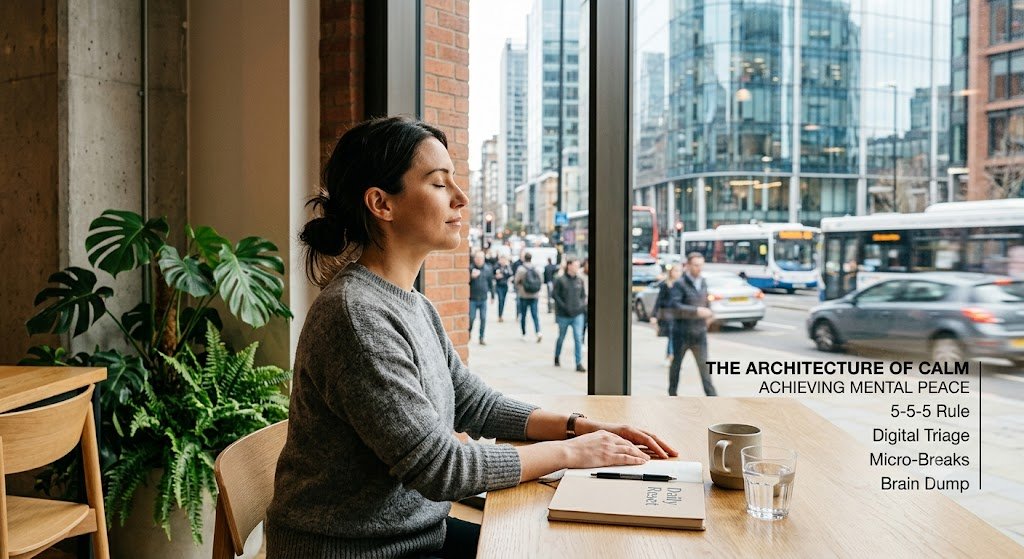
In our todays real life critical work environment stress is a very common major health issue observed in working professionals. Our todays human brain is processing more data in a single day than our ancestors did in their entire lifetime as we are from a single survival mode to a societal cum survival mode. We live in a culture that treats constant availability and endless efforts and busyness as a status symbol. The result of this? is A silent epidemic of chronic stress, mental tiredness, and a persistent feeling of being overwhelmed. And here comes a mindfulness practices comes in picture.
Many people believe that achieving mental peace requires a radical lifestyle changes, quitting a high-stress job, moving to a remote peaceful village area for stay, or committing to daily meditation. But in reality, true psychological strength is not about escaping the modern world. It is about building strategic, unbreakable boundaries within the life you already lead.
To transition from a state of constant mental reactivity to deep, sustainable peace, we must understand the mechanics of the modern stress response and implement practical, evidence-based systems to protect our mental health.
What is stress and its Aspects:
- The Physiology of Modern Stress
To fix a disturbed internal mental condition, we firstly needs to understand why our brains feel so restless. The human nervous system is evolved to handle high, short-term stress, encountering a predator, seeking safe shelter, or surviving an immediate threat in their jungle life. When faced with these situations, the brain’s amygdala triggers the sympathetic nervous system, releasing a quick rush of cortisol and adrenaline. This fight or flight response increases heart rate, sharpens immediate focus, and suspends the non-necessary body functions such as digestion etc.
In todays modern world, our stress elements are also changed form earlier higher physical threats, instead, they are become chronic with psychologically stressful life events which including below.
- An tension of unread work emails of unfinished task.
- Competitive and Toxic Social as well as work environment.
- The mental pressure of back-to-back virtual meetings and work deadlines.
- A non-stop easy receiving cycle of global news as well as astonishing events.
- The subconscious comparison driven by social media algorithms and changed social interactions.
Because these triggers never truly disappear life’s physical threats, our body remain in a low-level of constant fight or flight mode. This long term exposure to cortisol reduces our mental strength, aligned to the prefrontal cortex, the area which is responsible for logical decision-making and emotional regulation, and makes us feeling continuously exhausted yet unable to rest. Mental peace, therefore, it is not a luxury, it is a physiological necessity for long-term health.
- Digital Triage: Reclaiming Control Over Your Attention
Our attention is the most valuable thing in the digital economy. Every app, platform, and device is engineered to capture and retain our focus by triggering intermittent loops of dopamine, the neurotransmitter associated with short term reward and anticipation. Every time a phone vibrates or flashes a notification, the brain experiences a tiny spike of anxiety and curiosity.
App Notification => Dopamine Spike / Curiosity => Check Device => Mental Attention Diversion
To combat this constant mental stress, you must adopt a strict restriction of digital devices usage.
The Strategy
Go into your device settings and disable all non-human notifications. If a notification does not come from a person by direct call or message, any person is trying to connect with you directly via a phone call or a direct text message, the it has no right to interrupt your thoughts. News alerts, social media likes, promotional emails, and app allerts and updates should be entirely muted to achieve better mental focus on productive tasks.
Instead of allowing your environment to rule when you pull your focus away from your work or your family, schedule specific time to check these digital devices intentionally during your day. By shifting from a reactive relationship with technology with an intentionally planned interaction, you may instantly eliminate dozens of micro-stress tasks from your daily life.
- The Power of Bookending Your Day
The first and last hours of the day are critical for your psychological well-being. The brain transitions through different states as it wakes up and sleep. When you first open your eyes, your brain moves from delta and theta waves into alpha and beta states, making it highly sensitive to external stimlations.
Daily Timeline to Practice a mindfulness
- MORNING Start (First 30 Mins): Screen-Free day, MIDDLE DAY: Small intentional Breaks, NIGHT (30 Mins before going to bed): Brain Relaxation
- MORNING Start (First 30 Mins): Hydration & Better Sun Light Exposure, MIDDLE DAY: Focused Work practices, NIGHT (30 Mins before going to bed): Screen-Free Early Sleeping
- MORNING Start (First 30 Mins): Aim on your Daily Goals, NIGHT (30 Mins before going to bed): Relax Yourself
If the very first action you take when you wake up in the morning is grabbing your smartphone to scroll through news feeds or work emails, then this will immediately start injecting stress, urgency, and other people’s priorities in your mind. You should train your brain to start the day in a defensive, and reactive manner and with aligning yourself with your self decided day goals.
Implementing the Daily Routine to Achieve Mindfulness
Adopt a strict 30-minute screen-free time zone at the both ends of your at morning as well as at night.
- The Morning Start: Use the first half-hour of the day for low-stimulation activities that will help to you stabalize your day routine. Drink water, look out a window to get natural sunlight in your eyes, which will help to regulates your circadian rhythm, read a physical book, or write down three primary intentions for the day ahead.
- The Evening Time: For the 30 minutes before going to sleep, put your phone in another room or place it entirely away of your reach. Change the the blue light of screens, which suppresses melatonin production and disrupts deep sleep, and make yourself habitual of doing other beneficial tasks such as light body stretching workout, reading books, writing, or listening to a relaxing music.
- Ultradian Rhythms and the Necessity of Micro-Breaks
A common misconception about productivity is that the human mind can sustain a high-level of focus for eight consecutive hours. When we force ourselves to push through hours of continuous screen time without a pause, we may experience a sharp reduction in mental ability & brain decision making and analysis functioning, along with increased frustration and anxiety.
Our body operate on ultradian rhythms, a natural biological cycles that occur throughout a 24 hour of day and night time cycle.
High Focus / Energy (90 Mins) => Brain Fatigue (15 to 20 Mins) => Reset Required
For roughly 90 to 120 minutes, the brain can maintain higher focus and energy. After this timeline, it naturally enters a signaling for a need of rest with showing symptoms such as yawning, restlessness, loss of concentration, or sudden cravings for sugar or food.
If you ignore these signals and rely on caffeine or own will power to coverup the situation and continue what you are doing, then your body begins to generate stress hormones to keep you alert of the fatigue situation. To prevent this depletion, build in micro-breaks during your work to reduce brain as well as physical fatigue. For every 90 minutes, stay away from your works for just two to three minutes to recover the anxiety. Do not use this break to check social media, as digital content can also provide stress to your memory. Instead, practice a purposeful walk to get a glass of water, or do a physical stretching, or look out of window outside to give your optic muscles a relax. These small intervals helps in releasing valve for accumulated stress, keeping your base tension lower across your daily routine.
- Clearing Mental Pressure: The Nightly Brain Relax
One of the main drivers of night time anxiety and insomnia is an overloaded working memory. When you carry a list of tasks, loose ends, deadlines, and personal worries in your head, then your brain treats those pending items as unclosed loops. The Zeigarnik effect, a well-documented psychological phenomenon, shows that humans remember uncompleted or interrupted tasks much better than completed ones. Your brain will keep reminding you of these open loops, often right when you are trying to fall asleep.
To close these loops and achieve mental clarity before bed, practice a night brain relaxation.
The Method for Achieving Mindfulness
Take a physical notebook and a pen, and write down absolutely everything occupying space in your mind. This is not about creating a beautifully formatted, organized to-do list, but it is to give a vision to your mind. Write down the emails you forgot to send, the tasks you need to do for tomorrow, the day conversation that bothered you, or the long-term project that feels anxious.
By writing your thoughts on a simple paper, you can change your vision on them. You transition from experiencing the chaos to observing it objectively from the outside. This simple practice may send a powerful signal to your central brain nervous system that the information is safely stored, allowing your mind to step down from its guard post and enter into a state of deep rest and mindfulness.
- Real-Time De-escalation: The 5:5:5 Grounding Technique
No matter how structured your routines are, there will be moments during the day when a sudden pressure hits, an unexpected crisis at work, a challenging conversation, or an intense wave of over thinking and anxiety. In these high-stress moments, rationalizing your way out of anxiety rarely works because the emotional centers of the brain have effectively bypassed your logical thinking. You have to use the physical body to calm your mind.
One of the fastest, and most effective way to break an active anxiety loop is the 5:5:5 Grounding Technique. This exercise more mindfulness and sensory awareness to shift your brain out of its internal worries and track it back into the the current moment with stable and positive thoughts.
When you feel a wave of anxiety building, stop what you are doing, take slow, deep breaths, and consciously identify with your senses:
- Sense: Sight, Action Step: Look around and clearly name five physical objects in your direct range of vision such as a pen, the grain of wood on your desk, a leaf of tree outside.
- Sense: Sound, Action Step: Close your eyes if possible and listen closely for five unique sounds in your environment such as the hum of an air conditioner, a traffic, a bird chirping, your own breathing.
- Sense: Touch, Action Step: Bring your full awareness to your physical form and acknowledge five different sensations which you can feel right now such as the texture of your clothes against your skin, the strongness of the chair supporting to your back, the temperature of the air, your feet pressing firmly into the ground.
5 Most effective Mindfulness Meditation
- Breathing Workout: Breathing workout bringing your mind in focusing your each and every breathing, this not only reduce anxiety but also provide more oxygen in your blood which effectively promote brain processing.
- Dhyana Meditation: Dhyana meditation is an Ancient practice followed from centuries by many cultures such as Hindu Culture in India, Dhyana includes controlled breathing and mind focus which effectively impacts on positive mental process.
- Workout and Exercise: Physical workout not only helps to improve your physical strength, but also improve your mental focus and clearing your mind thoughts.
This sending exercise works as an immediate circuit breaker for negative and un-useful thoughts. By forcing your brain to process and concrete on sensory data from your physical surroundings, you can reduce the stress response the mental boost which needs your mind keep spinning. It is an easy tool that can restore your emotional equilibrium in just two minutes.
Protecting your peace in todays critical and continuously hustling world, does not require a flawless, stress-free life, but it requires a commitment to protecting your personal boundaries. True mental clarity is built in the small, daily changes, by choosing to leave your phone on the counter for the first 30 minutes of the morning, stepping away from your desk when your body signals tyredness, and clearing your mind thoughts and tasks on paper, before going to bed helps a lot in stress relief.
Do not try to implement all of these changes at once, as attempting a sudden lifestyle changes may also become a source of creating mental pressure. Instead, select just one task per week and start practicing it. Master it, turn it into an effortless habit, and you can observe the shift in your stress levels. By taking intentional control over your surrounding environment and your daily routines, you will find that you can maintain a deep, unshakeable sense of calmness, even no matter how fast the world is moving around you, one can achieve mental peace and refresh mind.

She is a Clinical Health Psychologist & Mindfulness Educator
She has done her Ph.D. in Clinical Psychology, University of Michigan
She is also a licensed psychologist with over 15 years in behavioral health, Dr. Monica Reyes specializes in integrating mental wellness with everyday lifestyle practices. Associated with Gymbag4u.com since its initial days.
