






Published Wed, Feb 25, 2026 · 12:30 PM
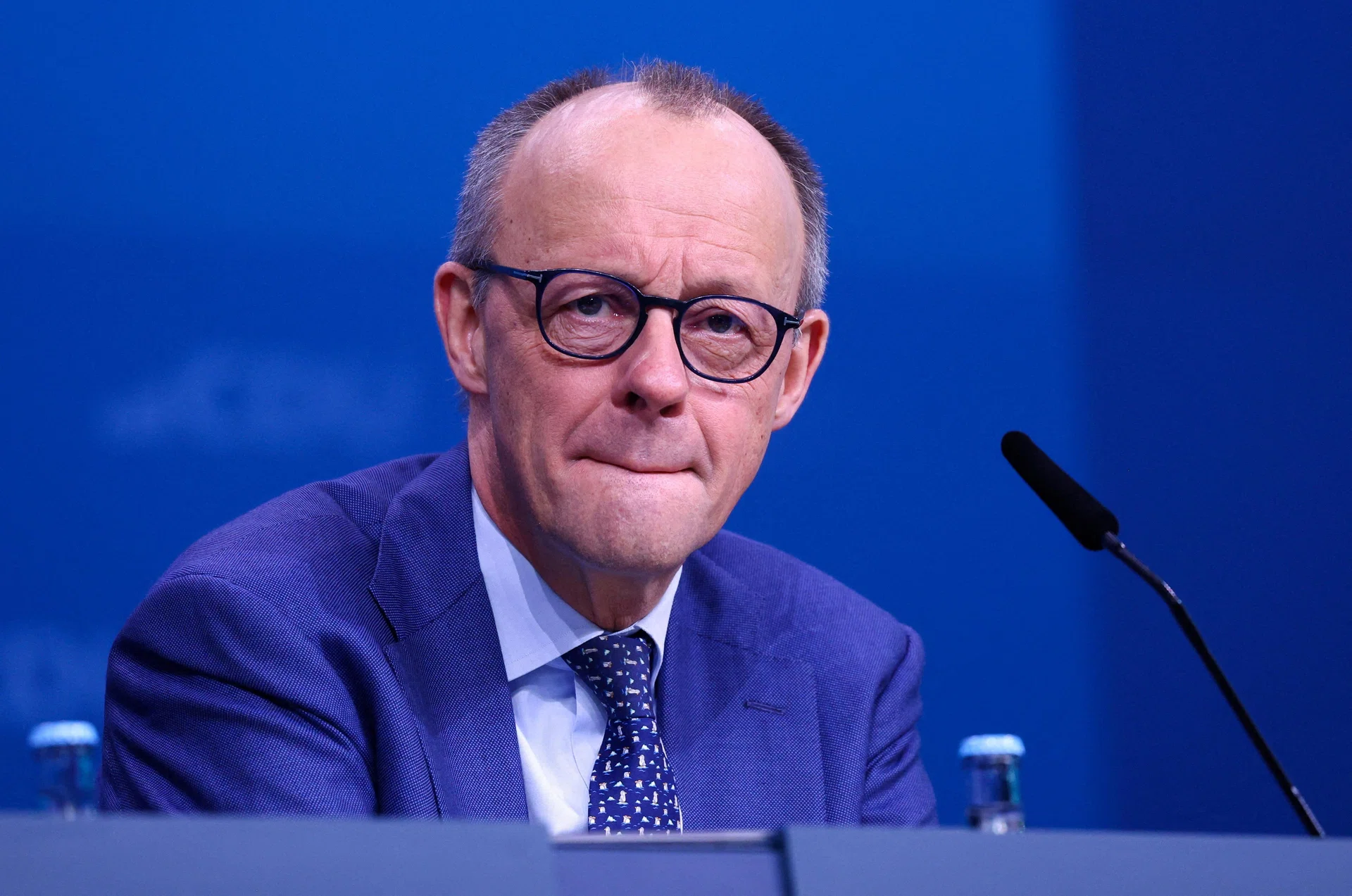
[BERLIN] German Chancellor Friedrich Merz arrived in Beijing with a large business delegation, aiming to use his first official visit to China to improve ties while raising his concerns about trade and key minerals.
Merz, a conservative who took power in May and has been critical of Beijing in the past, started his two-day trip on a surprisingly positive tone.
“China has risen to the ranks of the major powers,” he told reporters in Berlin on Tuesday (Feb 24) before departing. “Our China policy has to take account of that.”
The 70-year-old will hold separate talks with President Xi Jinping and Premier Li Qiang on Wednesday. He is scheduled to visit a Mercedes-Benz Group plant on Thursday in Beijing before travelling to the tech hub Hangzhou to tour of facilities operated by Chinese robotics firm Hangzhou Unitree Technology and Germany’s Siemens Energy.
China’s status as both a strategic rival and an essential trading partner for Germany makes the visit tricky. Merz has warned executives against expanding investment in China in the past but recently toned down his criticism some. The German economy has been shedding 10,000 manufacturing jobs a month, experiencing what some economists call the “second China shock”.
“China systematically exploits the dependencies of others,” Merz said this month at the Munich Security Conference. “Raw materials, technologies, and supply chains become instruments of power in the zero-sum game of the great.”
Navigate Asia in
a new global order
Get the insights delivered to your inbox.
Merz joins a long list of foreign leaders travelling to China recently trying to improve ties with Beijing, while the Trump administration worries officials around the world with tariff policies and other moves.
Merz’s strategy for his meetings with Xi and Li will be to engage in intelligent dialogue without losing sight of the potential risks from dependence on Chinese supplies of critical raw materials and rare-earth elements, a government official in Berlin said.
Merz signalled his government’s China policy must begin at home by Germany strengthening its competitiveness and diversifying supply chains. “Only if we in Germany and Europe are united, strong and competitive can we shape a balanced partnership with China,” he said before his departure.
Germany will continue to carefully pursue its policy of so-called derisking from China, Merz said.
“It would be a mistake for us to seek to decouple ourselves from China,” he said. “That kind of policy would only harm our own interests.”
Merz’s predecessor, Olaf Scholz, had set a goal of making Europe’s biggest economy less dependent on the Asian nation.
Dirk Jandura, president of Germany’s BGA export lobby, said the government was right to derisk from China and highlighted the need for “a balanced approach between openness and resilience” rather than a broader decoupling.
“Critical dependencies, for example, in raw materials, intermediate goods or key technologies, should be addressed through dialogue and reduced through diversification,” Jandura said on Monday. “Simultaneously, supply chains must remain stable and resilient.”
China is the dominant supplier of materials vital for the production of electric vehicle batteries, smartphones and fighter jets. The minerals took on greater importance last year when China started to curb exports of rare earths in response to US President Donald Trump’s trade tariffs.
In a separate note on Monday, the government in Berlin said that the issue of “competition” will be the focus of Merz’s trip and that Germany remains committed to efforts to secure a “level playing field” in international commerce.
Chinese companies have an advantage over their German counterparts for a variety of reasons, including state subsidies, a favourable exchange rate for exports and “Buy Chinese” policies in multiple sectors, the government said.
Speaking before the trip, Merz indicated he’d push his Chinese counterparts for greater cooperation.
“A horse does not show off its strength by acting alone, but by pulling the carriage together with others,” he said. “That is an appropriate image at the start of this trip.” BLOOMBERG
Decoding Asia newsletter: your guide to navigating Asia in a new global order. Sign up here to get Decoding Asia newsletter. Delivered to your inbox. Free.


