


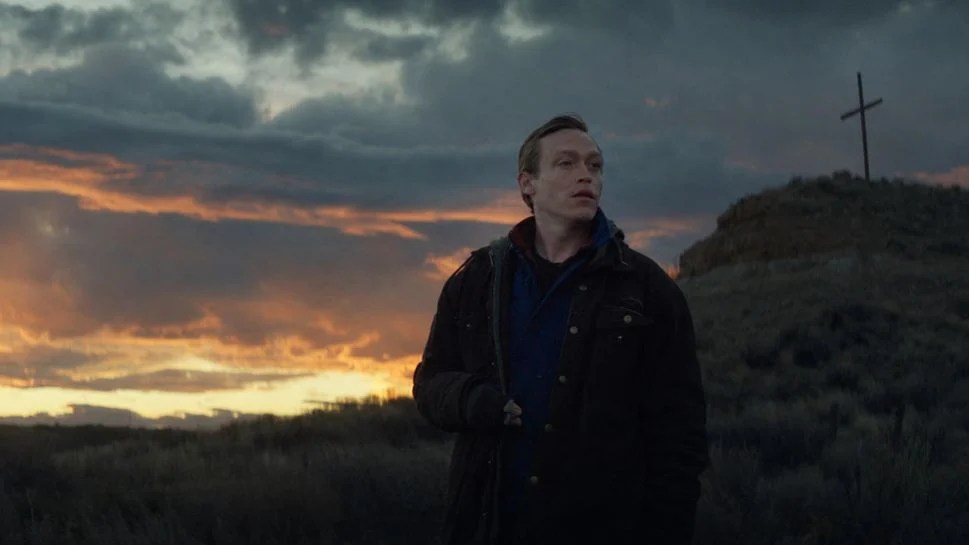
A young pastor in a small Texas town has a mission: to help people experiencing homelessness. But he is faced with a harsh winter – and resistance by his congregation. This is the world of Down the Arm of God, starring Caleb Landry Jones (Three Billboards Outside Ebbing, Missouri; Dracula; X-Men: First Class) and directed by Peter Brunner (My Blind Heart, Luzifer), which world premieres at the 79th edition of the Locarno Film Festival on the Swiss fest’s Piazza Grande program on Aug. 11.
The creative duo, which previously collaborated on To the Night, co-wrote the screenplay, inspired by true events, and developed it with people without housing. Their goal: to highlight that experiencing homelessness is the result of systemic failures.
“For about five years, Caleb and I created this project with people who live the reality of homelessness,” Austrian director Brunner, a former student of Michael Haneke, shares in a director’s note. “Their voices form the heart of our film, which approaches this crisis not through statistics, but through human experience.”
The film stars Jones as young pastor Nick, India Marie Cross (Wicked City), Nick Stahl (Let the Right One in), Mena Suvari (American Beauty) and Jones’ brother John P.W. Jones, among others.
Produced by EuropaCorp‘s Luc Besson, who previously directed the star in Dogman and Dracula, along with Jones, Christian Sosa and Jon Wroblewski via their Roosevelt Film Lab, Down the Arm of God features cinematography by Peter Flinckenberg, with Brunner handling editing. International sales are handled by Kinology.
The Art of Elysium has partnered with Down the Arm of God creatives Brunner, Jones and Besson to launch a companion curriculum “to explore empathy, creativity and the human connection.” After all, Brunner says, “Down the Arm of God is intended as a conversation starter rather than an advocacy film. Created at eye level with people who have lived and continue to experience homelessness, we want to invite audiences to look beyond stereotypes.”

‘Down the Arm of God’
Courtesy of EuropaCorp
Ahead of the Locarno world premiere of Down the Arm of God, Jones and Brunner talked to THR about how they developed the film and brought it to life in a collaborative fashion, why it’s neither poverty porn, nor meant to be preachy, and their hope for what audiences will take away from it.
How did you end up finding this community of homeless people and making a film with and inspired by them?
CALEB LANDRY JONES Peter and I met some years ago when we worked on To the Night, and we’ve been trying to work together ever since then and we’ve been trying to find a project. But Peter and I are both sticklers for the right project. Peter had about four or five ideas for a possible film, and it started with talking about the relationship of a son and a father, and then we began talking more and more. Peter wrote the first draft of the script by himself, which very much had everything already there: the structure, the characters.
A question, with an Austrian and an American making this together, was how I could help with making it more American and making it make more sense to a place like Texas.
PETER BRUNNER The theme of the father was one of the early ideas that we gravitated to, that we felt very strongly about in the world that we were living in back in 2021. It was also very obvious to us that we needed to do something about social help because that is important to us and that touched our lives at a certain point. Nick has his own way of having his life touched by people who are unhoused and live the reality of homelessness.
We really wanted to create a lot of depth to the characters because all of them are based on interviews rather than middle-class tourism and just sugar-coated fairy-taleish things. We wanted to know how it really is in those encampments. How do people talk about their own relationships? Going to encampments with different non-profits and doing outreach was like a stepping stone to rewriting the script. The script was getting updated until the very end, until days before shooting, or sometimes even on the set. It was something that was very much alive because it always had to serve what we would find.
‘Down the Arm of God’
Courtesy of EuropaCorp
We invited our collaborators, even the people in the small town, the people in the unhoused encampment, to be part of a collaboration on eye level in a long process, where they knew these were characters. It’s not themselves being exploited. We wanted this to be something where they have ownership, also when the movie was finished, and where they, in a certain way, teach us about their realities. It was one of the most beautiful, most inspiring experiences of my whole life.
And we experienced day by day how our friends and collaborators grew into such strong forces on the movie and started to tell us: “Maybe the light should be here!”
JONES “The boom [mic] is in!” Yeah, you’re right. Dang, please get the boom out of the shot! Thank you so much. That would have messed things up.
BRUNNER They are underestimated. We saw while making the movie that it was beautiful to have a true collaboration with people.
JONES With responsibility comes a greater need to then take care of the thing that someone is responsible for, and we were finding that very much throughout this entire film with the people we were working with. It was incredibly special that the cast members were really showing Peter and I, a testament to what we were doing, that they weren’t giving up. They were the ones that were showing up and saying: “Come on, Peter, let’s do this! Come on, let’s get the show on the road! It’s going to be difficult, but come on!” They feel the agency.
‘Down the Arm of God’
Courtesy of EuropaCorp
BRUNNER It’s also personal for everyone, including myself. Everyone who participated in making the film had a very personal connection with it. Specifically the actors, I think, because everyone in the film, in one way or another, is bringing something from their lives to the film. So, it’s this blend of fiction and something very true and honest, even if the names are changed and there are slight variations of what happened. It is still rooted in this reality.
Caleb, how did you get into Nick as a character?
JONES I hate when people say, “It was like jazz.” But it really was in this case in the sense that I play music too. It was really about understanding the character and the movie in another kind of way than I’m used to. I think it comes from this brotherly relationship that Peter and I have. Because he allowed me so early on in the process to write with him, I knew the movie better than I’ve ever known a movie.
What do you want audiences to take away from Down the Arm of God?
BRUNNER Our collaborators know better than anyone else that the average American right now is one paycheck away from homelessness with the high living costs and the debt that most people have. You just need to catch a flu or have an accident, and you don’t get that paycheck.
It’s so difficult because some people think you’re doing poverty porn, other people think you’re sugar-coating it, other people think it’s white savior middle-class tourism. But what really interested us with this movie was trying to understand the humanity and searching for and exploring the love and the loyalty to characters to have a dialogue with an audience and not do it for the sake of ego or shock.
‘Down the Arm of God’
Courtesy of EuropaCorp
JONES We were really seeing the film work in another kind of way. It didn’t feel like it was just a film anymore. It felt like it was much bigger than that. [Some people are losing] trust when it comes to our profession of making films and directors being allowed to come to a project with their vision without being bullied into submission to make something else. That’s becoming more and more rare to make a film like this and more difficult.
This film was made to spark a conversation. I was talking to Peter a few days ago about how it annoys me to hear so many people going: “That’s not why you guys made the movie. That’s how you’re selling the movie.” But it is our real desire that there is a conversation outside of this film that can take place with others. It’s not so much a message of, “You better take care of each other.” I don’t like messages in this kind of way either. But at the same time, I think our film has a very strong stance.
We hope that by making the film the way we did, there is a space for non-judgmental viewing of the film and of the people in the film. I can only hope that translates to after the film and to someone’s daily life, and that people may have conversations.
