


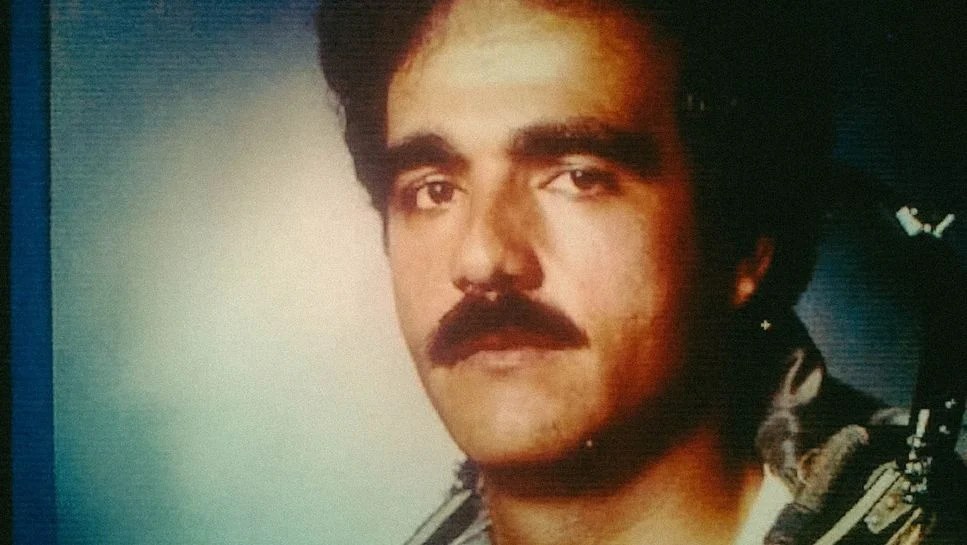
In 1988, Afghanistan sent its first cosmonaut into space. Yes, really. Abdul Ahad Momand went where no Afghan had gone before — or has gone since — making Pashto the fourth language ever spoken beyond Earth. So why does barely anyone remember his name, his journey, or the hope it sparked among fellow Afghans at the time?
Part of the answer may lie in timing: just as the spaceflight took place, Afghanistan was on the brink of civil war, a conflict that would soon force millions of its people into exile. As a new film argues, the country’s story has been shaped by conflict, exile and diaspora ever since, with science, culture and ideas pushed to the margins.
Elham Ehsas (There Will Come Soft Rains, Yellow, Our Kind of Love), a London-based Afghan filmmaker and actor, is working to change that narrative and spotlight a piece of history too often left out of it. His short film Forgotten Spaceman — which blends documentary and essay elements while uncovering a surprising link between Afghanistan’s space history and his own family’s past — will world premiere on Aug. 9 in the Pardi di Domani – Concorso Internazionale program of the 79th edition of the Locarno Film Festival.
Ehsas wrote, directed and edited Forgotten Spaceman, which is executive produced by Catherine Tschaepe and Jack Thomas-O’Brien of Ken Loach’s Sixteen Films, which backed the film. World sales and festivals are being handled by María Vera of Kino Rebelde.
Beyond the story of Afghanistan’s spaceman and Ehsas’s own family history, the short also examines “shadows of colonialism and the memory of a fractured and silenced nation,” per its synopsis. Ehsas spoke with THR about his surprise at discovering Momand’s story, how Forgotten Spaceman came together, and what he hopes audiences take away from it.
Can you share a little bit about the journey behind Forgotten Spaceman?
I feel this film was almost a coming of age for me in terms of getting to know my own past and my country’s past. I was researching a short fiction film that I was trying to make around space. And then I came across Abdul Ahad Momand, and I was like, “Who is this guy? How is it possible that we have an Afghan cosmonaut who went to space?” He put Afghanistan on the map in 1988. When he called his mom, Pashto became the fourth language ever spoken in space. It’s Russian, English, Mandarin and Pashto. And it just blew my mind.
So I went to my parents and spoke to my mom and dad, and I was like: “How did you guys not tell me about him?” And it’s interesting because I’ve spoken to a lot of my cousins and family members my age and asked, “Do you guys know we have a spaceman?” And they were all [reacting the same way]: “What? Come again?” So, almost at every turn, this was a teaching opportunity for my own cousins and friends as well. It was such a discovery.
And I also learned a lot. Through this experience of listening, I learned about making a documentary because it’s my first documentary. I learned to just relinquish control and go where this story is taking me. Sometimes, letting go is one of the best things you can do.

‘Forgotten Spaceman’
Courtesy of Foreigner Ltd.
The film starts out as a story about the Afghan spaceman, but then it also connects to your family story, and then you zoom out to show us a universal story. Did you know from the start that Forgotten Spaceman would also touch on these bigger themes?
This whole film was a complete accident. I was trying to make this fiction film about space and then found Momand. And then I realized that he’s a refugee out in Europe somewhere, so then my idea was that I’d make a documentary about me looking for him. I put in about four, five months of work, shooting different footage around London. When I found out that he’s in Stuttgart in Germany, I thought I’ll go to Germany and speak to him.
And then several months into this whole process, my dad gave me a picture. “Oh yeah, I have this photo of Momand.” That completely blew the whole thing open for me. It was insane. I can’t believe we have this photo, and I can’t believe that this photo speaks so much of my own family and of my own relationship with Momand and space, but also all of us and our relationship to home, to our country, to Afghanistan.
Do you want to talk more about the photo and what it shows, or is that too much of a spoiler? And what did you do?
I pivoted because I felt something was happening here. I am being guided by this film, and this film wants to be something else. Because I come from a narrative background, I’m used to scripting, casting, shooting, crafting, and engineering this whole narrative. But here is a true story that kept evolving, and it kept changing, and I felt the best thing here was to surrender to what’s happening. Maybe the story isn’t about me looking for Momand. Maybe the story is about this photo. And what if I can build something around this one photograph? No spoilers, but for people who see it, they’ll realize why this picture is so important, and that gave me the architecture for the rest of the film.
Parts of the film felt a bit like a detective movie to me. And it also felt like a journey of discovery where another layer is uncovered. We see some family footage but also official, I assume, TV footage from Afghanistan about the space trip. Where did you find all this footage?
It’s so interesting that you speak about the detective element. I almost felt like a detective trying to find this footage, these different pieces of archive. It’s really hard to find pre-Soviet era archive footage around Afghanistan, especially around such a niche as the space program.
‘Forgotten Spaceman’
Courtesy pf Foreigner Ltd.
I reached out to a bunch of official, independent archive houses, [Russian Space Agency] Roscosmos, as well as the Afghanistan archive in Kabul. Because my dad is a journalist, he still has his network in Afghanistan. So I was speaking to a bunch of really interesting people, and through that, we found all of this beautiful footage. But I wanted the texture of the footage to not just be about his flight, but also about the rest of Afghanistan, about the history of his country. So that meant I had to dig deeper into the Soviet invasion from ‘79 to ‘89. At one point, I licensed about six hours of random footage that I didn’t know what it was. I just knew it was coming from Afghanistan and from that part of history. An archive house said, “Look, the deal is we’ll give you this for an affordable price, but we don’t know what’s in it, so you have to just take a blind shot.” So I had all of this footage, and it really helped me get the whole thing together. So, yes, the whole thing is a discovery.
You have big-name executive producers on the film, such as Ken Loach’s Sixteen Films…
I’m incredibly lucky for this project to attract such incredible collaborators, including someone like Ken Loach and Sixteen Films. They are renowned for telling stories that aren’t often told, telling human stories from different times and from different social and historical backgrounds. One of the executive producers is Sixteen’s Jack Thomas-O’Brien, who worked on this amazing film On Falling [by Laura Carreira]. So I have had a bunch of collaborators that I was sending the film to and getting their thoughts. The story started in my bedroom, and it just started getting bigger and bigger with all of these collaborators. It’s all about the magic of the moment [of the Afghan space trip], but also space and what it tells us about home and ourselves. I’m very lucky for the film to have resonated with incredible collaborators who have come on board and championed us and supported us. It’s just an incredible privilege and honor.
You mentioned how Forgotten Spaceman goes into what space tells us about Afghanistan and, actually, also the exile experience. Can you talk about that a little bit?
When I started this film, I thought I was making a film about this really super cool guy called Momand, who was an Afghan spaceman. But as the film was evolving in front of my eyes, I realized that there’s this family connection, so it’s also about me and my family. But then you keep going, and you keep discovering, digging deeper and deeper, excavating. And then I realized that actually this film isn’t just about Momand, me and my family. It’s about all of us and all of those people who have left home and moved. It’s about migration, it’s about refugeeship, it’s about the loss of home and the things we leave behind.
‘Forgotten Spaceman’ director Elham Ehsas
Courtesy of Locarno Film Festival
Here is Momand, an astronaut who went up to space, took the Quran with him and spoke Pashto up there. And then he came plummeting back down, went into exile, lived in Germany and became an accountant. So, it’s also about what a country loses when its children go into exile.
That also speaks to memory, history and this divide between the East and the West. The East has these incredible stories, this incredible history, but this fragile memory, while the West has a short memory. As an Afghan filmmaker, I thought it was almost my duty to bring this story to life. I need more people to learn about Momand, and I need more people to know that he was Afghan. We’re not just bullets and blood and violence. We’re more than that. The West has chosen to only show Afghanistan in a specific light, which speaks to a bias. My colleagues from the diaspora and I feel it’s our duty to tell these stories in different ways.
The film mentions that Afghans’ and Afghanistan’s stories usually get told through violence, conflict and war…
Yes, for most of my lifetime, Afghanistan has been defined in the world’s imagination by conflict, headlines of war, statistics of death. But that’s not the country that my parents grew up in, or my grandparents. And it’s not the whole story of the place. Afghanistan is a country of poets and scientists and filmmakers and history and art and music, as I’ve shown in the film as well. And it’s a country that sent a man into space in 1988. When you start pulling on that thread, you find the whole landscape of achievement and imagination that has been buried and the tragedy of the lost potential of those people who had no choice but to move.
Is that also why Forgotten Spaceman features Afghan music?
I was faced with this incredible, epic tale of this man, and then through that tale, I zoom out and talk about our country and migration and refugees. But how do I tell that story, especially in a short documentary, in the most succinct way? I love music, especially Afghan music. I grew up on it, especially old folk songs. So, I thought, what if I engineer the film like a music album? What if it’s built around three different songs for the three different acts of the story? And that’s where the inspiration for that came. I went down this deep rabbit hole of old Afghan music that I grew up listening to, but also discovering new songs and remembering which songs my mum or dad used to listen to when I was a kid. I found these three beautiful, beautiful songs, and the fourth one in the credits by an incredible artist called Zarsanga.
‘Forgotten Spaceman’
Courtesy of Foreigner Ltd.
Does the film’s original title Hershewe Fazanawerd mean exactly the same as the English title – Forgotten Spaceman?
It literally translates to the man who went to space, or the spaceman. But Afghanistan has two national languages: Pashto and Dari. I was mindful that my previous films had dialogue in Dari, and I never included Pashto, which is actually my mother tongue, and it’s the language that Momand spoke in space. So, I decided to do the voiceover in Pashto, almost as an ode to my mother tongue and to Momand.
I heard that you are working on your first feature as a writer and director?
Yes, it’s a feature film called Our Kind of Love, and it’s based on my first-ever short film. We’ve been working hard on developing it with the BFI, and we’re just coming out of the script stage. Making films is so hard, and telling stories is so hard. I think there is value in putting a lot of time into trying to get it right, especially when you want to speak about a specific theme.
Our Kind of Love ultimately is about the East and the West meeting. The short film was about an Afghan woman who was on a first date with an Afghan man who was born here [in the U.K.], and she was born in Kabul. It’s about how, if you put the East and the West together in a room, they interact. I’m a first-generation refugee. I came from Afghanistan to this country, and so I juggle two identities, and I juggle two cultures and countries. That’s what really always informs my work.
‘Forgotten Spaceman’
Courtesy of Foreigner Ltd.
What’s next for Forgotten Spaceman?
We’re really excited that the film will premiere at the Locarno Film Festival, and then it is going to Toronto. I’ll be so curious being there for the first screening at Locarno to look at the audience and their reactions. It will be such a privilege for me to see them experience it. The film is how the legacy of Momand survives, and the legacy of these refugees who have done great things.
Do you ever think that Forgotten Spaceman could be expanded into a feature-length film?
Well, it’s such an epic story, and it’s such a beautiful story that speaks to so much. So, I’d be very curious to see and discover how it would look as a feature film.
Is there anything else you’d like to highlight or mention?
I want to also speak about my collaborators, the people I worked with on this film, and especially the music. My co-producer is Lorraine Bhattachary, and our composer CJ Mirra. Our sound designers are Rob Szeliga and John Cohen, who did such an incredible job because a lot of the film lives and dies in the sound. A lot of these experiences are so sonic, especially in space, and we wanted it to be something grand and beautiful. They all smashed it, and that’s what this film, and film in general, is about — collaboration.
