







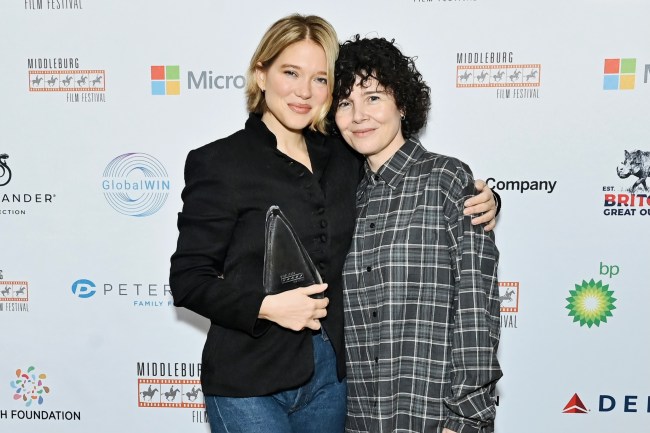
While accepting the Middleburg Film Festival Achievement in Acting Award this weekend, Léa Seydoux told the crowd that her parents sent her to summer camp in Middleburg. “The first time I came to the United States,” she said, “I flew on my own, and I was eight years old, and I didn’t speak a word of English, which is true. I knew how to say ‘yes,’ ‘no,’ and ‘sorry, I don’t understand.’ So it was it was difficult, but also rewarding. I discovered a new culture. I didn’t know then that I would become an actress, and that this would be my life: traveling, discovering new cultures, and exploring human nature.”
That has become the 41-year-old Seydoux’s hallmark, as she accompanied her Cannes breakout “Gentle Monster” (Netflix) to Middleburg with Austrian filmmaker Marie Kreutzer. Seydoux is in the running for the Best Actress Oscar.


Kreutzer grabbed the germ of an idea for the film from a 2020 newspaper article about pedophiles. “The article made it clear to me how close [to us] the perpetrators mostly are in most cases,” she said. “And that I must certainly also know not only victims of child sexual abuse but also perpetrators myself.”
When Seydoux first heard about the film from her agents, she was hesitant. As the mother of two children, “I was a bit scared of it,” she said. “I read the script, and I fell in love with the character. The script was so well-written, so intelligent, and that was it.”
In the film, when Lucy Weiss, a French pop singer living with her Austrian husband (Laurence Rupp) and young son in the country, finds out that her husband is accused of abusing children, “she’s in a state of shock,” said Seydoux. As the revelations about his behavior keep coming, “It’s a shock after another shock. It’s all these contradictions. This is what I loved about the character. It’s through her perspective that the story unfolds. It’s not through the victim’s perspective, not through the traitor’s perspective, but through her. I was able to bring a lot of different emotions that are not explainable with words.”


Seydoux is often silently reacting. “I used my facial expressions,” she said. “I try to to express internalized emotions with my body and my face. That was extremely interesting for me as an actor.”
Kreutzer structured a script that starts off with an intimate relationship with the husband, then evolves as Lucy finds out one thing after another, terrified that she might discover that her son was a victim of her husband’s predatory behavior. “After doing research and learning more about the subject,” said Kreutzer, “I became aware that I had had so many stereotypes in my head about pedophile criminals, so I really wanted to show a man and a couple that could feel like friends to an audience, a guy who would never have any suspicions of that kind. I like to get the audience to like them, to feel close to them. And then when all of this unfolds, also being in Lucy’s shoes and not wanting this to be true, and hoping for her and hoping for him that it’s not true, and that there will be some explanation, because that’s very human. When it comes to someone we know and have trusted, it’s much harder to accept that they have done awful things.”
Added Seydoux, “When it’s someone we know, that’s way harder to to accept because everyone has different sides to them, and also monstrous people have likable sides.”
Seydoux had to speak three languages on this film: English, French, and German. “Of course the German language is difficult in the pronunciation,” she said. “I found it difficult to play the emotions with the language you don’t speak. But then I had to be, emotionally speaking, in a strong emotion. There was a word that I struggled to pronounce, and at some point I remember that I burst into tears. Lucy can’t really express herself, and she doesn’t speak the language either, and so she’s even more isolated.”
The great Catherine Deneuve, who plays Lucy’s mother, points out that she’s supposed to be in the city, not in the country, because she’s a performer. “Yes,” said Seydoux. “The hardest part for me was the piano and the technical aspects. We spent some time in Vienna with Marie and a piano teacher who helped me. I had to press the right keys. The singing is my voice. I’m proud of it, and I’ve always loved singing. So that was for me also a dream come true.”
After 20 years in the business, Seydoux has learned many lessons, but none as heart-wrenching as shooting Abdellatif Kechiche’s “Blue Is the Warmest Color,” which won the Palme d’Or in 2013 for the director as well as his two actresses, Seydoux and Adele Excharpoulos.

“That was thirteen years ago,” Seydoux said, “at the time before the #MeToo movement. I’ve spoken already a lot about how disrespectful the director had been with us. We shot for six months, and we just discovered the movie in Cannes. The scenes were graphic, let’s say. So I discovered them during Cannes, which is absolutely crazy, and I didn’t have any approval on these scenes. We won the Palme d’Or, which makes us in a way co-writers of the film, which was true. True, because there was a lot of improvisations, and the story is based on both of us.”
It was after that award that things got complicated when Seydoux started to speak out about “the bad conditions,” she said. “The producers came to me and said, ‘You better shut your mouth, because if you want to be nominated for something, if you want to do the award season, you better stop.’ And I said ‘no, I want to explain how mistreated we’ve been on this film,’ and I didn’t say half of what happened. Really, it was horrible. And so I got fired. They fired me for promotion. It was difficult because then the director started to bully me. He said that if I was speaking, it’s because I come from this privileged family.”
Seydoux has never revealed the promo firing before. At a Golden Globes Q&A, Seydoux was challenged by some of the HFPA members, who said she was speaking out because of her family. “This was so humiliating,” said Seydoux. “Even now I could cry, but I’m not doing it. But I burst into tears and it was hard.”
“Since “Blue,” Seydoux has worked steadily with directors in France and Hollywood, from Wes Anderson (“The Grand Budapest Hotel”) and Woody Allen (“Midnight in Paris”) to Mia Hansen-Løve (“One Fine Morning”).
After #MeToo, her director has not returned to his previous station in international cinema. And Seydoux demanded final approval on any scenes involving her naked body. “When you work hand in hand with a director,” she said, “as I as I did with Marie, she showed me the scenes. I need to have the approval of that because it’s so intimate.”


