






When Kent Jones was a critic at Film Comment, he was known for, among many other things, his eloquent and insightful analyses of performance. Whether it was Nicole Kidman in “Moulin Rouge,” Robert Forster in “Jackie Brown,” or Daniel Day-Lewis in “There Will Be Blood,” Jones had a way of clearly and concisely zeroing in on what an actor was trying to convey, how they went about conveying it, and what their approach meant for the audience.
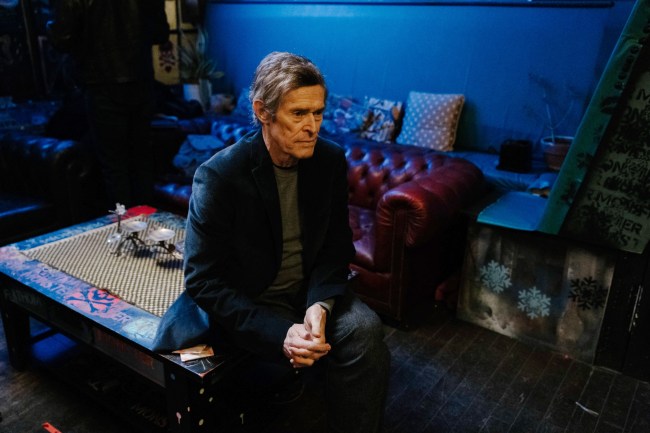
It’s not surprising, therefore, that when Jones began directing narrative fiction films (after forays into documentary filmmaking with movies on Elia Kazan, Val Lewton, and Alfred Hitchcock) he would give some of our finest actors some of the best roles of their careers. His debut feature, “Diane,” showcased a powerhouse performance by Mary Kay Place; his latest, “Late Fame,” revolves around equally complex and specific work by Willem Dafoe.


Dafoe plays Ed Saxberger, a forgotten New York poet working in the post office who gets back in touch with his roots when he meets a group of aspiring writers who not only remember him, but seem to revere him. In writer Samy Burch’s adaptation of the Arthur Schnitzler novella, the “enthusiasm society” that Saxberger befriends is presented with warm humor and empathy; while the film grapples with questions of authenticity and artistic purity, Burch never really makes fun of either Saxberger or his young protégés — she certainly doesn’t go for easy laughs, or show the cynicism toward her characters that Schnitzler does.
After reading Burch’s script, Jones wanted to lean into that sensibility and avoid taking shots at the characters. “It’s easy to imagine Billy Wilder making a completely different movie out of the same material,” Jones told IndieWire. “When I read the novella I thought the situation was great, but I preferred Samy’s script because it took some of the edge off. My tendency was to go even further in that direction. I wanted to get you as close as possible to the characters so you could feel their ridiculousness, but at the same time see the beauty of the delusion.”
While Jones wrote “Diane” and based many of its ideas on women in his own family, he looked forward to merging with another writer’s sensibility on “Late Fame.” “I liked the idea of meshing with somebody else,” Jones said. “In this case it was two other people, Samy and Schnitzler.” Jones found his own way into the film via its evocation of 1970s and 1980s New York, which reflected the time that both he and Dafoe arrived and began to find their way in the city. “Willem and I spent a lot of time talking about the New York of that moment, because it’s important to both of us. Once Willem came on board, he was practically the only actor that would make sense in that part.”


Indeed, the greatness of Dafoe’s performance is that there seems to be no space between the actor and character — it feels in every scene like he’s playing himself, even though the lives and careers of Ed Saxberger and Willem Dafoe have almost nothing in common aside from their ages and when they arrived in New York. Jones’ camera is beautifully attuned to Dafoe’s subtle gestures and expressions, which give a real sense of the character’s feelings and history even when he’s just silently reacting; the rhythms of the film all extend from what Dafoe is doing with his body, face, and line delivery, making “Late Fame” unthinkable without him.
“There are some people who think that actors are interchangeable,” Jones said. “This one leaves, so I’ll just get another one. But whenever there’s an actor in a role, it becomes a completely different entity.” There were two actors in “Late Fame” who fell out of the movie and had to be replaced, and in both cases Jones said it was a lucky break — and that part of directing is being open to the positive effects that can emerge when things don’t go according to plan.
“It’s ironic, because a lot of the language of film criticism is about control, and a lot of the work of being a film director is about letting go,” Jones said. “You have to do two things at the same time; obviously you have to stay in control and keep things unified, but at the same time you also have to let yourself be surprised and be open to, as Martin Scorsese would put it, new values that come up as you’re working.”
To that end, Jones tried not to be too prescriptive in the way he handled his actors, adopting a handheld style with multiple cameras so that he could respond to wherever they wanted to go in the moment, both emotionally and physically. “I don’t understand people who dictate to the actor as if they’re just a figure in a landscape,” Jones said. “You can do that, I just don’t know what kind of a working environment it would make. For me it’s more like we’re all on an adventure together.”
Jones tried to remain similarly open during the editing of the film, where he found the delicate pace that propels Saxberger’s story — it’s one of those rare movies that has the rhythms of life yet never feels slow or meandering. “You have to find the rhythm that’s proper to what’s there,” Jones said. “And there’s that great Bob Dylan quote, ‘Sometimes the beat gets in the way of the rhythm.’ There’s nothing worse than a movie that imposes a beat. It’s all about adjusting it so that everything feels in balance.”
Jones got a late start making features, but everything in his life has been geared toward it, from his work as a critic and working for Martin Scorsese in various capacities for 35 years to serving as director of the New York Film Festival. “ I always wanted to make films, period,” Jones said. “I always wanted to engage with them. It was great to write about them, and then it was great to make films about the making of them, and then to make fiction films.”
So was Jones’ path by design? “ Luck is really important, but it’s equally important to take advantage of luck and to know what it is that you’re being lucky about,” Jones said. “I don’t think that there was really a plan. But then is there for anybody?”
“Late Fame” opens in theaters on August 7.


