






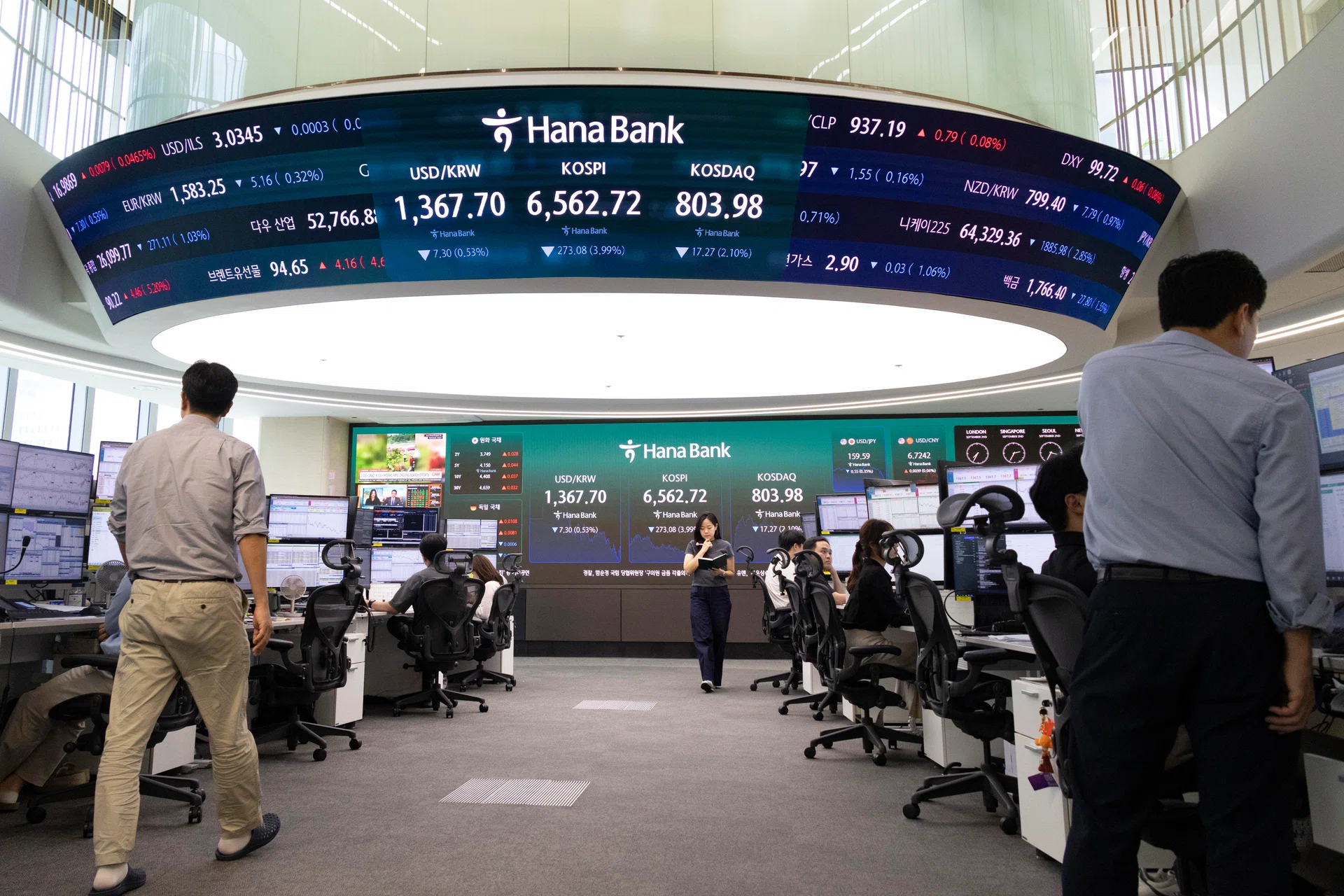
Concerns over the ability of hyperscalers to generate revenues have eased due to strong Q2 earnings
US EXCEPTIONALISM was supposed to be last year’s theme. This year was expected to be all about balance and broadening of growth across countries. That vision has not quite played out.
From an economic point of view, the US continues to outpace other major economies. The significant gap in artificial intelligence capital spending is believed to be one of the main reasons for this divergence.
The market has put the US’ AI capital expenditure this year at an estimated US$800 billion, whereas China’s is only about US$100 billion, and Europe’s AI-related spending is roughly 5 per cent of the US level.
The primary beneficiary of the AI capex boom has been emerging market technology hardware and semiconductor stocks, particularly in South Korea. At their peak this year, MSCI Emerging Markets Information Technology Index had advanced over 100 per cent from January.
The South Korea segment of the index was up around 250 per cent. Even after the large correction from late June, the stocks are still up about 80 per cent in aggregate as at Tuesday (Sep 8), after the summer correction on the back of worries around the ability of hyperscalers to monetise the immense capital invested.
US hardware stocks have led the summer sell-off, which has spilled over into Asia. If US technology capex cools down, it is likely to trigger a synchronised correction, as the building of compute capacity is interconnected with Asia via the supply chains.
What goes up must come down?
The dramatic drop in tech stocks has understandably raised questions about whether the AI bubble is bursting.
Investors are demanding clearer evidence of return on investment, as operating costs may outpace broader AI commercialisation efforts.
In South Korea, investor leverage and leveraged exchange-traded funds have exacerbated the swings in the market.
SEE ALSO




That said, the concerns over immense capex deployed into AI and the ability of the hyperscalers to generate revenues have eased, with the release of strong second-quarter earnings. Importantly we have seen signs of monetisation, as enterprise adoption of AI in diverse spheres is taking shape.
Some market players see valuations as a concern, but such a view is not supported by data.
At late June’s market peak, the MSCI Korea Technology Hardware & Equipment Index’s forward price-to-earnings (P/E) ratio was just 7.2 times compared to a long-run average of 12.5 times. That is, P/E ratios were below average even then and are lower now.
Hence, the valuations do not seem to be stretched. Notably, 2026 earnings-per-share estimates for the largest Korean hardware and semiconductor stocks have been going up. We are of the view that the summer sell-off was more technical than fundamentally driven.
Overall, hardware tech stocks appear to have simply corrected after an oversized rally. Their growth outlook remains solid. By contrast, software companies face challenges from AI, while the hyperscalers see short-term earnings pressure from their massive capex programmes.
Nevertheless, investors have begun to focus on the revenue generated by AI models and these stocks are bouncing back.
Potential of European tech stocks
Compared with the US, European equity markets are more sensitive to oil prices and interest rates. Still, despite the rise both in oil prices and in global interest rates, European equities’ Q2 earnings have grown at the strongest pace in three years.
There is potential for European markets to make up more lost ground if a longer-lasting resolution is found to the Iran conflict, along with Europe’s need to address competitiveness and drive its strategic autonomy agenda forward.
A large share of the earnings growth in Europe came from the energy and financials sector, which is likely unsustainable.
In contrast, a greater portion of US earnings growth came from technology, which should be more persistent due to the structural growth catalyst from AI development.
Estimates for 2027 see European earnings growth dropping to half the US rate.
The opportunity, then, is likely to be greater in certain segments of European equities rather than in the broad index.
For example, while the tech sector is not as large in Europe – it’s only 9 per cent of the MSCI Europe Index – like the US, the growth potential of the tech sector is stronger than the rest of the market, supported by the same theme of building AI compute capacity.
Japan’s currency conundrum
The macroeconomic backdrop for Japan is supportive and earnings growth was exceptionally strong.
However, the biggest threat to the market is the potential strengthening of the yen as the Bank of Japan and US Treasury attempt to reverse some of the depreciation of the last two years.
Roughly 60 per cent of the revenue of companies in the MSCI Japan Index come from sales abroad – much higher than that of US and German companies.
Hence, Japan is seen as a market that benefits disproportionately from a weakening currency. If the governments succeed in pushing the currency up, the effect may offset, in part, otherwise positive fundamentals.
The writer is chief market strategist, BNP Paribas Asset Management


