


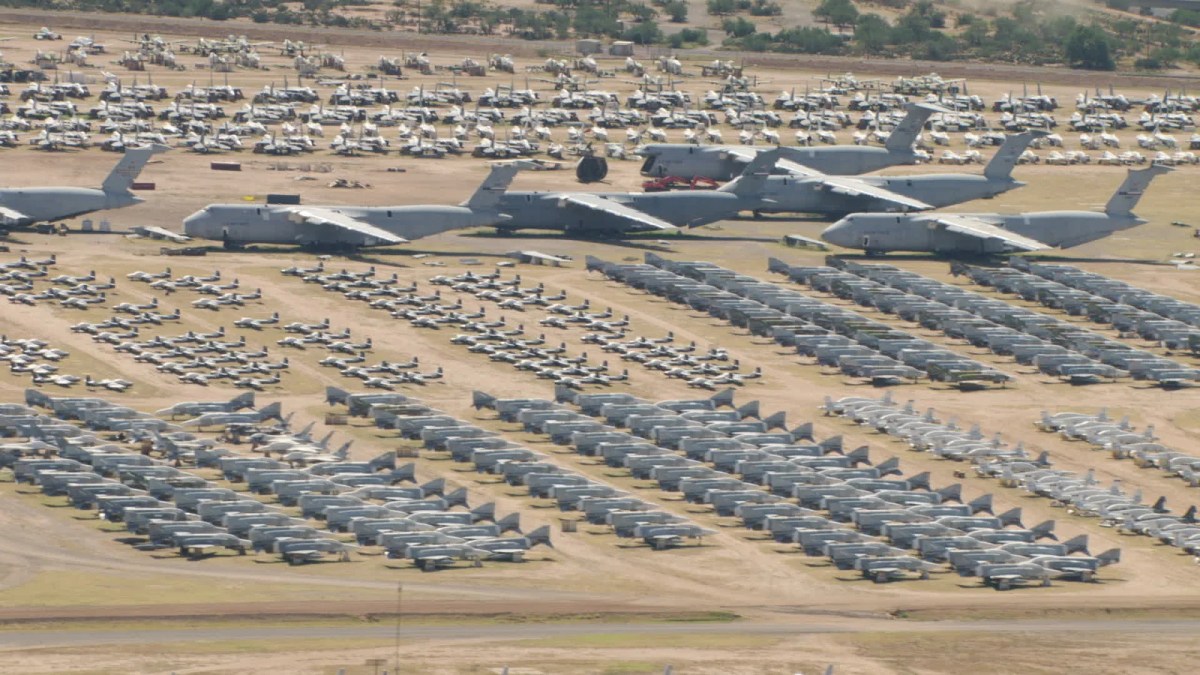

Do you ever wonder what the fate of military fighter jets, cargo planes, and even commercial airliners is after their last flight? The destination is the vast, sun-scorched landscape of the world’s largest aircraft graveyard—Davis-Monthan Air Force Base in Tucson, Arizona. It is not only an old aircraft graveyard; it’s a thriving, dynamic center of preservation, recycling, and war preparedness.

What Is an Aircraft Boneyard?
An aircraft boneyard is a specialized area where retired, decommissioned, or excess aircraft are stored, maintained, and occasionally torn down. These are not mere parking lots for old airplanes. They’re specifically selected based on climate and geology, and they serve a critical function in the lifecycle of the aviation industry. The 309th Aerospace Maintenance and Regeneration Group (AMARG) states that Davis-Monthan is the world’s largest aircraft boneyard.

Why Tucson? The Science Behind the Location
Why place thousands of aircraft in the Arizona desert? It’s all about the environment. The Sonoran Desert has low humidity (10-20%), little precipitation, and hard, alkaline ground. This particular combination retards corrosion and enables even the heaviest of planes to be placed directly on the ground without concrete pads. As the 309th AMARG describes, Tucson’s environment allows for indefinite storage with little breakdown.

Within Davis-Monthan: Operations and Organization
Davis-Monthan houses the 309th AMARG, a civilian-dominated workforce with more than 4,000 aircraft from the Air Force, Navy, Marine Corps, Coast Guard, NASA, and other government agencies. The facility is divided into specialized squadrons for maintenance, reclamation, storage, and support. Aircraft are processed based on their future: some are stored in mint condition in anticipation of possible return to service, some are stripped down for parts, and some are readied for recycling.

The Life Cycle of Airplanes in the Boneyard
It isn’t just left behind when a plane departs. What happens is that it begins with a good cleaning, particularly crucial for planes that experience salt or tropical environments. All fluids are exhausted, and sensitive pieces such as ejection seats and classified equipment are taken out. The plane is sealed with protective treatments like Spray-Lat, which protects it from the ultraviolet rays of the sun and temperature fluctuations. Desiccants are put in to keep moisture at bay.
Aircraft are classified based on their future fate:
Long-term storage (Type 1000): Kept in reserve for potential recall to active service.
Parts reclamation (Type 2000): Utilized as “aircraft storage bins” to maintain other aircraft airborne.
Short-term hold (Type 3000): Left virtually flyable, to be transferred or sold.
Scrap (Type 4000): Stripped and ready for recycling.

Preservation, Maintenance, and Parts Reclamation
Keeping these giants in condition is a painstaking task. Regular checks keep protective coats in place. Rubber seals, tires, and hoses are inspected and rotated. If a component is required for a flying aircraft elsewhere, AMARG’s crew pulls, inspects, and sends it—within hours if necessary. In one year alone, AMARG has reclaimed more than 10,000 parts valued at hundreds of millions of dollars, supporting everything from fighter planes to cargo planes.

Recycling and Sustainability: Environmental and Economic Impact
Aircraft boneyards are underappreciated sustainability heroes. Aircraft are constructed of precious, recyclable materials such as aluminum, titanium, and high-strength alloys. At the end of its service, up to 92% of the weight of an aircraft can be recovered and reused. Engines, avionics, landing gear, and even interior parts get refurbished or find their way to the market. The leftovers are melted down to be reused in everything from automobiles to buildings. As First America points out, recycling aircraft parts is an economic and environmental necessity.
Disposing of hazardous materials is an important aspect of the process. All liquids, oils, and poisonous chemicals are drained and discarded in an environmentally responsible manner, keeping the boneyard’s footprint as small as possible.

Global Perspective: Other Large Boneyards and Breakthroughs
Davis-Monthan is the largest in the world, but it is not unique. Spain’s Teruel Airport in Europe and TARMAC Aerosave in France are at the forefront of environmentally friendly plane recycling, processing anything from Boeing 747s to Airbus A380s. Europair says Teruel is able to recycle as much as 92% of an aircraft’s weight, generating jobs and backing the circular economy. TARMAC Aerosave, which is owned by Airbus, Safran, and Suez, has recycled more than 300 planes, including over 75% of all out-of-service A340s.

The Boneyard’s Role in Military Readiness and History
Davis-Monthan is not just a boneyard—it’s an asset. Planes stored there have been redeployed to fight in conflicts from Korea to the Gulf War. The boneyard also assists in programs that turn retired fighters into target drones and retains historic planes for museums. It’s a working repository of aviation history, with formations of B-29s, B-52s, F-4 Phantoms, and many more.

How to See the Boneyard Today
Tours within the base are no longer offered, but the sheer scope of the boneyard continues to be visible from surrounding roads such as Escalante and Irvington. The Pima Air & Space Museum adjacent provides an up-close view of hundreds of vintage aircraft, several of which previously dwelled in the boneyard.
Next time you see a shiny jet soaring through the air, keep in mind: its path could someday take it to Arizona’s desert landscape, where the history of flight never really finishes—just pauses for the next installment.
