


The bloc’s ability to maintain centrality comes from trust built through overcoming crises together, he adds
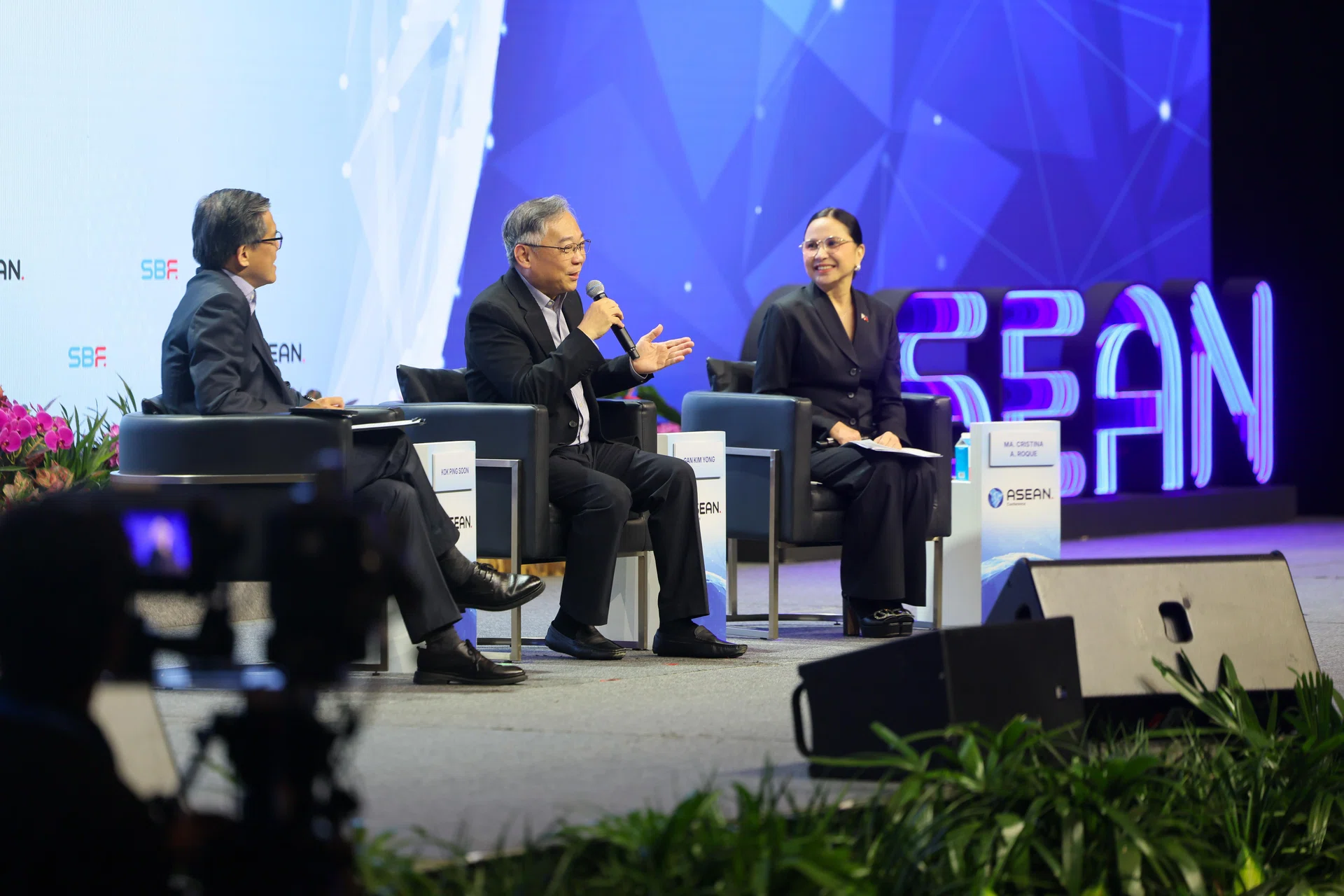
[SINGAPORE] Asean is responding to geopolitical rivalry and protectionism by deepening economic integration, said Deputy Prime Minister Gan Kim Yong.
“The world is fracturing, fragmenting apart, but at the same time, ASEAN is integrating,” he said on Friday (Jul 31) in a panel discussion at the Singapore Business Federation’s (SBF) Asean Conference 2026.
He highlighted how Asean came together during the Covid-19 pandemic to strengthen its supply chains, and then again to upgrade its Trade and Goods Agreement in 2025, when the US announced its sweeping global tariffs.
The event, held in Singapore’s Resorts World Convention Centre, featured business leaders and government officials from around the region in discussions on the challenges facing the South-east Asian bloc amid wars, tariffs and the artificial intelligence transformation.
DPM Gan said the foundation of Asean’s ability to integrate and maintain centrality is not the similarity among member economies, but rather the trust built through overcoming multiple crises together.
“Because we have gone through many crises together, and with every crisis, we were able to overcome and work together, it deepens the trust among Asean members,” he said.
The Digital Economy Framework Agreement (Defa) is the latest example of Asean’s integration journey.
Defa, which will come into effect in 2027, is expected to simplify how businesses, especially small and medium-sized enterprises, scale across South-east Asia by creating common rules for digital trade, data flows, payments and online transactions.
But DPM Gan noted that the success of these agreements and the future of Asean will be determined not just by governments, but also by active business community participation.
SEE ALSO
After Defa is implemented, AI will become the next major digital agenda for Asean, he said. The focus in AI collaboration will be on capability development, interoperability, standards, governance principles and practical applications.
Still, some projects and plans will require more time to find consensus or achieve significant progress. They include the Green Economy Agreement and the Asean Power Grid.
DPM Gan said that when Singapore takes over the Asean chairmanship in 2027, priorities will include continuing internal integration while expanding engagement with the rest of the world.
In other panel discussions, John Kain of Amazon Web Services (AWS) said investments in AI infrastructure will continue to pick up across the region in the coming years, benefiting the region’s economy.
He said the US tech giant’s own planned investments in Indonesia, Malaysia, Singapore, and Thailand in cloud and AI infrastructure are expected to reach over US$33 billion by 2039.
They will also support thousands of jobs annually and add US$64 billion to the four countries’ collective gross domestic product by 2039.
New York-based Kain, who heads leads AWS’ worldwide business and market development efforts for the financial services industry, said Amazon has trained over 2.7 million individuals across South-east Asia on cloud skills since 2017.
He said companies should begin AI adoption immediately, rather than waiting for perfect solutions.
“Don’t wait for the perfect model because it will continue to evolve,” he said. “The challenge is always: How does the technology get implemented and integrated into your business operations that will actually augment productivity and efficiency?”
Edmund Leong, head of UOB’s corporate banking, said that beyond its technological implications, AI is also about economic growth.
“AI is really not just a technology story. It is an economic growth story in terms of business impact. Companies and enterprises are adopting it because it really has those positive economic returns,” he said.
In a fireside chat, Aw Kah Peng, chairman of Shell Companies in Singapore, discussed the need for Asean to build a resilient energy market, especially after the disruption to oil and gas supplies and spiking prices from the Iran war.
“Now more than ever is the time for us to say how do we now invest for growth, but with the additional lens of resiliency in mind,” she said.
“And that’s important, because if we don’t already build that in, when we have the opportunity to do it and do it urgently, then we’re losing that window.”
Aw noted that Asean represents about 10 per cent of the global population, but energy usage is only 50 to 60 per cent of the EU’s levels. That means there is tremendous room for energy investment without compromising on cleaner energy goals.
“So, you can see that there’s actually a huge amount of opportunity ahead for us to keep investing in energy for growth,” she said.
She added that the events in the Middle East and global geopolitical tensions demonstrate that volatility is the new normal. Businesses must learn to continue operating and growing in this state rather than waiting for stability to return.
“The volatility is very real. No one knows when it’s going to settle down or resolve itself,” she said.
“So, volatility is here to stay. It’s not disappearing anytime soon. We need to get used to how do you continue your business, continue to grow in that state.” THE STRAITS TIMES
