


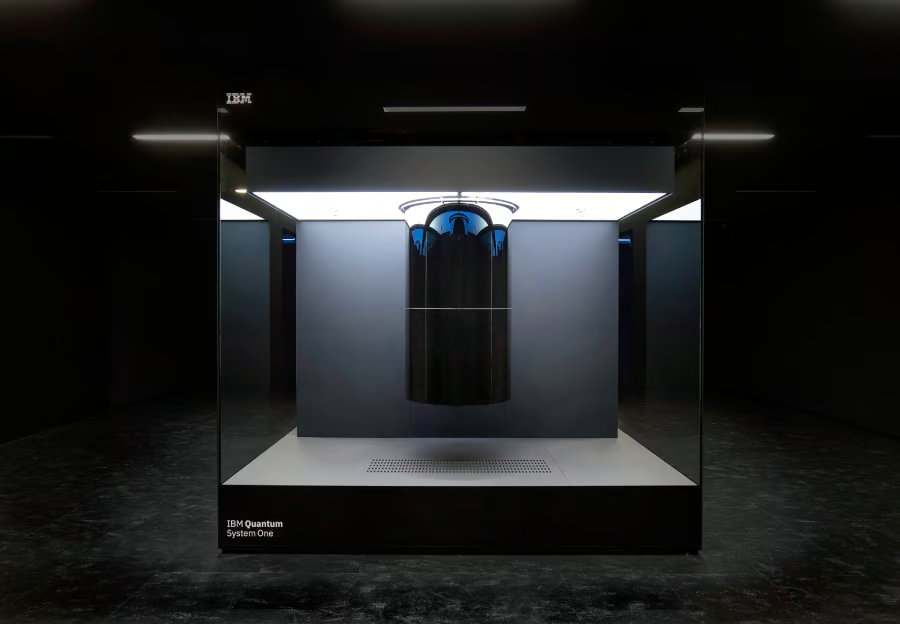
An IBM quantum processor completed a sampling benchmark in 19 seconds that researchers estimate would take the Frontier supercomputer roughly 110 years under their simulation model.
In a research study posted to arXiv on Sept. 23, researchers reported quantum computational advantage using IBM’s 120-qubit Nighthawk r2 processor. Running a benchmark known as random-circuit sampling, the system generated 1 million samples in 19 seconds. Using a tensor-network simulation model, the authors estimate that generating samples with comparable fidelity on Frontier would take roughly 110 years and require 1.2 × 10²⁷ floating-point operations. The 19-second figure covers the sampling run; the full experiment used about 11 minutes of quantum processor execution time.
“To our knowledge,” the authors write, “this is the first demonstration of quantum advantage for a vanilla random-circuit sampling on a commercially and broadly accessible quantum processor that most non-expert quantum computer users can easily replicate.”
Breaking out of the research basement
When Google made headlines in 2019 by asserting quantum advantage on its 53-qubit Sycamore device, the test ran on purpose-built hardware inside an elite research facility. In contrast, the BlueQubit team accessed Nighthawk r2 via IBM’s public cloud platform. They utilized standard cloud execution stacks and applied no custom, benchmark-specific calibration before running the 61-qubit, 36-cycle circuit.
Faster circuit execution is one improvement; the study also reports improved fidelity over Nighthawk r1. BM’s Nighthawk r2 retains the 120 programmable qubits of its Nighthawk r1 predecessor. IBM compares its throughput with the separate Heron processor family. However, Nighthawk integrates dedicated hardware reset elements directly onto each qubit.
According to IBM, the reset mechanism reduces a qubit’s effective energy-relaxation time from about 200 microseconds to roughly 25 nanoseconds, enabling idle periods between circuit runs as short as 1 microsecond. IBM reports throughput exceeding 100,000 circuit executions per second, compared with roughly 4,000 for Heron. Separately, IBM is developing modular cryogenic infrastructure to support larger quantum systems.
Architectural reality and trade-offs
The 110-year estimate comes with standard caveats. The estimate assumes unlimited working memory and 20% of Frontier’s theoretical peak performance. It applies to a specific sampling strategy and does not establish a minimum runtime for every classical approach. Classical researchers historically invent clever algorithmic shortcuts that narrow these windows.
Furthermore, random-circuit sampling remains a synthetic math benchmark designed specifically to prove a computational gap, rather than an application that solves real-world logistics or chemistry problems. The findings were released as an arXiv preprint. Other research, including a proposed superfluid-helium qubit architecture, explores different ways to reduce quantum errors.
What eWeek found: Benchmark speed leaves the business case open
For enterprise teams evaluating quantum services, the useful takeaway is to assess circuit throughput alongside accuracy, access costs, and performance on the intended workload. This sampling benchmark does not establish an advantage for logistics, chemistry, or another business application. Separately, IBM’s advancement in DARPA’s Quantum Benchmarking Initiative puts its approach under independent scrutiny focused on whether computational value can exceed cost.
Before committing to a pilot, teams should request an end-to-end comparison with their best classical option, including queue time, preprocessing, error mitigation, and total cost. Those measurements would help determine whether faster circuit execution translates into business value.
Read more: Explore how researchers are moving beyond sampling benchmarks by using a quantum simulator to model string-breaking physics.
