



[SINGAPORE] China electric vehicle (EV) brands are making fast and furious sales in the Asia-Pacific, but Japanese carmaker Suzuki is not going head-to-head with them.
Recognising that the EV wave is powered partly by government incentives, the mass-market brand is staying focused on petrol-electric hybrids for now, said Masafumi Harano, managing officer and executive general manager of automobile marketing for Suzuki in Asia.
“I think Suzuki, and almost any company really, is trying to find out what is going to be the mainstream technology down the road,” said Harano, who also oversees Latin America and Oceania.
“Hybrids will be a strong solution for a while, and that is the area we try to focus on.”
Still, Suzuki plans to introduce its own EVs to Asia in the next five years, while it keeps an eye on policy developments, he said.
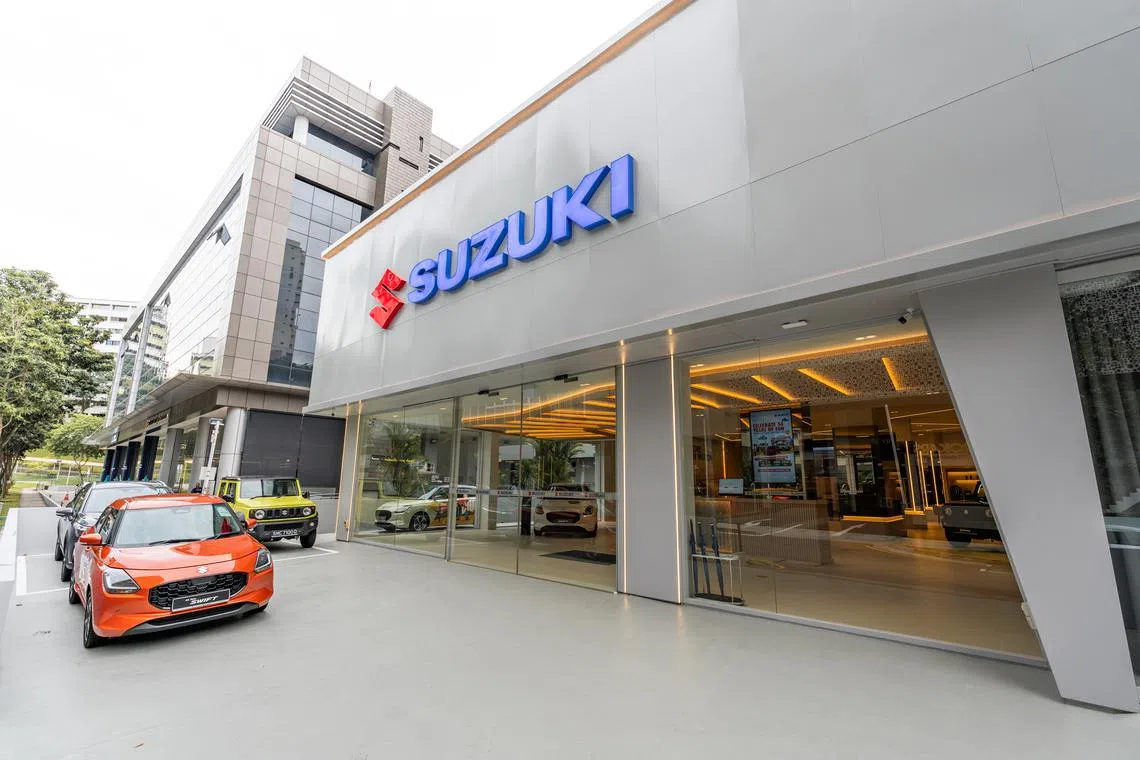
He was speaking to The Business Times at the opening of Suzuki’s Singapore showroom on Wednesday (Aug 27). This year marks the brand’s 50th anniversary in Singapore with dealer Champion Motors, a subsidiary of London Stock Exchange-listed multinational automotive distributor, Inchcape.
BT in your inbox

Start and end each day with the latest news stories and analyses delivered straight to your inbox.
Not the only road
EV sales in South-east Asia have soared in recent years, especially in the region’s three largest automotive markets of Indonesia, Malaysia and Thailand. There, EV incentives have boosted sales, and governments have encouraged local production by China carmakers.
But the incentive-driven nature of this rise is precisely why Suzuki has taken a cautious approach.
“One thing we have been carefully watching is that (China carmakers’) increase in sales is heavily supported by incentives, not only here in the (Singapore) market, but also from China,” said Harano.
At home, China’s carmakers have achieved economies of scale, thanks to tax breaks and consumer subsidies that have boosted EV sales, as well as indirect help from government contracts.
“When incentives change, that will also change the picture,” said Harano. “So we try to be very careful.”
Incentives “will not continue forever”, he added. Countries cannot pay these out indefinitely, and will eventually reduce them. “Once that is going down, maybe the popularity (of EVs) is going to change.”
China players such as BYD, the world’s biggest EV maker, have been setting up production facilities to feed their roaring regional sales. BYD was the top-selling car brand in Singapore in July; it was fourth in Thailand in June, and sixth in Indonesia in July, just behind Suzuki in fifth.
But Suzuki is “not too worried about the big jump” in BYD sales, nor does it have immediate plans to expand production in South-east Asia, said Harano.
While economies of scale are valuable in the automotive industry, companies cannot go “too far” in chasing volume either, he added.
While he did not elaborate on the downsides of BYD’s aggressive strategy, a relentless price war among domestic EV makers in China has been blamed for crashing second-hand car values and bankrupting dealers.
Suzuki is maintaining its hybrid focus because EVs are just one option for a more sustainable future, said Harano. He noted that how green EVs truly are depends on how the electricity that powers them is generated.
Getting a jolt
But this does not mean Suzuki is ignoring the EV market.
Production for its first mass-produced EV, the e Vitara, has begun in India. Sales of the small sport utility vehicle are expected to start in Europe, Japan and India in the coming months.
India is Suzuki’s biggest market, accounting for just over half of its total sales.
Suzuki will expand its EV line-up further down the road, introducing six models to Japan and four each to India and Europe by its 2030 financial year.
While introducing the e Vitara to the wider Asia market is a “possibility”, there are no immediate plans for this, said Harano. But he added: “Definitely, in the next five years, there will be some more (EVs) for the Asian market.”
For the rest of its 2025 financial year ending in March 2026, Suzuki is looking to keep things stable, despite a rough road ahead.
For its first financial quarter ended Jun 30, profit fell 12.2 per cent to 102 billion yen (S$891 million) – the first fall in nine months. Its revenue dipped 4.1 per cent to 1.398 trillion yen, down for the first time in more than a year.
Like for other carmakers, Suzuki’s revenue and profits have been dampened by weak consumer sentiment amid economic uncertainty from the US Trump administration’s tariffs.
Suzuki is sticking to its previously announced full-year sales target of 3.3 million units, but Harano noted: “Achieving (our target) may not be easy because there’s a lot of uncertainty, particularly after Mr Trump announced (the US) strategy for the tariffs.”
Still, sales volume is not everything, he added – citing Singapore as an important example.
“Singapore, we don’t expect big volume from – but it is a very important market because it is a great showcase to the people from around the world, because so many people come to visit,” he said.
“That’s why we place a high importance on Singapore, and we have enjoyed the last 50 years in relationship with Champion Motors, because they have done a very good job for the presentation for our brand here.”
