


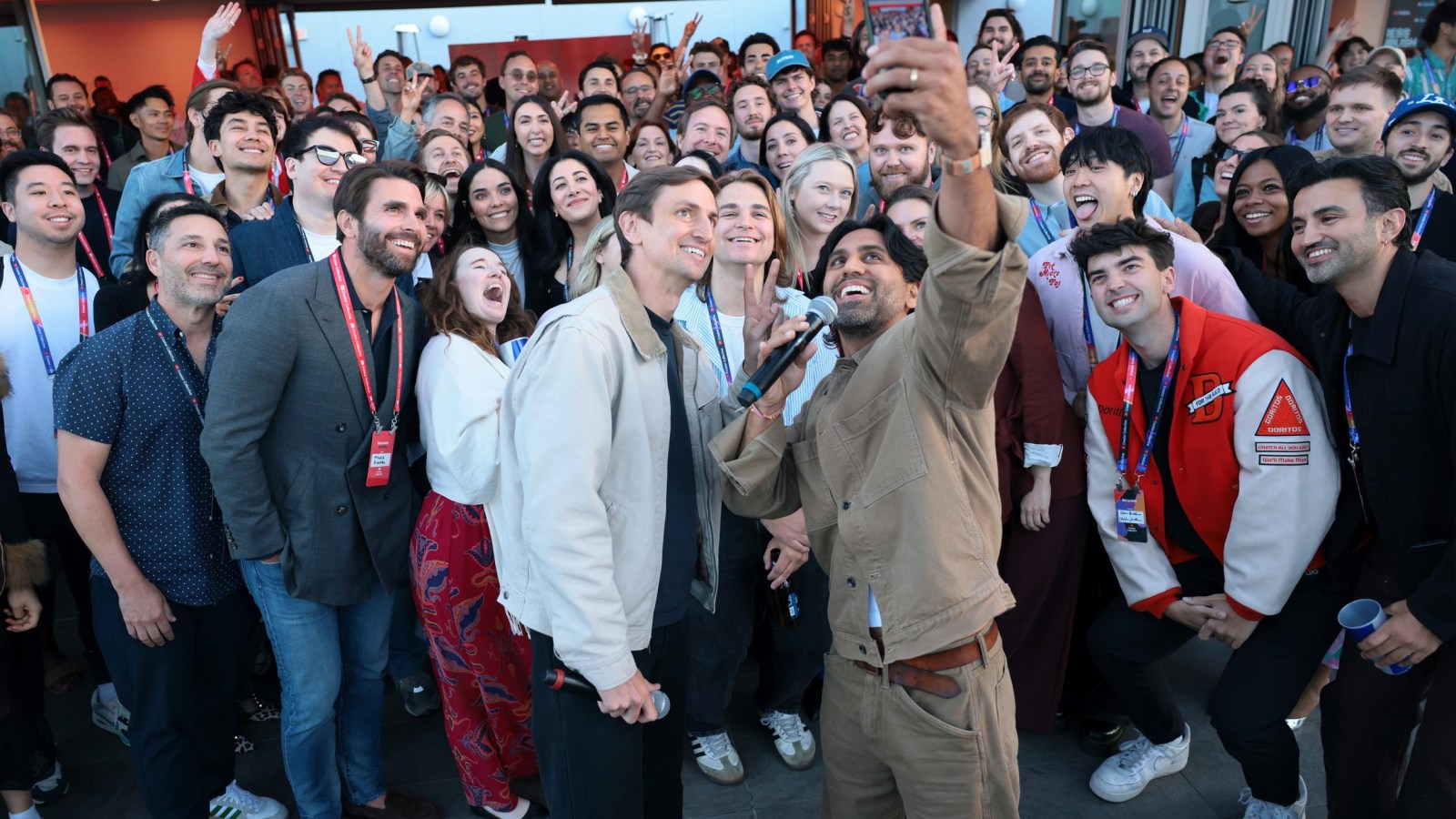
It’s a warm morning in May, and thousands of YouTubers, TikTokers, Facebook posters, and Instagram influencers have flooded the Fox Studio Lot in Century City, Los Angeles. They’re being ushered through manicured sidewalks by the hosts of this gathering, creator-industry whisperers Colin Rosenblum and Samir Chaudry. Winding past murals of the Simpsons and Marilyn Monroe, the group eventually finds itself in a rough re-creation of New York City, as imagined by Samsung, Canon, and Google, among others.
Corporate sponsors pursuing creators isn’t new. But Rosenblum and Chaudry hosting a summit on this century-old lot marks a new era of partnership. Social media has long been a place for studios to find talent — see Kane Parsons’ Backrooms and Curry Barker’s Obsessions. Now, they’re investing in creators to build audiences on the platforms where they’re already thriving. “For the first time, the Hollywood system is recognizing internet storytellers as viable partners,” Chaudry says. Or, as Billy Parks, the new head of the Fox Creator Studios, recently put it, “The creator economy isn’t separate from Hollywood. It’s increasingly becoming the future of entertainment.”
A COUPLE OF WEEKS LATER, I’m in Parks’ office at Fox. He’s only had this gig for three months, but he’s spent a decade and a half working closely with creators. When he met Fox Entertainment CEO Rob Wade last year, Wade had just announced his intent to start an arm of the business to invest in digital natives. “I was very excited about what it could be, but I was also a little scared about legacy media trying to do this,” Parks says.
The venture is something altogether new: For 50 percent of the revenue earned from the content they make together, Fox Creator Studios lends support for ambitious projects creators might not be able to do on their own. “What we offer them is capital, so they can go faster and make more things,” Parks explains. Fox also helps sell ads against the content — as they do for all of the shows they produce — and, when asked, sets up creators with experienced producers. So far they’ve signed 10 deals, including with comedian Tom Segura, influencer Josh Richards, and race-car driver Emelia Hartford.
Fox, along with every other studio, has been pulling talented people from YouTube to create and star in shows for years. What makes this different, Parks says, is the end goal isn’t necessarily to discover the next sitcom star. “If our wins were only counted by finding cool people on the internet and bringing them into broadcast, I think we would lose,” he says. Instead, they’re finding people with, say, a promising single season of a TikTok show and combining forces so they can take off on that platform. “We’re like, ‘We want to help you with Season Two, and Three, and beyond.’”
Not everyone, however, wants to be bound to a Hollywood studio. Take, for example, Rhett McLaughlin and Charles “Link” Neal. In 2006, when the two childhood friends from North Carolina started posting videos on their Rhett & Link YouTube channel, they were twentysomething aspiring filmmakers just looking for a creative outlet.

Sam Reich, owner of Dropout Media, hosting the game show ‘Game Changer.’
Kate Elliott
But it quickly turned into a real business. In 2011, they launched an IFC reality show, Commercial Kings, and relocated to Los Angeles. When that was canceled after one season, they doubled down on making their own videos. “That’s when we invented Good Mythical Morning out of Rhett’s garage,” says Neal, referring to the daily talk show with segments like Oreo-flavor rankings or dating red flags. Now in its 15th year, it boasts 3,000 episodes and almost 20 million subscribers. Their flagship shows are available on Netflix, and they even have a channel on some streaming platforms that plays their videos nonstop.
For McLaughlin and Neal, handing over power to a corporation is a nonstarter. In their experience, when someone offers cash to “port your audience over here,” as Neal puts it, fans are often turned off. “If it feels different in any way, [the creator] might be screwed,” he says. “You can’t take away what’s working.”
AS HOLLYWOOD HAS CIRCLED around creators, the creators themselves have built their own infrastructure. Sam Reich is the owner of Dropout, a subscription-only service that offers a handful of independently created properties, including the popular game show Game Changer and the Dungeons & Dragons live-play Dimension 20, which sold out Madison Square Garden last year. Reich uses word of mouth to find most of the comedians to join his loyal band of regulars. “This Jason Maxey ecosystem caters not exclusively to people who are very funny and talented, but even more to people who are good hustlers and entrepreneurs,” Reich says.
In a former boot-camp gym a few blocks from the airport in Burbank, Dhar Mann has used that kind of entrepreneurial hustle to build a one-stop shop for content creation. Mann, 42, got his start posting scripted videos with a moral tilt on Facebook in 2018. When the pandemic hit, he leased this property and built out sets, including one modeled on a classroom. That move proved prophetic. Bringing in child actors to play out quandaries about school life led Mann to shift to YouTube, where younger audiences connected with the content.
He’s since brought on hundreds of people to work on the content — including former MTV President Sean Atkins, now his CEO — essentially creating his own TV studio. “There’s this thinking that creators are replacing traditional Hollywood, and my belief is [that] the line is disappearing,” he says. “The real magic comes in when those two groups come together and create something much bigger and much more meaningful.”
In conversations around creators in 2026, two movies inevitably come up: Parsons’ Backrooms and Barker’s Obsession. In a matter of months, their films have become shorthand for creator-industry-crossover success stories. But still, they had traditional partnerships with studios: Obsession was produced by Blumhouse, and Backrooms had the backing of A24.
There was, however, a third horror movie from a YouTube star: Iron Lung, made by Mark Fischbach, better known as Markiplier, which cost roughly $5 million and recouped more than $50 million at theaters. Fischbach, 37, a former biomedical engineering student, got his start posting playthroughs of video games. By 2022, Forbes had listed him as the third-highest-paid creator on YouTube. Because of this revenue stream, he was able to finance Iron Lung entirely himself, and place it in theaters across the country, including in big chains like AMC. And, as he’d hoped, the audiences came with him.
Markiplier in his self-financed movie ‘Iron Lung.’
Philip Roy
Chaudry sees studios bringing on creators not just as a way to hedge risky bets; these are people with dedicated audiences who will follow. But the shift, he says, is because they are finally willing to work with creators on their own terms. “The one thing Hollywood historically has not had, and what has changed in our conversations with studios, is the respect for momentum [in the creator world],” he says. “If I pitch you an idea, I’m excited about the idea right now. If it takes six months for us to agree on making that idea, I might have moved on.” Yet he doesn’t see creators as replacing the established system. “My hope is to learn from those people,” he says. “If both sides are willing to learn from each other, great work will be made.”
