


In a year without Glastonbury, music lovers have turned to other festivals in the U.K. and Europe to fill the void. There’s Primavera Sound in Barcelona, with its proximity to the beach and genre-diverse lineup, or Reading and Leeds in England for those who want a true camping experience with a rock-focused flair. But look a little further north and you’ll find a hidden gem that’s capturing the attention of both festivalgoers and artists around the world: Øyafestivalen in Oslo, Norway.
Compared to a juggernaut festival like Glasto — known for its sprawling grounds, mandatory camping and rowdy atmosphere — Øya, which kicks off on Wednesday, delivers a more intimate experience. The capacity is about 10 times less (with 22,000 people expected to attend each day this year), it’s held in Tøyen Park in the middle of Oslo and there’s a certain Scandinavian politeness that seems to keep people from getting completely off their faces. But over the past decade or so, Øya has consistently delivered huge headliners and some of the best, most varied lineup curation on the festival scene, booking everyone from Blur to Kendrick Lamar to Charli xcx.
This year’s four-day lineup is headlined by the Cure, Nick Cave and the Bad Seeds, Sombr and homegrown artist Dagny, but also includes Geese, Wilco, Lily Allen, Clipse, Blood Orange and Tomora (the collaboration between Chemical Brothers’ Tom Rowlands and Norwegian singer Aurora). There’s truly something for everyone, and its relatively small capacity, lack of huge crowds and overall peaceful vibe make it possible to actually see the artist you’re watching.
“Everybody can book a big headliner and put on a big show, but it’s the details and taking care of everything — being really nerdy on where you put the toilets and the bars and the sound bleed between the stages — all these things are very important,” says Claes Olsen, who co-founded the festival in 1999 and serves as its booking manager. “That’s what makes it unique.”
It’s such an enjoyable experience for artists and attendees alike that many of them — like the Cure, Nick Cave, Wilco and Blood Orange this year — are repeat bookings. As its profile has grown worldwide, Olsen says artist requests to play the festival have increased as well. Nowadays, Øya books its lineup up to 17 months in advance.
“We’re getting tons [of requests] every day,” Olsen says. “So as a booker, one of the most important jobs we actually do is to say no to people, which is not that fun. It’s hard. But of course, we also have to reach out a lot.”
Something Olsen is particularly proud of is that the Cure — who previously headlined the fest in 2019 — asked to come back before the band plans to retire in 2029. “We got an email from the agent for the Cure saying that Robert Smith wanted to play Øya before they stopped being the Cure,” he says. “I’ve been a fan since I was a teenager, so that was pretty amazing.”

Robert Smith from the Cure at Øya Fest in 2019.
Redferns
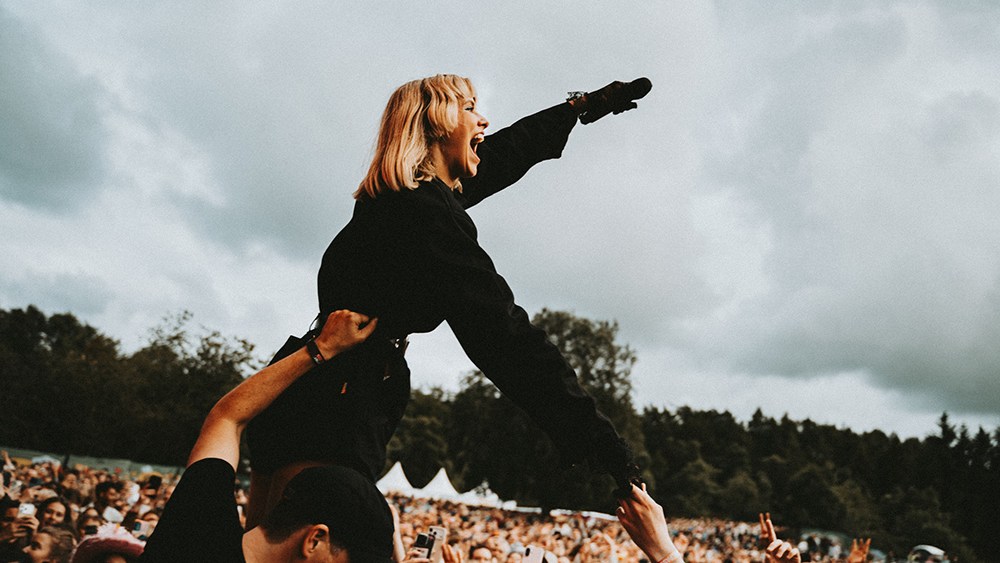
But it’s not just about attracting acts from the U.K. and U.S. for Øya — the festival puts a huge emphasis on local Norwegian artists, mixing them in throughout each day so it’s “not just them playing first and hoping somebody shows up,” Olsen says. And, the headlining spot on Saturday, the final day of the festival, always goes to a homegrown artist. This year, it’s dance-pop singer Dagny (pictured above), who hails from the city of Tromsø and broke through with hits like “Somebody” and “Drink About.”
For Dagny, headlining Øya has always been a dream, ever since she first played on a small stage at the festival a decade ago. “It’s kind of my Madison Square Garden, if you know what I mean,” she says. “Øya is one of those festivals where I feel like people are so open to music and to just being present, right there and then in the crowd. It’s really one of my favorites.”
She just released her third album, “Dancefloor Erotica,” which leans more into electro-pop and marks a real creative milestone in her career. “I feel weirdly out of my comfort zone, but at the same time I feel like I’m where I want to be,” Dagny says. “We have such a different energy now playing this record — it’s a bit darker, it’s a bit heavier, a bit more danceable.”
Another priority for Øya is gender parity, with the festival committing to a roughly even split between male and female performers. This year, Saturday’s main stage lineup is only women, headlined by Dagny but also including Lily Allen, Irish breakout CMAT and U.S. singer Hannah Cohen.
“Øya is real proof that [gender parity] doesn’t have to be a problem because they’re probably the biggest Norwegian festival and they always seem to get a pretty even balance,” Dagny says. “Not only am I the headliner on that stage with lots of female artists that day, but I think I’m also something like the fifth or sixth female artist to headline that slot in the last few years.”
This was of the utmost importance to U.K.-based feminist band Girl Group — four out of five members of which hail from Oslo — who are playing Øya for the first time. Having formed at the Liverpool Institute for the Performing Arts in response to the male-dominated culture they experienced, Girl Group only works with women and nonbinary people, from the music-making process down to their videos and photography.
“They care a lot about the environment and feminism, and they try to make active choices for society, not just the festival itself,” Girl Group’s Mia Halvorsen says of Øya. “For us, being on a lineup with all the women we really value feels very special and meaningful. And obviously, our project is very political and very feminist, so it feels good to be seeing a bit more of that in festivals.”
Girl Group
Serskaten
In addition to its gender split pledge, Øya is a leader in festival sustainability, prioritizing waste management, stopping the use of fuel generators in 2008, and only serving meat-free food since 2024. Last year, the fest added human rights to this initiative, and is once again partnering with Amnesty International to fundraise for medical aid in Palestine.
“Working with Amnesty has helped us a lot to educate ourselves on the whole human rights situation, not only in Palestine but other places in the world as well,” Olsen says. “That work is super important going forward.”
As Øya has grown on the global stage, Norway as a whole has been experiencing a bit of a cultural moment. From Joachim Trier’s “Sentimental Value” bringing the country its first international feature Oscar earlier this year to their football team making it to the World Cup semi-finals, Norway’s profile is rapidly rising.
“It’s good to see Norwegian people charming the world a bit,” Olsen says. “It’s been really hard groundwork for the last 10 years, so I hope that continues.”
Dagny has not only observed an uptick in Norwegian artists being recognized internationally, but also on a local scale. “Music in the mother tongue has completely gone up,” she says. “I think after COVID, it’s pretty much just been Norwegian music that has been happening in Norway, with a few exceptions. Seeing how many Norwegian artists are doing so great, it’s helping to raise everyone’s bar of where we’re going to be at.”
Having lived in the U.K. for nearly a decade before moving back to Oslo before the pandemic, Dagny also believes that Norway’s environment contributes to her creative output. “Norway is thankfully a small and peaceful place, and sometimes what you need to be creative is time and space and quiet,” she says. “I think there is maybe something to the fact that I didn’t write an album until I moved back to Norway.”
Girl Group, who are currently based in Liverpool, have come to a similar realization — though for them, the artistic freedom they feel in Norway can be traced back to the way the country is run.
“We are a socialist country, we pay taxes, we have good education,” says Girl Group’s Katya Birkeland. “When you have good education, you get good directors, people who get to do acting, people who get to spend their time practicing football — you get people who get to do what they love.”
Adds member Maria Tollisen, “I think you need to be privileged and have a bit of financial safety and stability in order to be able to do art.”
Beyond just spotlighting homegrown acts, Øya also serves as a bit of a reunion for the local scene. “If you’re in a certain music scene in Oslo, it’s almost impossible to not have met a lot of [the acts],” Dagny says, mentioning that she’s looking forward to catching up-and-coming artist Ary and Tomora at the festival.
Girl Group also mentions Ary as a must-see artist, as well as the band Three40Four and singer-songwriters Elia and Ea Othilde. “One of my childhood best friends is a dancer for [Ary] now and I’ve not seen her for ages,” Birkeland says. “I can’t wait!”
