


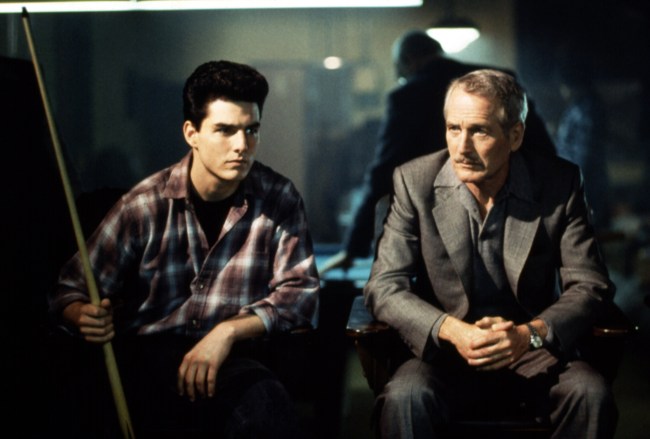

In the mid-1980s, Martin Scorsese got an intriguing piece of fan mail from someone more typically on the receiving end of such letters, movie star Paul Newman. Newman had been a huge admirer of Scorsese‘s “Raging Bull,” and he wanted the director to bring the same propulsive energy and meticulous sense of craftsmanship to a sequel no one but Newman was clamoring for: a follow-up to his 1961 hit “The Hustler.”
In that film, Newman had played Fast Eddie Felson, a pool hustler whose career ends before it really gets started. “The Hustler” was based on a 1959 novel by Walter Tevis, who wrote a sequel called “The Color of Money” in 1984. Although “The Hustler” was over 20 years old and mostly forgotten by a generation of filmgoers flocking to the likes of “Flashdance” and “Beverly Hills Cop,” Newman thought the character still had some juice left in him, and he thought Scorsese was the guy to help him bring “The Color of Money” to the screen.


The choice of Scorsese to helm a redemption narrative set in the world of pool halls and seedy motels probably seems obvious now, and to a certain degree it probably was then; after all, Scorsese was already considered one of the best directors of his generation thanks to a steady stream of great movies that included “Mean Streets,” “Taxi Driver,” and “The Last Waltz.” Yet his career was in one of its many transitional periods when Newman wrote that letter; some of the movies for which Scorsese would later be most celebrated, like “Raging Bull” and “The King of Comedy,” hadn’t been fully appreciated in their moment, and “King of Comedy” had been an unmitigated disaster at the box office.
Worse, Scorsese’s initial attempt to film “The Last Temptation of Christ” fell through right before its intended start date when Paramount caved to pressure from evangelical activists, leaving him demoralized and exhausted. Scorsese’s phone kept ringing — he was offered, among other things, “Witness” and the never-made “Flashdance 2” — but he wasn’t finding the kinds of projects that made him excited to face the studio grind again. When he did return to work, it was on the scrappy indie “After Hours,” a harrowing and hilarious black comedy that proved to the world — and to the director himself — that his inner maverick was still alive and well.
One might have thought at the time that a “Hustler” sequel wasn’t that different from the kinds of jobs Scorsese was passing on; at least “Flashdance 2” offered the possibility of big box office. But as it turned out, “The Color of Money” was the right movie at exactly the right time for both Scorsese and Newman, who, together with screenwriter Richard Price, jettisoned much of Tevis’ novel and turned the story into a thinly veiled joint autobiography.
The concept in “The Color of Money” as conceived by Newman and Scorsese and put to paper by Price (the three men worked in close collaboration on the screenplay, hammering it out in marathon Malibu writing sessions just as Scorsese and De Niro had wrestled “Raging Bull” into shape during a sojourn on Marlon Brando’s Tahitian island) was that Eddie would now be a liquor salesman adjacent to pool but not a part of it — his run-ins with professional gambler Bert Gordon (George C. Scott) and rival player Minnesota Fats (Jackie Gleason) in the first movie ended his career. When he discovers a flaky but talented up and coming player named Vince (Tom Cruise), Felson sees a way to get back in the game by mentoring — and exploiting — his new protégé.

The technical wizardry in “The Color of Money” is, as expected in a Scorsese film, unparalleled; reuniting with “After Hours” cinematographer Michael Ballhaus, the director stages the pool scenes as dynamically and expressively as he designed the boxing scenes in “Raging Bull.” Each set piece is as aesthetically pleasing for its own sake as it is narratively vital, expressing and developing character the way the musical numbers do in “New York, New York.” There are sequences in “The Color of Money” as dazzling as any the director ever shot (or his longtime editor Thelma Schoonmaker ever cut), most notably a game choreographed to Warren Zevon’s “Werewolves of London” in which Tom Cruise sinks one trick shot after another without benefit of CGI.
But “The Color of Money” is much more than a technical exercise, and it’s more than simply a calling card for Scorsese to get back in the game as a reliable studio craftsman. What gives “The Color of Money” its urgency are the parallels with Scorsese’s own life at the time; it’s a movie about what it means when the thing you’re best at and that you love the most is taken from you, just as “The Last Temptation” had been taken from Scorsese at the last minute. It’s also about what it means when you get another chance, and the moral questions that accompany that chance — what are you willing to do to get back in the game, and who are you willing to hurt? How much pain are you willing to absorb? What are the costs of being on the outside, and what are the costs of clawing your way back in?
These were all questions Scorsese had probably been pondering in the previous 10 years, ever since “New York, New York” underperformed and became Scorsese’s first movie to falter with critics. (Never mind the fact that it was the best film of 1977.) They weren’t foreign to Newman, either; he might have still been one of the biggest stars in the world, but the movie he made before “The Color of Money,” “Harry and Son,” had flopped — and with Newman in the director’s chair, the failure was doubly placed on his shoulders.

So Scorsese and Newman both had a lot to prove when they made “The Color of Money,” and you can feel their determination to knock the audience’s socks off in every frame of the film. Novelist Richard Price had something to prove too, this being his first screenplay to go into production, and Cruise’s combination of cocky bravado and uncertain inexperience is pitch-perfect coming from a guy who would explode into superstardom with “Top Gun” just a few months before “The Color of Money” was released.
It’s bizarre that critics saw “The Color of Money” as watered down Scorsese; even his earliest and most fervent admirer, Roger Ebert, wrote that the film didn’t have the electricity or wound-up tension of Scorsese’s best work. What movie was Roger watching? It was the beginning of a pattern that would be repeated when Scorsese made “Cape Fear,” an opera of marital discord as penetrating as the best of John Cassavetes and as savage as the darkest Ingmar Bergman chamber piece that was nevertheless received as a kind of impersonal journeyman assignment by the critics. (Like “The Color of Money,” it was one of Scorsese’s only films to not get a four-star rating from Ebert.)
There was the sense that Scorsese was practicing the “one for me, one for them” approach of a director like Clint Eastwood, who would make “Dirty Harry” sequels for Warner Bros. so that he could alternate them with idiosyncratic personal statements like “Bird” and “White Hunter, Black Heart.” What the critics got wrong was that for Scorsese there’s no such thing as “one for them” — they’re all for him, movies ripped out of his nervous system and delivered straight to the viewer with no barrier and no protection.
As it turns out, “The Color of Money” was one for everybody; the star power of Newman and Cruise — and an equally impressive (and Oscar-nominated) performance by Mary Elizabeth Mastrantonio as Cruise’s girlfriend — combined with Scorsese and Price’s razor-sharp dialogue and action made the movie an unexpected crowd-pleaser that gave Scorsese one of the biggest hits of his career. Paul Newman was right — people did want to see a “Hustler” sequel, and Scorsese was the right director to give it to them.
Looking back at Scorsese’s filmography, it’s fascinating how many of his best films were made at the behest of actors. The pattern began early with Scorsese’s fourth feature and first Hollywood studio assignment, “Alice Doesn’t Live Here Anymore,” a movie that was made because Ellen Burstyn wanted to make it — and after “The Exorcist” minted money for Warner Bros., the studio was happy to give Burstyn whatever she wanted. Burstyn handpicked Scorsese for “Alice” after seeing “Mean Streets” on Francis Coppola’s recommendation, and her gamble on the young director paid off in the form of an Oscar for her lead performance (the first of 10 Best Actress nominations the work of this supposedly male-oriented filmmaker would yield).
In Scorsese’s hands, “Alice” became an exquisitely calibrated comedy filled with sharp insights and observations of the sort that one didn’t usually see in studio movies of the time, and almost never sees now — observations illustrating the unfortunate truth that for most people, choices about where to live or who to live with are dictated as much by economic determinants as Hollywood concepts like love and dreams and personal fulfillment. Although the life experience of a single mother waiting tables in the American Southwest was about as far from Scorsese’s existence as the New York pool halls and churches of “Mean Streets” were close to it, “Alice” had the same attention to anthropological detail; it was the first indication that Scorsese’s understanding of human nature was as broad as it was deep, and extended beyond the neighborhood in which he grew up.
The precedent set by Burstyn continued throughout his career, as Scorsese tended to alternate self-generated passion projects with movies brought to him by actors — which then became passion projects, of course, because Scorsese is genetically incapable of making any film with indifference or even mere detached professionalism. The most famous example is probably “Raging Bull,” a boxing movie the sports-averse Scorsese had zero interest in and had to be talked into by his old pal Robert De Niro (who, like Burstyn, would score an Oscar for his efforts). After saying no to De Niro for years (or at least kicking the can down the road), Scorsese finally said yes to “Raging Bull” when his personal life and career were in crisis, and his transmutation of his own demons into the Jake LaMotta biopic yielded the best movie Scorsese (or anyone else) ever made.
De Niro would bring other projects to Scorsese like “The King of Comedy,” “Cape Fear,” and “The Irishman,” and while they began with the actor they ended as full-blooded Scorsese masterpieces that often allowed and encouraged him to burrow into his personal obsessions from different perspectives and with more probing intensity than ever before. (De Niro rewarded his director’s loyalty — and facilitated another Scorsese classic — by stepping in for a supporting role in “Goodfellas” when Scorsese needed him to provide marquee value alongside the unknown Ray Liotta.)

De Niro, Burstyn, and Newman weren’t the only actors with an intuitive sense of what Scorsese could do for them, and of what their material could do for Scorsese. “After Hours,” the movie that brought Scorsese back to life after “Last Temptation” imploded, came to Scorsese through actor and producer Griffin Dunne, who had optioned the script as a vehicle for himself, and as many of Scorsese’s collaborations with Leonardo DiCaprio have originated with the actor than the other way around. The situation speaks to one of Scorsese’s many great talents, which is his ability to listen to actors and absorb what they have to say — not only during rehearsals and on set, but even when it comes to making the decisions about what movies he’s going to make.
In the case of “The Color of Money,” Newman’s overtures resulted not only in a hit that reestablished Scorsese as a Hollywood player (just as Fast Eddie finds himself back behind a cue stick at the end of the film), but the well-deserved Oscar Newman should have gotten years earlier. Seen in relation to “The Hustler,” it becomes clear that Scorsese pulled off something unique here: he directed one of the greatest sequels of all time, one of the few that gains resonance from its association with the original and retrospectively infuses its source with new textures and meanings, a movie that works on its own but works even better in conversation with the original.
And it works even better than that in conversation with Scorsese’s other films, and Newman’s, and Cruise’s — even with later Price screenplays like “Sea of Love” and “Mad Dog and Glory.” That’s why “The Color of Money” holds up to so many repeated viewings and plays better than ever 40 years after its release — it’s one of the few sequels that doesn’t feel like it was made for the money (even though its subject, ironically is money). It was made because the greatest director in the history of American movies had to make it, even if he didn’t know until Paul Newman told him.
